


Botanical Porcelain Serving Dish
A botanical porcelain serving dish brings hand-painted floral and fauna studies directly to the table.
Botanical Porcelain Serving Dish
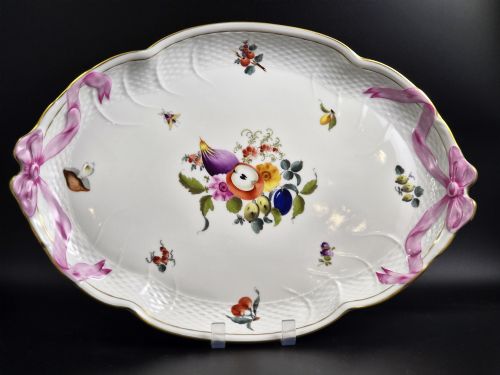
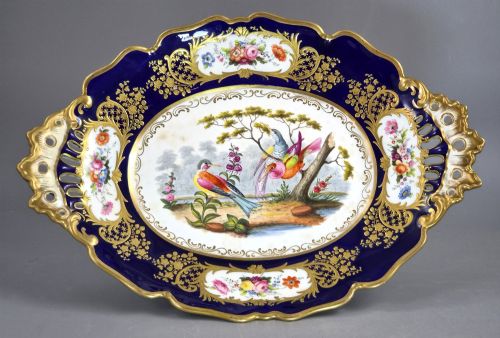
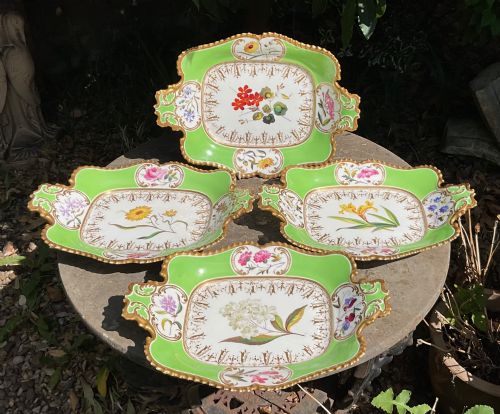
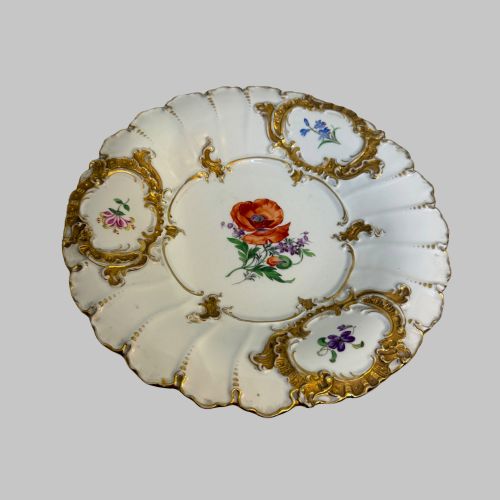
A botanical porcelain serving dish combines utility with natural history illustration, taking the form of platters, oval dishes, and dessert service plates. These items emerge from Georgian, Regency, and Victorian periods, often decorated with hand-painted flowers, birds, butterflies, and fruit bouquets.
The pieces on this page lean heavily towards English and Continental manufactories, presenting forms from simple fluted shapes to elaborate Rococo Revival contours. Buyers will encounter both individual serving platters and surviving components from larger dessert services.
The decoration serves as the defining characteristic, showing meticulous botanical or ornithological studies rendered in polychrome enamel. Gilding and gold leaf frequently edge the rims, framing the central natural subjects.
Materials and production methods
The bodies utilise hard-paste porcelain, bone china, and felspar porcelain, fired at high temperatures to achieve a durable and bright white base. Potters then applied smooth glaze coats to seal the surface before any artistic work began.
Decoration relied on hand-painted enamel colours, sometimes enhanced with applied gold leaf or detailed gilding along the borders. Painters executed the botanical and avian subjects freehand, drawing from contemporary horticultural illustrations of the period.
Listings feature hard-paste porcelain, bone china, and felspar porcelain across Georgian, Regency, and Victorian periods.
Distinctions in quality
Quality rests primarily in the precision and artistic merit of the hand-painted enamel work, where finely detailed botanical studies surpass simple repetitive stencilling. The crispness of the porcelain moulding and the generosity of the gilding further divide standard production from exceptional pieces.
The prestige of the maker influences desirability, with notable factories achieving superior porcelain bodies and more sophisticated glaze surfaces. Preservation of the original enamel colours and minimal wear to the gilt edges maintain the visual strength of the piece.
Herend·Coalport·Chamberlains Worcester·Meissen·Spode·Barr Flight And Barr·Kpm·Royal Crown Derby·Bloor Derby·Wedgewood
The Botanical Porcelain Serving Dish Glossary
- Bone china
- A type of soft-paste porcelain containing bone ash, known for its high strength and milky translucency. English factories utilised this composition extensively throughout the nineteenth century.
- Hard-paste porcelain
- A dense, durable ceramic composed of kaolin and petuntse, fired at very high temperatures. Continental makers favoured this formula for its resistance to thermal shock.
- Felspar porcelain
- An innovative ceramic body introduced by Spode incorporating felspar into the paste. This material allowed for greater stability and whiteness during high-temperature firing.
- Enamel
- Vitreous coloured paints fused to the glazed porcelain surface through secondary low-temperature firings. These provide the vibrant pigments seen in floral and bird motifs.
- Gilding
- The application of gold leaf or powdered gold to the rims and handles of ceramic items. It adds a decorative metallic border that frames the central artwork.
Botanical Porcelain Serving Dish: Frequently Asked Questions
How do I care for antique porcelain dishes?
Wash these pieces by hand in warm water using a mild detergent, avoiding dishwashers entirely to protect the delicate enamel and gold leaf. Store them with padded dividers between stacked items to prevent rim chipping.
Keep them away from direct sunlight for extended periods to preserve the vibrancy of the hand-painted botanical pigments.
Were these dishes used for food?
These items functioned primarily as serving platters and dessert service components for high-status dining tables. They presented fruit, sweetmeats, and confectioneries during the final courses of formal meals.
Today, many collectors continue to use them for light serving or display them as decorative wall and cabinet pieces.
How do I distinguish Georgian from Victorian pieces?
Georgian and Regency examples often display restrained neoclassical forms with refined floral painting and delicate gilding. Victorian items frequently embrace the exuberant curves of Rococo Revival styling, featuring heavier moulding and bolder polychrome palettes.
Examining the paste body and any factory marks helps confirm the production era alongside stylistic clues.
What does attribution to a factory mean?
Attribution indicates that a piece lacks a direct factory stamp or signature but displays all the stylistic, material, and technical markers of a specific manufactory. Experts compare the paste, glaze, and painting style against documented examples to determine the likely origin.
This is standard practice for unmarked early nineteenth-century porcelain.