
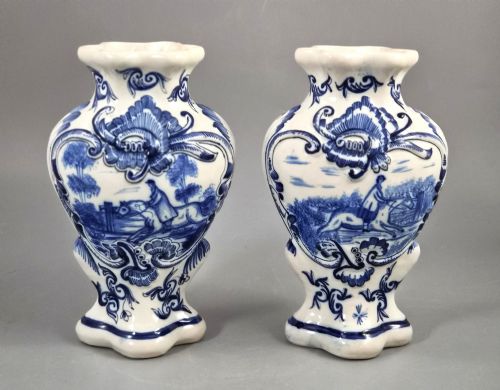


Blue White Faience Jar
A blue white faience jar brings centuries of tin-glazed ceramic history to a room through hand-painted cobalt botanical and figural scenes.
Blue White Faience Jar
The blue white faience jar category encompasses historic apothecary vessels, wet drug jars, albarelli, and large decorative urns shaped for domestic display and apothecary storage. These pieces span from the seventeenth century through to the nineteenth century, reflecting diverse European ceramic traditions across Italy, France, and the Netherlands.
Buyers meet variations ranging from tall Italian albarelli and pharmacy bottles inscribed with drug names to Dutch Delft urns decorated with birds and flowers in the Chinoiserie taste. French workshops also contribute nineteenth-century revival vases and lidded urns that adapt earlier baroque and rococo forms.
The materials recorded across these examples centre on tin-glazed earthenware and ceramic bodies painted with cobalt pigment. Brass fittings appear occasionally on specific lidded forms, anchoring the primary earthenware construction.
Materials and production methods
Potters built these vessels using earthenware clay bodies before coating the surfaces in an opaque tin-glaze that provided a smooth white ground for decoration. This glaze layer required careful firing to achieve the characteristic glossy finish essential for holding liquid or dry apothecary preparations.
Painters applied cobalt pigment directly onto the unfired or raw tin glaze, where the metallic oxide absorbed into the surface to yield deep blue tones during the kiln firing. This technique demanded steady brushwork, as any error in the floral motifs, birds, or pharmacy inscriptions became permanent once fired.
Listings feature earthenware bodies decorated with cobalt pigment under tin-glazes, spanning forms from seventeenth-century Dutch Delft to nineteenth-century French revival urns.
Distinctions in quality
Quality rests upon the confidence of the cobalt painting and the crispness of the tin-glaze surface. Strong examples display fluid, expressive brushwork in the floral and avian scenes, whereas lesser pieces show stiff or hurried execution in the painted details.
The proportion and weight of the earthenware body also signal quality, with superior vessels maintaining balanced walls and well-defined foot rims. Surviving original lids on urns and pharmacy jars elevate the integrity of the piece.
Fourmaintraux-Courquin
The Blue White Faience Jar Glossary
- Faience
- Tin-glazed earthenware produced in European countries outside of Spain and Italy, most notably in France and the Netherlands. The ceramic body receives an opaque white glaze that supports painted cobalt decoration.
- Tin-Glaze
- A ceramic glaze made white and opaque through the addition of tin oxide. This surface creates a receptive canvas for cobalt pigment application prior to the final kiln firing.
- Cobalt Pigment
- A metallic oxide colorant that turns blue under high kiln temperatures. It serves as the primary pigment for painting decorative motifs and pharmacy inscriptions on these jars.
- Chinoiserie
- European artistic style reflecting Chinese aesthetic influences, prominent in seventeenth-century Dutch ceramics. Designs incorporate stylized landscapes, birds, and floral elements.
- Majolica
- Italian tin-glazed earthenware decorated with painted colours, closely related in technique to faience. Pieces often feature narrative scenes or pharmaceutical lettering.
Blue White Faience Jar: Frequently Asked Questions
What were blue white faience jars used for?
These vessels originally served practical roles in European apothecary shops and dispensaries, holding dry drugs, medicinal herbs, and wet preparations. Pharmacy jars and albarelli kept contents sealed and identified through painted inscriptions.
Over time, many of these utilitarian containers transitioned into decorative objects displayed on mantelpieces and cabinets for their visual appeal.
How do I date a faience jar?
Dating relies on stylistic clues, potting characteristics, and the handling of the cobalt pigment across different European traditions. Seventeenth-century examples often exhibit looser, more dynamic painting styles, while nineteenth-century pieces show revival tendencies.
Inscriptions and glaze thickness also offer indicators, as earlier tin-glazes display distinct pooling and surface textures compared to later production methods.
Where were these jars made?
Production centres span across Italy, France, and the Netherlands, with distinct regional styles developing in each area. Italian workshops in Savona and Naples produced distinctive albarelli, while Dutch kilns specialised in Delftware.
French makers in towns like Desvres later revived these historic forms during the nineteenth century, adopting earlier decorative motifs and shapes.
How do I care for an antique jar?
Display these earthenware pieces away from direct sunlight and damp environments to protect the historic tin-glaze surface. Dust them gently with a dry, soft cloth rather than using liquid cleaners.
Avoid placing them near heat sources or in areas prone to sudden temperature changes, which can stress the ceramic body and glaze.