





Blue Satsuma Ceramic Vases
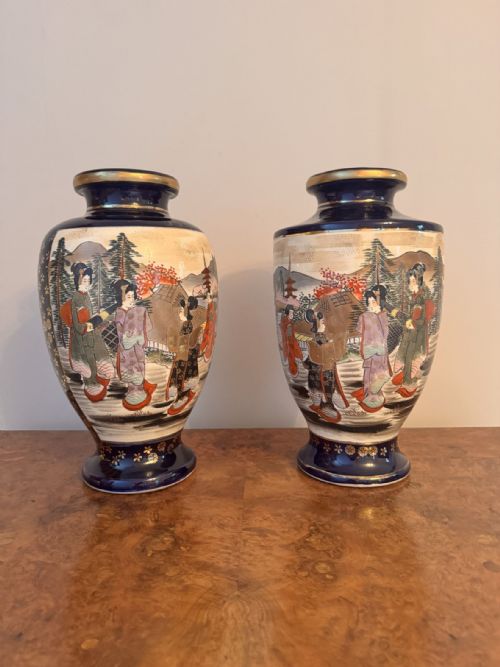
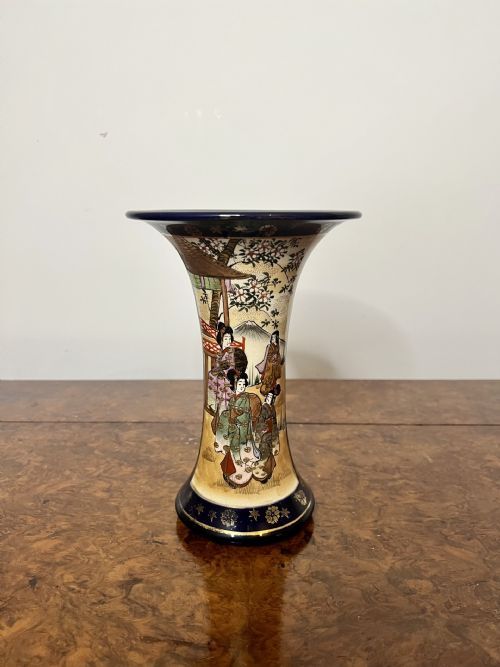
Blue satsuma ceramic vases bring painted court figures and heavy gilding into a room, offering the rich palette of Meiji ceramics.
Blue Satsuma Ceramic Vases
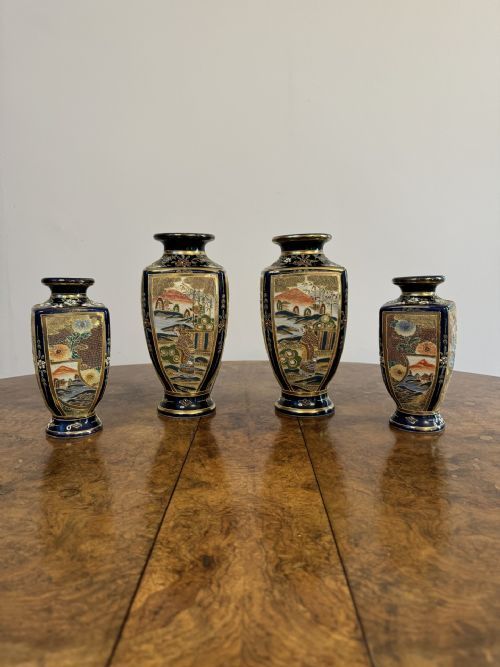
When you search for blue satsuma ceramic vases, you are looking at earthenware vessels defined by cobalt grounds, gilt highlights, and intricate hand-painted panels. The pieces on this page span the nineteenth century, the Meiji period, and the early twentieth century, taking the form of single vessels, garnitures, pairs, and table lamps.
You are most likely to meet pairs of vases and larger decorative pieces featuring cobalt blue grounds paired with raised moriage decoration. These objects range from nineteenth-century work to items from the Taisho and early Showa periods.
How they were made
These pieces utilise earthenware bodies finished with enamel paints, glaze, and extensive gold leaf or gilding. Artisans applied raised moriage details to create tactile surfaces alongside hand-painted court scenes and landscape panels.
Production combined traditional ceramic forming with meticulous surface decoration. Wood and fabric elements appear on adapted table lamps, while the core vessels rely on precise enamel work and heavy gilding.
Blue Satsuma Ceramic Vases Retail Price Guide 2026
Typical asking prices for blue satsuma ceramic vases among the pieces listed under this phrase on Sellingantiques today, from the lower quarter to the upper quarter. They describe what is for sale here now, not the wider market.
Object forms include standard vases, decorative garnitures, and table lamps incorporating wood and fabric components.
What varies in quality
The standard of painting on the court figures and landscape panels sets the upper tier apart from simpler work. Finer examples display precise brushwork in the facial expressions and robes, alongside controlled application of cobalt and gold leaf.
The density and crispness of the moriage relief work also determine the grade of a piece. Superior vases maintain clean, sharp raised patterns that complement the underlying glaze without crowding the painted scenes.
Kinkozan·Nanzan·Tashiro
The Blue Satsuma Ceramic Vases Glossary
- Satsuma
- Earthenware originating from Japan, traditionally characterised by a fine crackle glaze and intricate enamel painting. It became widely produced for export during the Meiji period.
- Moriage
- A Japanese ceramic technique where slip is piped onto the surface in raised dots or lines to create a tactile, three-dimensional pattern. It is frequently highlighted with gold.
- Garniture
- A set of matching vases or vessels designed to be displayed together on a mantelpiece or sideboard. These sets often comprise three, four, or five pieces.
- Meiji
- The period of Japanese history spanning from eighteen sixty-eight to nineteen twelve, noted for the opening of trade with the West and the export of ornate decorative arts.
- Cobalt ground
- The primary background colour of a ceramic piece, achieved using deep blue cobalt oxide beneath or within the glaze. It provides a dark, rich contrast to gilt decoration.
Blue Satsuma Ceramic Vases: Frequently Asked Questions
What is a blue satsuma vase?
A blue satsuma vase is a Japanese earthenware vessel featuring a cobalt blue ground and detailed hand-painted panels, often highlighted with gold leaf and raised moriage decoration.
These pieces were predominantly produced for export during the late nineteenth and early twentieth centuries, spanning the Victorian and Meiji periods.
How do I display a pair?
Pairs of vases look best placed symmetrically on sideboards, mantels, or pedestals where their painted court scenes and gilding can catch the light. Larger examples work well as standalone focal points in a room.
Ensure they are placed away from high-traffic areas to protect their delicate enamel and raised surface details from accidental knocks.
How do I date a piece?
Dating relies on stylistic markers, potter marks, and the materials used in the construction, such as the distinct styles of the Meiji period versus later Taisho production. Nineteenth-century examples often display denser hand-painting and heavier gilding.
Examining the base for specific workshop signatures, such as those associated with Kinkozan or Nanzan, also helps narrow down the period of manufacture.
Were these vases made for export?
The vast majority of satsuma ceramics from the late nineteenth century onwards were created specifically for the Western export market. Artisans tailored the ornate designs, religious panels, and court scenes to suit European and American tastes.
This global demand led to a flourishing of workshops producing varied forms, from standard vessels to large garnitures and table lamps.