
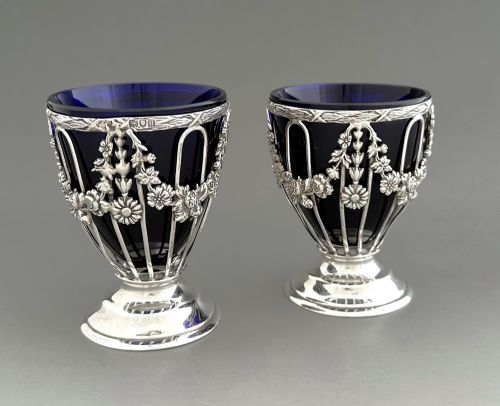
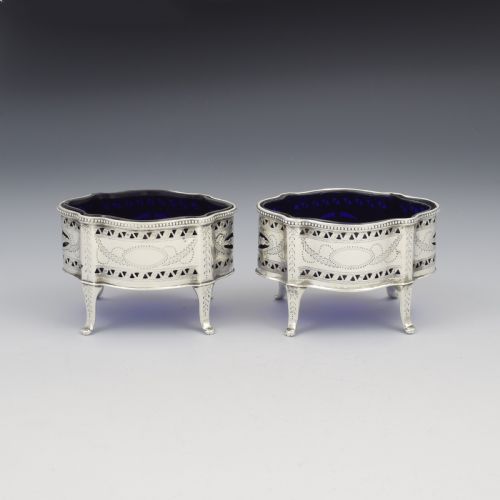


Blue Glass Open Salts
Blue glass open salts bring intense cobalt colour and polished silver to the dining table, offering miniature stages for traditional dining.
Blue Glass Open Salts
When you search for blue glass open salts, you are looking at small open containers designed to hold loose salt at the table, usually paired with a metal frame. The pieces seen here span the eighteenth century through the Edwardian period, alongside Georgian Revival and Art Deco interpretations.
The most common format on this page pairs a silver frame with a deep cobalt glass liner. These range from simple boat shapes and wirework tubs to pierced serpentine table salts and boxed condiment sets complete with spoons.
How they were made
The frames are formed from sterling silver, silver plate, or silver wirework, often shaped through casting, piercing, or delicate wire bending. Artisans constructed these metal housings to securely cradle the removable glass vessels.
The glass liners themselves utilise rich cobalt glass, blown or moulded to fit the specific contours of the metal frames. Silk occasionally appears in association with boxed sets, lining the fitted presentation cases.
Some antique sets still retain their tiny matching spoons, perfectly proportioned for scooping salt from deep cobalt tubs.
What varies in quality
Quality reveals itself in the weight and crispness of the metalwork, distinguishing heavy cast or pierced silver frames from lighter plated alternatives. Finer examples display meticulous piercing and robust wirework rather than flat, stamped assembly.
The relationship between the glass liner and the silver mount dictates the harmony of the piece. Superior sets retain their original cobalt glass liners, fitting snugly within the handmade frames without excessive movement.
The Blue Glass Open Salts Glossary
- Salt Cellars
- Small open vessels used to hold table salt before the invention of free-flowing salt shakers. They sit directly on the dining surface for individual or shared use.
- Cobalt Glass
- Deep blue glass coloured with cobalt oxide, widely utilised for decorative vessels and small tableware liners. Its intense hue masks the salt while providing a striking contrast against silver.
- Wirework
- Metalwork constructed from fine silver wire shaped into open geometric or scrolling patterns. This technique creates a light, airy frame around the glass liner.
- Serpentine
- A curved outline featuring a convex centre flanked by concave ends, often seen on the rims and bodies of Victorian table salts. This fluid shape adds movement to small silver forms.
Blue Glass Open Salts: Frequently Asked Questions
How were open salts used at the table?
Dinners used these small open vessels to hold dry table salt, dipping a small spoon or the tip of a knife to transfer the seasoning.
They sat beside each place setting or were shared between diners down the length of the table.
What periods do these pieces come from?
The pieces span several centuries, including eighteenth-century Georgian examples, Victorian designs, and later Art Deco interpretations from around nineteen thirty.
Edwardian and early twentieth-century variations also appear frequently across the current selection.
Are the glass liners removable?
Most metal frames are designed with open work or hinged elements that allow the cobalt glass liner to lift out easily for cleaning.
Original liners are shaped specifically to fit the contours of their individual silver mounts.
What metals are used in the frames?
Frames are constructed primarily from sterling silver or silver plate, alongside delicate silver wirework.
These metals provide a durable structure that contrasts sharply with the deep blue glass held inside.