
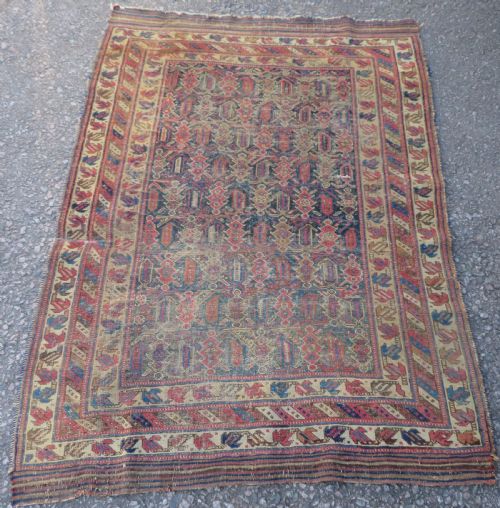
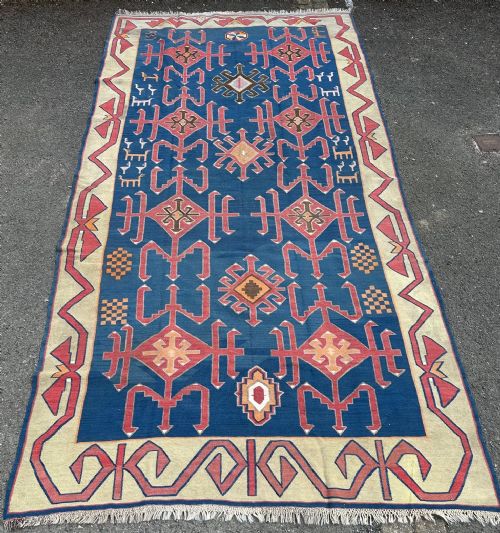


Blue Flat Weave Rug
A blue flat weave rug brings tribal geometry and softened natural dyes into a room, offering durability without heavy pile.
Blue Flat Weave Rug
When you search for a blue flat weave rug, you encounter nomadic kilims, storage bags, and utility textiles originating from Persian, Caucasian, Bessarabian, and Portuguese traditions. The selection spans periods from the mid-nineteenth century through the mid-twentieth century, capturing utilitarian floor coverings and domestic textiles repurposed for modern interiors.
You are most likely to meet tribal kilims and flatweave rugs featuring geometric motifs, banded designs, and soumak work. These pieces demonstrate the practical artistry of nomadic weavers across the Caucasus, Persia, and Eastern Europe.
How they were made
The pieces on this page rely primarily on hand-spun wool and cotton, worked into flat structures without a raised pile. Weavers utilised natural dyes to achieve subtle tonal shifts across the surface of each textile.
Techniques such as soumak work and needlepoint appear alongside traditional slit-weave kilim construction. These methods produce structurally sound fabrics that withstand regular floor use while retaining flexibility.
Listings span the mid-nineteenth century to the mid-twentieth century, featuring wool and cotton construction.
What varies in quality
Quality rests in the precision of the tribal geometry and the complexity of the weave structure. Tightly packed warps and wefts indicate superior tension control during the creation of the textile.
The integrity of the natural dyes and the preservation of the original edges dictate the standing of an individual piece. Finer examples maintain structural balance across every panel and border.
The Blue Flat Weave Rug Glossary
- Kilim
- A flat-woven carpet or rug produced without a pile by interlocking coloured weft threads over stationary warps. This technique creates a lightweight textile historically used for floor coverings and wall hangings.
- Soumak
- A brocaded tapestry weave technique where decorative weft threads wrap around the warp threads in a continuous sequence. This method adds structural weight and distinct surface texture to tribal bags and rugs.
- Mafrash
- A large rectangular storage chest panel or container woven by nomadic tribes to hold bedding and household goods. These pieces frequently feature bold geometric compartments.
- Khorjin
- A traditional pair of saddlebags woven for transport on horses, donkeys, or camels during tribal migrations. Surviving examples often appear as single panels or matched halves.
- Sofreh
- A flat-woven textile utilised historically as a cloth for preparing bread dough or serving communal meals. These domestic objects display distinct regional tribal patterns.
Blue Flat Weave Rug: Frequently Asked Questions
Where should I place a flat weave rug?
A flat weave rug functions effectively in high-traffic zones like hallways, entryways, and living rooms where heavy pile carpets might impede doors.
Their lightweight profile allows them to sit flat against the floor without bunching under furniture placement.
How do I care for an antique kilim?
Regular gentle vacuuming without a rotating brush roll removes trapped dust and protects the wool fibres from abrasive particles.
Professional specialist cleaning remains necessary for deeper maintenance to prevent dye bleed or structural distortion.
Are these rugs suitable for daily foot traffic?
Nomadic weavers designed these textiles for rigorous everyday use in domestic environments and pastoral tents.
The absence of a fragile pile means the underlying structure resists crushing under constant movement.
How do I distinguish regional tribal designs?
Caucasian pieces tend to display crisp geometric medallions and sharp angular borders executed in saturated palettes.
Persian and Anatolian examples often incorporate softer floral abstractions or complex diamond lattices unique to specific tribal groups.