



Blue Crystal Vase
A blue crystal vase brings intense colour and brilliant refraction into a room, combining the heavy weight of lead glass with deep cobalt and sapphire tones.
Blue Crystal Vase
When you search for a blue crystal vase, you are looking at decorative vessels that primarily span the Victorian era and the Art Deco period of the 1920s and 1930s. These pieces range from heavy moulded French glassware to English and Belgian cased glass and Bohemian overlay work.
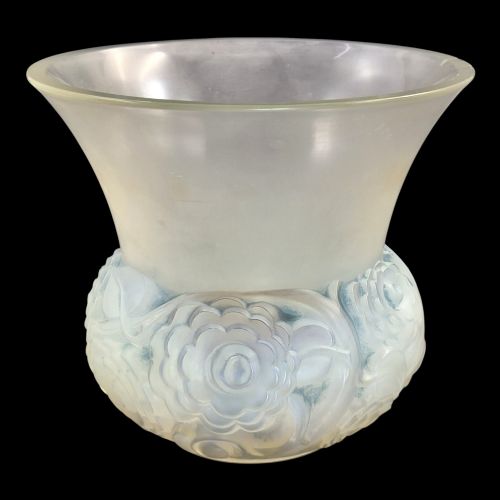
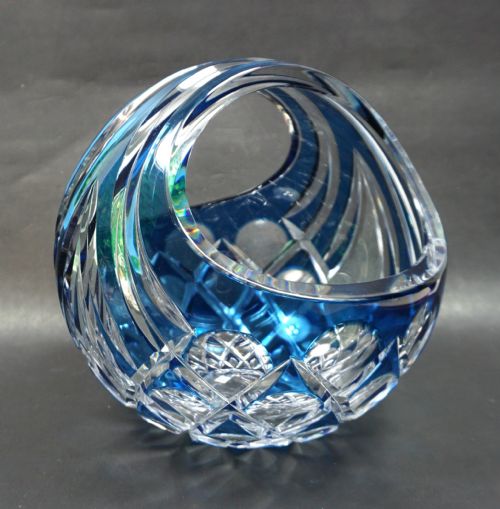
The versions you are most likely to meet on this page include Art Deco moulded pieces from continental makers alongside nineteenth-century cut glass and mantel lustres. They showcase forms that vary from simple cylindrical profiles to complex opalescent floral reliefs and baskets.
Materials and construction
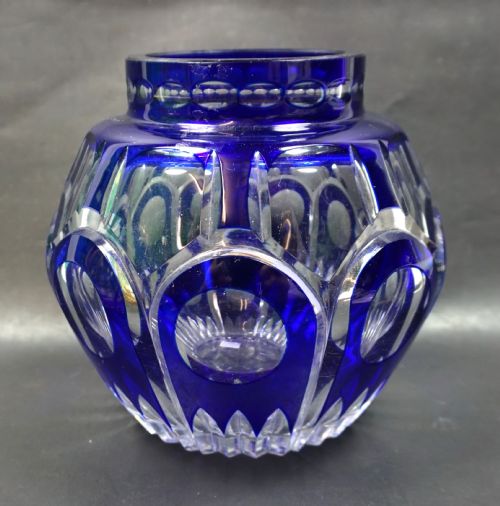
The pieces rely on lead crystal, cased glass, and cobalt glass, often layered to allow for deep surface cutting. Overlay techniques permit makers to cut through a coloured outer stratum to reveal clear crystal beneath.
Moulding and acid-staining define the Art Deco examples, particularly where opalescent glass is highlighted with blue staining to accentuate relief details. Victorian pieces utilise heavy wheel-cutting and polishing on cobalt substrates.
Listings span the Victorian era, the 1920s, and the 1930s, utilising lead crystal, cased glass, opalescent glass, and enamel.
Assessing quality and execution
Quality rests upon the crispness of the wheel-cut facets and the depth of the colour saturation within the material. Superior pieces display sharp definition in layered cased glass where the colour contrast remains clean and precise.
The weight of the lead crystal and the finish of the pontil mark or base indicate the level of workshop care. Fine mouldings show crisp details in high-relief elements without blurring in the recesses.
Rene Lalique·Joseph Simon for VSL·Val St. Lambert·Pierrefonds
The Blue Crystal Vase Glossary
- Cased glass
- Glass formed of two or more distinct layers of different colours, often fused together while hot. This technique allows artisans to cut through the outer layer to expose the contrasting colour beneath.
- Lead crystal
- Glass containing a significant proportion of lead oxide, which increases the weight, refractive index, and clarity of the material. It allows for deeper and sharper facet cutting.
- Opalescent glass
- Glass that exhibits a milky, milky-blue, or pearlescent appearance, shifting in tone depending on the light source. It was widely utilised by French makers for sculptural vessels.
- Overlay
- A method where a vessel is dipped or encased in a second layer of coloured glass before being shaped and cut. Bohemian and Belgian workshops frequently employed this technique.
- Mantel lustres
- Decorative glass vases fitted with hanging glass prisms, designed to sit on a fireplace mantel. They reflect candlelight through their cut pendants and coloured bodies.
Blue Crystal Vase: Frequently Asked Questions
What is cased glass?
Cased glass involves fusing two or more distinct layers of glass together during the blowing process. This creates a vessel with an exterior colour different from its interior or base layer.
Artisans then cut through the outer layer using wheels to expose the contrasting glass underneath, producing sharp patterns and deep optical effects.
How do I date a blue glass vase?
Dating relies on stylistic markers such as the geometric lines of Art Deco pieces from the 1920s and 1930s versus the heavy ornamentation of Victorian items. Maker signatures, mould numbers, and finishing techniques also indicate the period.
Victorian pieces often feature hand-cut facets and heavier proportions, while twentieth-century examples frequently utilise moulded signatures and opalescent finishes.
What makes opalescent glass blue?
Opalescent glass gains its characteristic milky-blue appearance from the chemical agents added to the molten batch, which scatter light waves differently than clear glass. When illuminated, these pieces display distinct blue and amber highlights.
French makers in the interwar period mastered this effect to give sculptural vessels a sense of depth and luminosity.
Where were these vases made?
The pieces originate primarily from workshops and factories in France, Belgium, and Bohemia. Each region developed distinct specialities, from French moulded art glass to Belgian cased vessels.
Major centres of production included the Val Saint Lambert works in Belgium and various glasshouses across Bohemia and France.