
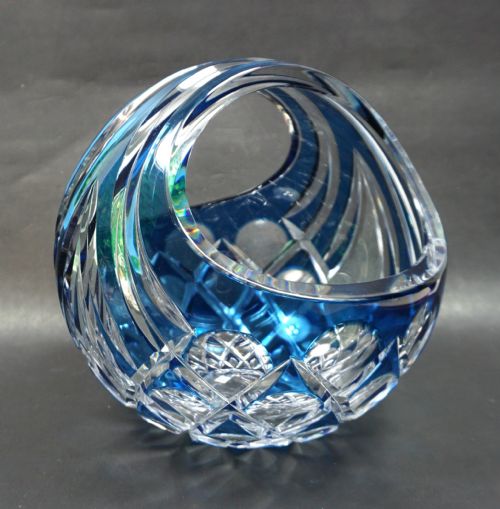


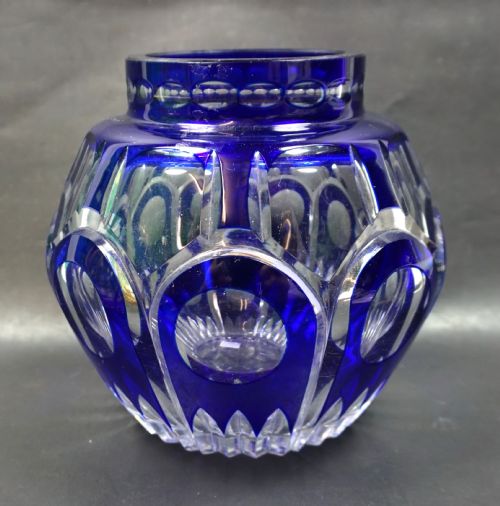


Overlay Crystal Vase
An overlay crystal vase brings brilliant contrast and heavy hand-polished depth to a room through contrasting layers of coloured and clear glass.
Overlay Crystal Vase
When you search for an overlay crystal vase, you encounter decorative vessels formed by fusing a distinct coloured layer over a clear crystal or glass body. These objects range from nineteenth-century Victorian and Bohemian pieces to Art Deco designs from Belgian workshops.
Victorian and nineteenth-century examples often employ cut-to-clear techniques where the outer coloured glass is carved away to reveal the clear crystal beneath. Art Deco pieces from the 1930s favour smooth contours and striking primary colour overlays.
How they were made
These items rely on cased or overlay glass techniques where a gather of coloured glass is united with clear crystal while hot. Makers then shape the vessel by blowing or moulding the combined layers together.
Surface decoration is achieved by cutting through the outer coloured stratum down to the clear base or by adding enamel details. This subtraction method creates sharp geometric or floral motifs with a distinct tactile edge.
Some mantel lustres include dangling crystal prisms designed to tinkle gently whenever someone walked past the drawing room fireplace.
What varies in quality
Quality rests in the precision of the cut and the purity of the metal. Superior examples display crisp, deep facets that expose the clear crystal with exact symmetry.
The richness and saturation of the coloured layer also dictate distinction, alongside the weight and clarity of the underlying crystal body.
Joseph Simon·Charles Graffart·Val St. Lambert
The Overlay Crystal Vase Glossary
- Overlay glass
- A vessel formed from two or more distinct layers of glass, typically a coloured exterior over a clear crystal body. This method allows artisans to carve through the outer layer to create contrasting patterns.
- Cut-to-clear
- A decoration technique where the outer layer of coloured glass is ground away completely in specific areas to reveal the clear crystal underneath. It produces a sharp, faceted relief.
- Cranberry glass
- A rich pinkish-red glass coloured with gold chloride during production. It is frequently utilised in nineteenth-century decorative glassware.
- Mantel lustres
- Decorative ornamental vases fitted with dangling glass prisms suspended from the rim. They were designed to sit on a fireplace mantel and reflect candlelight.
Overlay Crystal Vase: Frequently Asked Questions
What is an overlay crystal vase?
An overlay crystal vase is a decorative vessel made with at least two bonded layers of glass. The outer coloured layer is often cut away to expose the clear crystal underneath.
These pieces showcase contrasting colours and heavy faceted designs developed across the nineteenth and twentieth centuries.
How do I identify Victorian pieces?
Victorian examples frequently feature deep cut-to-clear geometric patterns and rich cobalt or cranberry colours. They carry the heavier proportions typical of nineteenth-century manufacturing.
Art Deco alternatives from later decades tend to display smoother profiles and bolder primary shades.
What are mantel lustres?
Mantel lustres are decorative overlay glass vessels adorned with hanging crystal prisms around the top rim. They were placed on drawing room mantelpieces to catch and multiply the light of lamps.
Pairs of these lustres often served as centrepieces on nineteenth-century tables and shelves.
How should I clean my vase?
Clean these delicate glass pieces gently by hand using lukewarm water and mild soap. Avoid abrasive cloths or harsh detergents that might scratch the surface or damage enamelled details.
Dry them immediately with a lint-free cloth to maintain the clarity of the crystal.