


Blue Border Persian Rug
A blue border persian rug brings traditional craftsmanship and distinct regional patterns directly into a room.
Blue Border Persian Rug
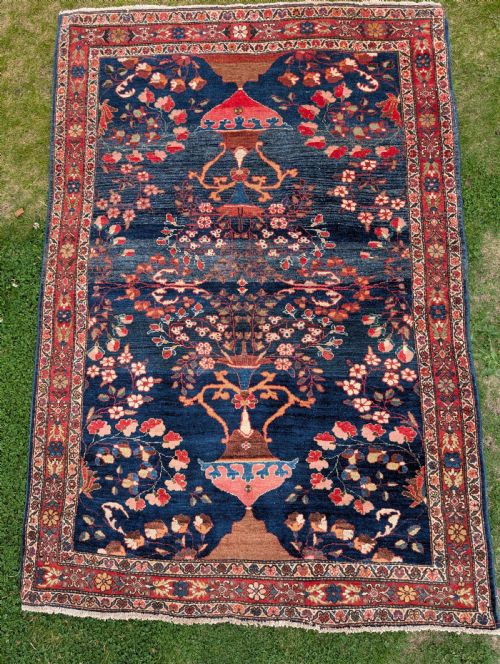
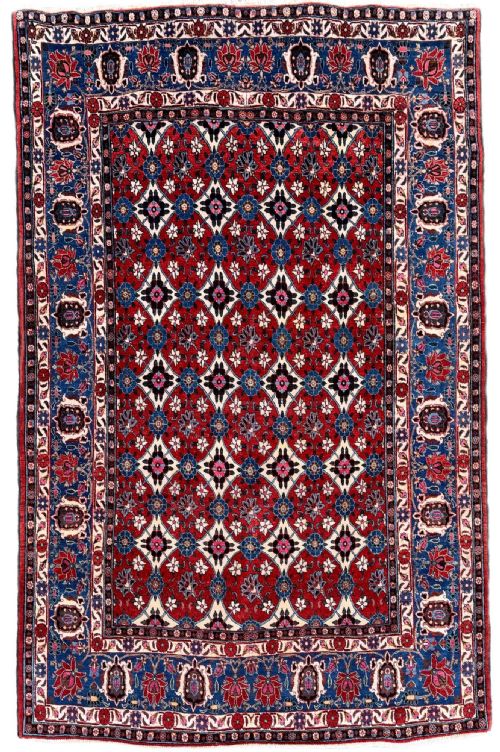
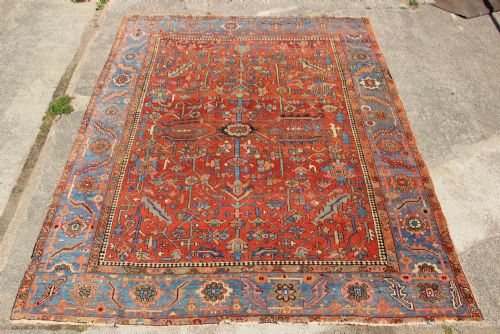
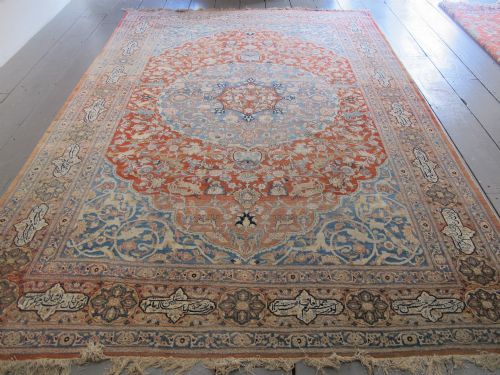
A blue border persian rug spans various historical origins and weaving traditions, ranging from village productions to city workshop carpets. Buyers searching for a blue border persian rug encounter room-size carpets, corridor runners, and smaller area formats originating from weaving centres such as Heriz, Sultanabad, Tabriz, and Kashan. These floor coverings reflect traditional Persian styles produced across the nineteenth and early twentieth centuries, encompassing both geometric tribal patterns and curvilinear floral compositions.
The selections available here emphasise wool, cotton, and occasionally silk constructions dating from the 1870s up through the 1930s. Regional attribution often reveals itself through specific border layouts, such as the Shekarlu or crab motifs found on pieces from northwest and western Persia. Whether structured as a large gallery carpet or a compact scatter rug, each example showcases the traditional dyeing and hand-knotting techniques characteristic of its respective period.
How they were made
Weavers constructed these carpets using hand-spun wool pile knotted onto sturdy cotton or wool foundations, relying on upright looms set up in households or larger urban workshops. Natural dye sources provided the rich palettes seen across these nineteenth and early twentieth-century textiles, yielding durable colours that settled into varied hues over decades of use. Artisans bound the outer edges with wool selvedges and finished the ends with secured warps to prevent unravelling.
The structural density varies according to origin, with fine city workshops employing intricate curvilinear designs on high-knot-count foundations, while tribal weavers produced bolder, geometric motifs with coarser wool. The interaction between the pile material and the foundation determines the drape and resilience of each rug, influencing how the floor covering settles into a domestic space.
Blue Border Persian Rug Retail Price Guide 2026
Typical asking prices for blue border persian rug among the pieces listed under this phrase on Sellingantiques today, from the lower quarter to the upper quarter. They describe what is for sale here now, not the wider market.
Regional attributions represented across the inventory include Heriz, Sultanabad, Tabriz, Kashan, Veramin, and Bakhtiari tribal traditions.
What varies in quality
The visual strength of the border design and the balance of the central field distinguish exceptional examples from standard production. Artisans who achieved harmonious dye saturations and precise execution in regional motifs created pieces with enduring decorative impact.
Structural integrity depends on the uniformity of the hand-knotting and the preservation of the original wool pile across the entire surface. Pieces that retain their full dimensions, along with well-maintained edges and foundations, represent the higher end of surviving examples from this era.
Ziegler and Co
The Blue Border Persian Rug Glossary
- Warp
- The vertical threads stretched lengthwise on the loom that form the foundational skeleton of the rug. Fringe elements typically extend from these structural threads at either end of the carpet.
- Weft
- The horizontal threads passed back and forth between the warp threads to lock the knots in place. This material contributes to the structural firmness of the woven textile.
- Selvedge
- The bound outer edge of a rug running parallel to the warp threads. This finishing technique protects the sides from fraying.
- Pile
- The upright yarn surface formed by the ends of the knots. This tactile layer defines the thickness and texture underfoot.
- Knot count
- The number of individual knots per square unit of measurement. Higher densities often allow for greater detail in curvilinear floral patterns.
Blue Border Persian Rug: Frequently Asked Questions
How do I identify a Heriz carpet?
Heriz carpets typically feature bold geometric medallions, large corner spandrels, and sturdy wool pile knotted on cotton foundations. Their designs emphasise angular lines rather than flowing curves.
These characteristics stem from the tradition of village weavers in northwest Persia who utilised durable materials suited for heavy household use.
Where were Sultanabad carpets woven?
Sultanabad carpets originate from the region surrounding the city of Sultanabad, known today as Arak in west-central Persia. These pieces often served export markets through Western firms.
Production in this area frequently involved large-scale decorative formats featuring expansive floral patterns and softened colour palettes.
What is a Serapi carpet?
A Serapi carpet represents a finer, older nineteenth-century style associated with the Heriz region. They typically display more open, spacious medallion designs with muted primary colours.
Collectors often distinguish them by their balanced proportions and sophisticated handling of traditional geometric layouts.
How should I care for an antique rug?
Vacuuming gently without a rotating brush roll helps remove embedded dust while protecting the wool pile and delicate foundation threads. Keeping the textile away from direct, harsh sunlight prevents uneven fading of natural dyes.
Professional cleaning tailored to antique textiles ensures that wool and cotton fibres remain stable over years of domestic enjoyment.