





Blue Anatolian Carpet
A blue anatolian carpet brings centuries of regional weaving traditions into a room, offering deep indigo tones and intricate geometric or floral motifs.
Blue Anatolian Carpet
A blue anatolian carpet encompasses hand-knotted and flat-woven textiles originating from Turkish weaving centres, spanning from the nineteenth century into the early twentieth century. Buyers encounter formats ranging from large saloon carpets and long runners to specific regional prayer rugs and small village scatter rugs.
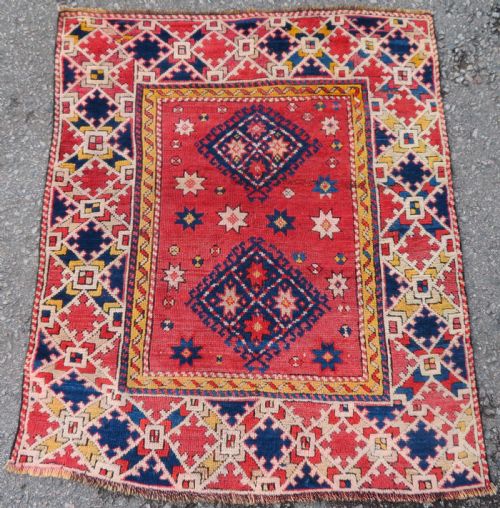
The selection includes specific regional types such as Ushak, Bergama, Konya, Ladik, and Kula pieces, often featuring characteristic blue grounds alongside traditional medallions. Formats vary from substantial room-sized carpets down to compact yastics and decorative cushions fashioned from older fragments.
Materials and construction methods
Weavers relied principally on natural wool, cotton, and occasionally silk or angora wool, utilising hand-spun fibres for foundation warps, horizontal wefts, and pile knots. Natural dyestuffs produced the characteristic deep blues, ranging from soft pale shades to rich indigo, set against contrasting reds, ivories, and browns.
Village and nomadic workshops employed traditional symmetrical or asymmetrical knotting techniques on vertical looms, resulting in dense, durable piles designed for practical domestic use. Flat-woven kelims utilised slit-tapestry techniques without a pile, creating lighter textiles with sharp geometric patterns.
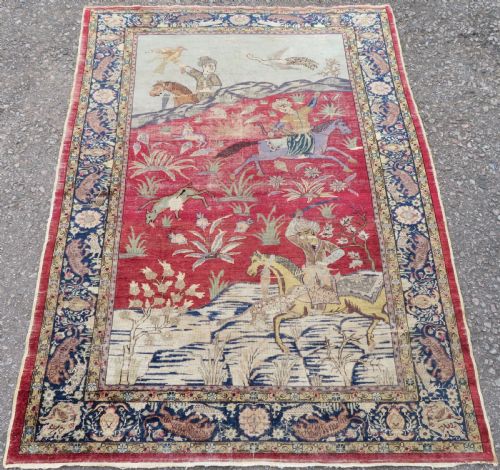
Hunting scenes woven into antique pictorial silk rugs occasionally feature tiny galloping quadrupeds hiding among intricate floral scrolls.
Distinctions in craftsmanship
Quality depends upon the fineness of the knot count, the precision of the geometric or floral drawing, and the depth of colour achieved through natural dyeing methods. Superior examples display balanced proportions in their central medallions and border guards, reflecting deliberate planning by the weaver.
The integrity of the foundation warps and the condition of the selvedges indicate the original structural soundness of the textile. Pieces that retain their full outer borders and original fringe terminations command greater respect from collectors than heavily altered or severely truncated examples.
The Blue Anatolian Carpet Glossary
- Medb
- The central ornamental motif or cluster of motifs positioned in the field of a rug, often dominating the visual composition.
- Kelim
- A flat-woven textile produced without a pile, created by interlocking coloured weft threads tightly across the warp.
- Prayer rug
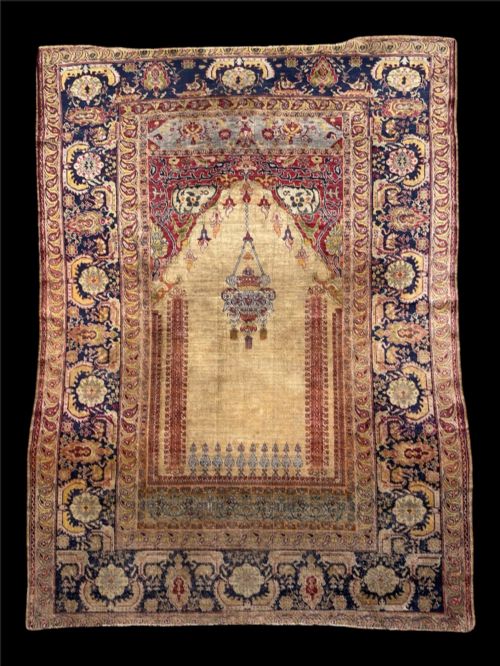
- A specialised format featuring a distinct architectural mihrab arch design at one end, traditionally used for individual daily prayers.
- Yastic
- A small Turkish cushion cover or small scatter rug traditionally utilised for sitting upon low divans within traditional interiors.
- Mihrab
- The arched niche depicted on prayer rugs that indicates the direction of prayer towards Mecca.
Blue Anatolian Carpet: Frequently Asked Questions
How do I care for an antique rug?
Vacuum gently with the beater bar switched off to protect the delicate wool pile and ancient foundation threads from excessive mechanical friction.
Keep the textile out of direct sunlight to prevent natural dyes from fading over the decades, and rotate the placement periodically to ensure even wear.
Are these carpets suitable for heavy foot traffic?
Substantial room-sized carpets woven with thick wool piles handle normal household walking quite well when supported by a quality underlay.
Fine silk or fragile nineteenth-century examples require much lighter placement, such as low-traffic bedrooms or display spaces, to preserve their structural integrity.
What causes the blue colour variation?
Dichroic variations occur naturally due to shifts in indigo dye batches and the varying absorption rates of hand-spun wool fibres over time.
These subtle tonal changes, often called abrash, demonstrate traditional hand-dyeing methods rather than mechanical uniformity.
How can I identify a specific regional type?
Look closely at the distinctive border arrangements, colour palettes, and specific structural motifs such as star medallions or prayer arches.
Different weaving towns like Ushak, Bergama, or Konya developed signature design vocabularies that help experienced eyes separate them.