

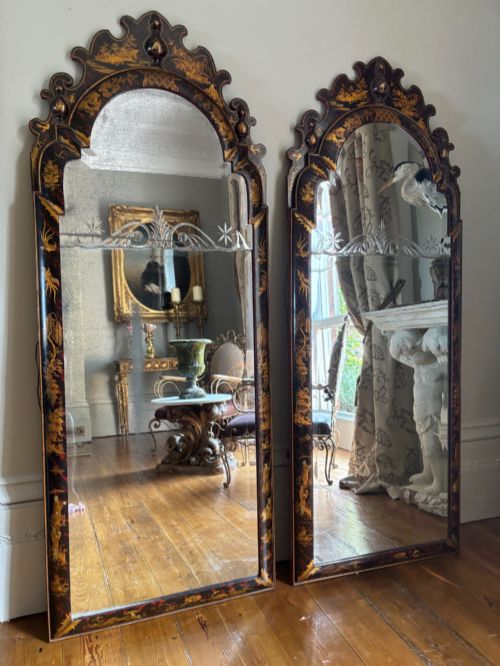
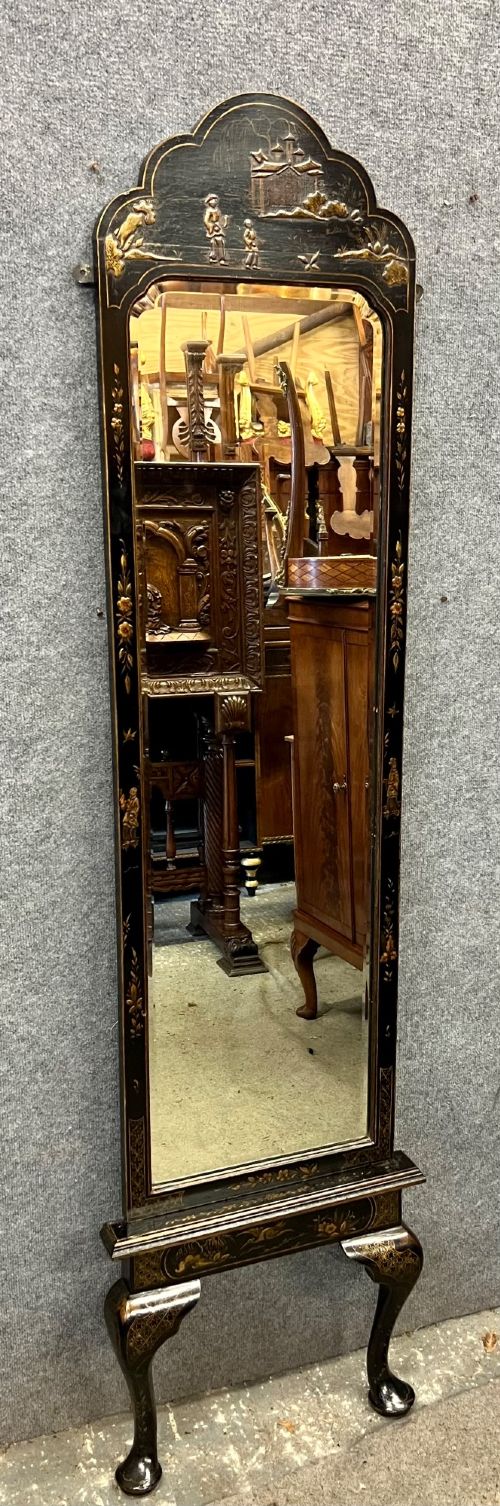
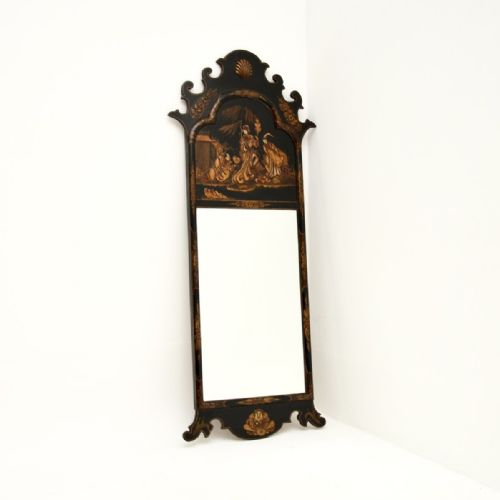
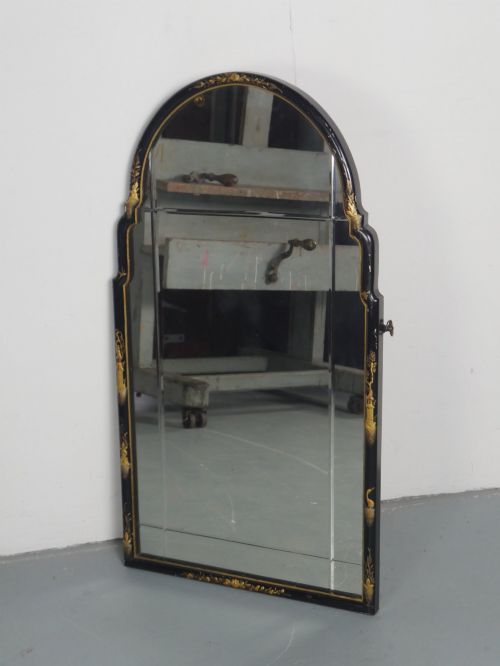
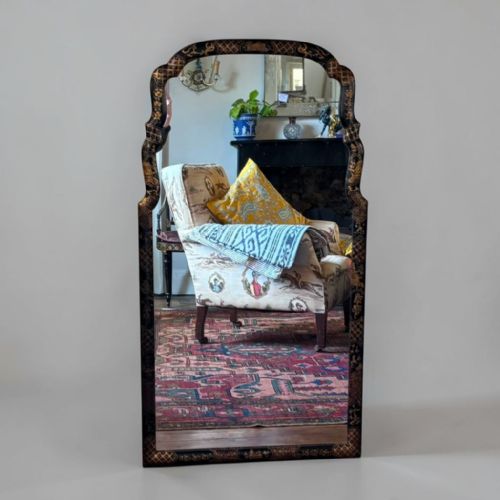


Black Lacquer Wall Mirror
These black lacquer wall mirrors bring depth and figurative detail to a room, ranging from compact ovals to large overmantels.
Black Lacquer Wall Mirror
A black lacquer wall mirror is a framed looking glass finished with dark surface coatings, frequently detailed with decorative motifs in the Chinoiserie taste or classical French Empire styling. When searching for a black lacquer wall mirror, buyers encounter a span of periods from the Georgian era and Victorian Aesthetic Movement through to Edwardian and early twentieth century examples.
The forms vary considerably across the selection, encompassing tall fret-cut panels, generous overmantel mirrors designed for chimney breasts, and compact oval or rectangular shapes. Many pieces incorporate gilt highlights or Japanese-inspired decoration upon the dark ground, creating a striking contrast that catches the light in a hallway or drawing room.
The most prevalent style meeting this search is the Edwardian Chinoiserie mirror, often dated around nineteen hundred to nineteen ten, alongside nineteenth century interpretations and Queen Anne revivals. These objects serve both practical reflection and decorative presence, functioning as focal points above console tables or fireplaces.
How they were made
The foundation of these pieces relies upon wood frames shaped into ovals, rectangles, or architectural overmantel profiles, which are then coated in layers of dark lacquer. Artisans built up the smooth dark surface before applying gilt details, gold leaf, or hand-painted figurative scenes.
Certain examples incorporate cast gilt brass mounts, particularly within the French Empire tradition, adding metallic enrichment to the ebonised wood or lacquered frames. Carved elements such as faux bamboo or fret-cut outlines further define the physical structure of the mirror frames.
Black Lacquer Wall Mirror Retail Price Guide 2026
Typical asking prices for black lacquer wall mirror among the pieces listed under this phrase on Sellingantiques today, from the lower quarter to the upper quarter. They describe what is for sale here now, not the wider market.
Heart-shaped mirror inserts occasionally appear within Edwardian overmantels, introducing a playful romantic touch to traditional black lacquer frames.
What varies in quality
Quality reveals itself in the depth and execution of the lacquer finish and the intricacy of the decorative painting. Superior examples exhibit layered, lustrous surfaces with finely preserved gilt detailing, whereas simpler pieces rely on plain ebonised wood without pictorial work.
The crispness of the framing work, whether through fret-cut woodwork or applied gilt brass mounts, distinguishes standard production from finer decorative pieces. The proportion of the mirror plate to the frame also dictates the visual balance of the object on the wall.
The Black Lacquer Wall Mirror Glossary
- Chinoiserie
- European decorative art imitating Chinese and East Asian artistic traditions. It appears frequently on these mirrors through hand-painted landscapes and figures.
- Ebonised wood
- Timber stained or finished to resemble ebony. This dark treatment provides a uniform backdrop similar to lacquer.
- Overmantel mirror
- A large looking glass specifically proportioned to hang above a fireplace mantelpiece. These often feature extended horizontal formats.
- Fret-cut
- Woodwork shaped by cutting intricate patterns through thin boards using a fine saw. It creates openwork silhouettes on mirror frames.
- Gilt brass
- Metal alloy treated with a gold-coloured finish or gold leaf. It adds contrasting bright highlights to dark frames.
Black Lacquer Wall Mirror: Frequently Asked Questions
Where should I hang a black lacquer wall mirror?
These mirrors suit dark panelled rooms, hallway entrances, or above living room fireplaces where the dark lacquer and gilt details reflect ambient light.
Matching the scale of the mirror to the wall space is essential, particularly with larger overmantel designs intended for chimney breasts.
How do I identify a Chinoiserie mirror?
Chinoiserie mirrors feature hand-painted or gilt motifs depicting oriental figures, pavilions, and natural landscapes set against a black lacquer background.
This decorative style recurs across Edwardian and Victorian pieces as well as earlier revival periods.
Are these mirrors heavy?
The weight varies according to the size and the wooden framework beneath the lacquer surface, with large overmantels requiring robust wall fixings.
Checking the structural integrity of the frame and hanging points ensures safe installation.
What is the difference between ebonised wood and lacquer?
Ebonised wood is timber stained or painted to look like ebony, while lacquer involves building up glossy resin layers to create a deep, reflective surface.
Both materials achieve the dark visual aesthetic characteristic of these mirrors.