
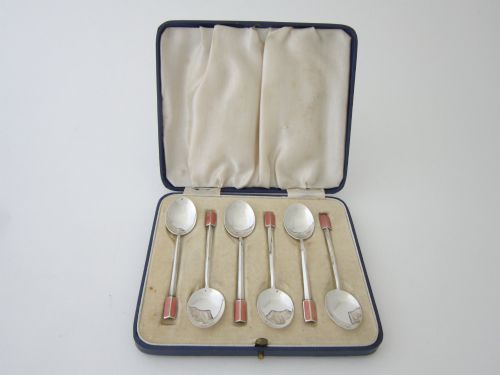


Art Deco Coffee Spoons
These art deco coffee spoons bring geometric precision and vibrant colour to the table, making them a collector favourite for after-dinner service.
Art Deco Coffee Spoons
Art deco coffee spoons appear in fitted cases containing sets of four, five, or six, often accompanied by matching saucers or housed in velvet-lined boxes. These smaller vessels follow the stylistic lines of the period, emerging mainly from the decades spanning the 1920s to the 1950s.
The form encompasses standard coffee spoons alongside specialist variants such as coffee bean spoons, bridge spoons, and card suit designs. Most examples originate from English assay offices, notably Birmingham and Sheffield, reflecting standard regional production of the era.
Materials and Construction
Silversmiths utilise solid sterling silver as the primary body material, frequently applying silver gilt to the bowl interiors or entire surfaces for a rich finish. Many pieces integrate vitreous enamel, guilloche enamel, or basse taille enamel to add intense colour panels to the handles.
Makers incorporate decorative details using materials such as green jade, Bakelite, and distinct bean-shaped knops on the terminals. Presentation sets typically feature fitted containers lined with satin, velvet, or leatherette to protect the metalwork.
Some sets feature tiny playing card suits on the handles, ensuring nobody loses track of trumps during high-stakes afternoon bridge.
Assessing Craftsmanship
The standard of enamel work dictates much of the visual distinction, with translucent or multi-coloured basse taille techniques requiring greater skill than plain metal surfaces. Crispness in the geometric stamping and clean hallmarks provide clear indicators of superior execution.
The integrity of the original fitted case and the completeness of matching sets influence the overall cohesion of the piece. Well-preserved gilding and undamaged enamel surfaces distinguish finer examples from heavily worn equivalents.
Walker and Hall·Turner and Simpson·Arthur Price and Co·James Dixon and Sons
The Art Deco Coffee Spoons Glossary
- Sterling silver
- A silver alloy containing 92.5 percent pure silver by mass and 7.5 percent other metals, usually copper. This composition provides the necessary durability for functional cutlery while maintaining a bright metallic lustre.
- Guilloche enamel
- A decorative technique where a precise mechanical pattern is engraved into the silver beneath a translucent layer of enamel. This creates shifting geometric light effects across the coloured surface.
- Silver gilt
- Silver objects that have been coated with a thin layer of gold on the surface. This finish protects the underlying metal from tarnishing and provides a warm golden appearance.
- Coffee bean spoon
- A spoon featuring a distinctive terminal shaped like a coffee bean attached to the end of the stem. This specific motif enjoys popularity within twentieth-century coffee service sets.
- Basse taille
- An enamel technique involving low relief metal engraving where translucent enamel fills the recessed areas. The varying depth of the cuts allows light to pass through the colour at different intensities.
Art Deco Coffee Spoons: Frequently Asked Questions
What are coffee bean spoons?
Coffee bean spoons are small decorative spoons featuring a distinct bean-shaped terminal at the top of the handle. They gained immense popularity during the twentieth century for after-dinner demitasse service.
These pieces often form part of matched sets housed in fitted presentation boxes. Their miniature scale allowed silversmiths to experiment with enamel work on the handles.
How do I date these spoons?
Dating relies heavily upon the stamped hallmarks found on the reverse of the stem or bowl. Assay office marks and date letters reveal the exact year and city of manufacture.
Stylistic elements like geometric enamel patterns or Bakelite details help place items within the 1920 to 1950 period. Original presentation boxes sometimes retain retailer labels that further clarify the timeline.
Are these spoons for everyday use?
While structurally sound for gentle use, enamelled and gilded surfaces require careful handling to prevent scratching or loss of the vitreous coating. Hand washing is essential to preserve the delicate materials.
many collectors prefer to keep cased sets for display or occasional celebratory coffee service rather than daily dining. Storing them in their original velvet or satin linings prevents surface rubbing.
What is a bridge set?
A bridge set typically incorporates motifs relating to card games, such as suits or specific symbols, integrated into the spoon design. These items served card-playing gatherings popular in the mid-twentieth century.
The inclusion of materials like Bakelite alongside silver marks these specific sets out from standard coffee cutlery.