
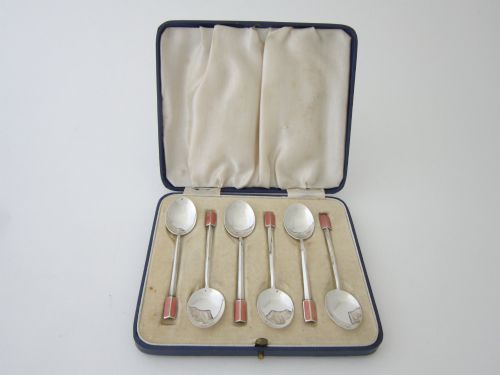


Art Deco Silver Teaspoons
Art deco silver teaspoons bring sharp geometric lines and vibrant colour to the table, packaged in fitted presentation cases.
Art Deco Silver Teaspoons
Art deco silver teaspoons comprise individual spoons and matched sets created during the 1920s, 1930s, 1940s, and 1950s. These pieces often arrive as cased sets of four, five, or six, complete with velvet, satin, or leatherette linings inside fitted boxes.
A buyer examining this selection encounters both standard teaspoons and smaller coffee spoons, alongside specialist variations like card suits spoons and coffee bean handle designs. The majority showcase the distinct modernist style of the period through angular handles and stylized bowls.
How They Were Made
Silversmiths shaped these utensils from sterling silver and solid silver, frequently applying gold plating known as silver gilt to the interior bowls. Many examples incorporate vitreous enamel and basse taille enamel to add rainbow colours and patterned details across the handles.
Makers utilised mechanical techniques such as engine turning to engrave precise geometric patterns directly into the metal surface. Finished cutlery was then hallmarked to verify the silver standard before being nestled into custom presentation cases.
Card suits spoons bring a playful touch of the bridge table right into your afternoon tea service.
What Varies in Quality
The presence of undamaged enamel work significantly elevates a set, as coloured glass fused to metal remains vulnerable to chipping over decades of handling. Complete sets housed within their original fitted velvet or satin lined boxes command stronger interest than loose, mismatched spoons.
Superior examples display crisp engine turned patterning and clear hallmarks from recognised assay towns like Sheffield alongside identifiable maker marks. The inclusion of specialised decorative elements, such as coffee bean finials or card suit motifs, distinguishes finer production from standard tableware.
Walker and Hall·Harrods
The Art Deco Silver Teaspoons Glossary
- Sterling silver
- An alloy comprising silver and other metals, standardly containing 92.5 percent pure silver by mass. This grade forms the base material for the majority of better quality cutlery.
- Silver gilt
- Sterling silver that has been coated with a thin layer of gold on its surface. This technique protects the underlying metal and provides a warm interior bowl colour.
- Vitreous enamel
- A material made by fusing powdered glass to a substrate by firing, usually between 750 and 850 degrees Celsius. It creates a glossy, durable coloured decoration on spoon handles.
- Basse taille
- An enamelling technique where the metal ground is engraved or chased so that pattern is visible through translucent enamel. This method produces rich depth and shimmering colour variation.
- Engine turning
- A decorative technique whereby a precision machine engraves intricate geometric patterns into metal. It provides a crisp, repeating texture across the handles of modernist cutlery.
Art Deco Silver Teaspoons: Frequently Asked Questions
How do I clean enamelled silver spoons?
Use a soft cloth and warm soapy water, avoiding harsh silver dips that can damage delicate enamel surfaces.
Dry the pieces thoroughly immediately after washing to protect any velvet or satin case linings they might touch.
Are these spoons safe to use daily?
Solid sterling silver withstands regular use, though pieces featuring fragile enamel work require much gentler handling.
Hand washing remains essential for preserving the bright finishes and preventing wear on gilded bowls.
What is the difference between teaspoons and coffee spoons?
Coffee spoons are noticeably smaller in overall length and bowl size, designed specifically for after-dinner demitasse cups.
Standard teaspoons offer a larger capacity suitable for normal tea service and broader table use.
Why do some sets include presentation boxes?
Many sets were retailed as luxury gifts, prompting makers to house them in fitted cases lined with velvet, satin, or leatherette.
These original boxes protect the silver from tarnishing while in storage and keep the matched items together.