

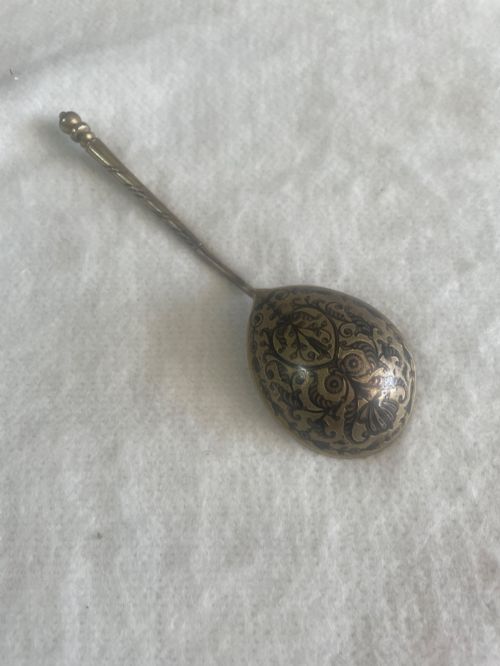


Enamel Tea Spoons
Enamel tea spoons bring vibrant colour and intricate metallic detail to the table, making them a collector's favourite for display and daily service alike.
Enamel Tea Spoons
Buyers exploring enamel tea spoons will regularly encounter complete sets housed within fitted presentation boxes lined with satin and leatherette. Individual spoons and smaller groupings also feature prominently, often showcasing the geometric motifs of Art Deco or the clean lines of mid-century modern design.
Origin and stylistic influence vary notably across the selection, ranging from British George V productions to distinct Russian imperial and Russian revival aesthetics. The incorporation of porcelain elements further expands the formal variety encountered within this category.
Materials and construction
The foundation of these pieces relies primarily upon silver, sterling silver, and solid silver, occasionally enhanced with silver gilt or gilt silver finishes. Artisans applied vitreous enamel directly to these metal surfaces, fusing powdered glass under high heat to create smooth, glossy ornamentation.
Advanced techniques such as cloisonné work appear on nineteenth-century examples, where delicate wire partitions hold the coloured enamel pastes before firing. Presentation packaging involved skilled casing, utilising satin and leatherette to protect the delicate metallic and vitreous surfaces during storage.
Enamel Tea Spoons Retail Price Guide 2026
Typical asking prices for enamel tea spoons among the pieces listed under this phrase on Sellingantiques today, from the lower quarter to the upper quarter. They describe what is for sale here now, not the wider market.
Assessing craftsmanship and condition
Superior examples demonstrate precision in the application and firing of the enamel, with smooth surfaces free from chipping, cracking, or shrinkage around the metal partitions. The weight and purity of the underlying silver, whether sterling or gilt, contribute substantially to the overall substance of the utensil.
The intricacy of the decorative design, particularly in cloisonné or multi-coloured Art Deco motifs, distinguishes finer workshop output from standard production. Additionally, the survival of original fitted presentation cases lined with satin and leatherette adds considerable integrity to a set.
David Andersen·Vasily Agafonov
The Enamel Tea Spoons Glossary
- Cloisonné
- An enamelling technique where metal wire is soldered to the base to form compartments for coloured glass paste. These wires create the distinctive outlines visible in the finished pattern.
- Vitreous enamel
- A material made by fusing powdered glass to a metallic substrate at high temperatures. This produces a durable, glossy coloured surface that resists tarnishing.
- Silver gilt
- Silver that has been coated with a thin layer of gold on its exterior surface. This treatment provides a warm golden sheen while retaining a silver base.
- Caddy spoon
- A short-handled spoon specifically designed for measuring loose tea leaves from a caddy. They often feature decorative bowls and handles matching tea service items.
- Coffee spoon
- A diminutive spoon intended for stirring demitasse coffee, typically smaller than a standard tea spoon. They frequently appear in matched boxed sets.
Enamel Tea Spoons: Frequently Asked Questions
How do I clean enamel tea spoons?
Clean these spoons gently using warm water and a mild soap, drying them immediately with a soft cloth to protect the metal and glass surfaces.
Avoid abrasive cleaners, chemical dips, and ultrasonic cleaning machines, as these methods can scratch the vitreous enamel or damage the underlying silver finish.
Can I use them for daily tea?
These spoons are structurally suitable for gentle everyday use, provided they are hand-washed promptly after handling acidic substances like lemon or tea.
Many collectors prefer to preserve delicate nineteenth-century or cased Art Deco sets for display or occasional entertaining rather than routine daily service.
Why are some sets cased?
Fitted presentation cases lined with satin and leatherette were originally designed to protect fine tableware from dust, tarnish, and physical impact during storage.
Such packaging indicates that the spoons were intended as luxury gifts or special acquisitions, helping to preserve the pieces in pristine condition over generations.
How do I identify Art Deco pieces?
Art Deco spoons display characteristic geometric patterns, stylised motifs, and bold contrasting colours that reflect the design sensibilities of the 1920s and 1930s.
These modern lines contrast sharply with the ornate, traditional ornamentation found on nineteenth-century Russian revival and imperial silver items.