





Architectural Marble Clock
An architectural marble clock brings monumental stone presence and precise nineteenth-century mechanics to a mantelpiece, offering both solid gravity and classical proportion.
Architectural Marble Clock
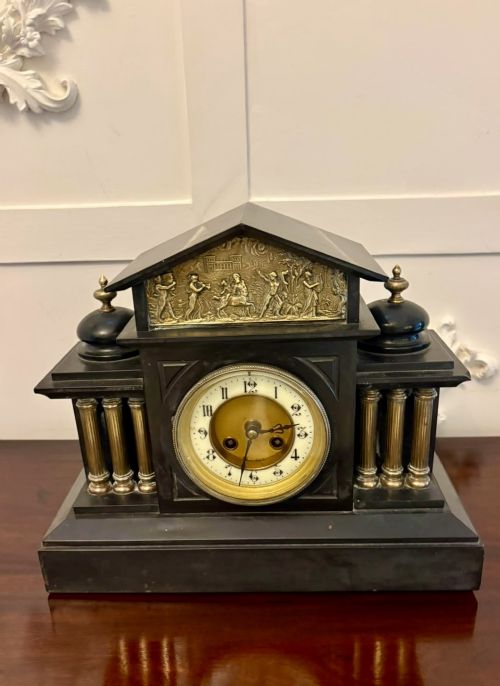
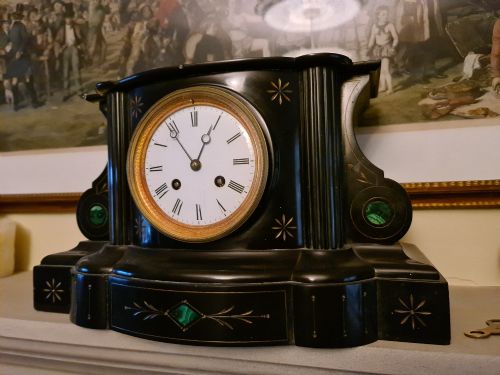
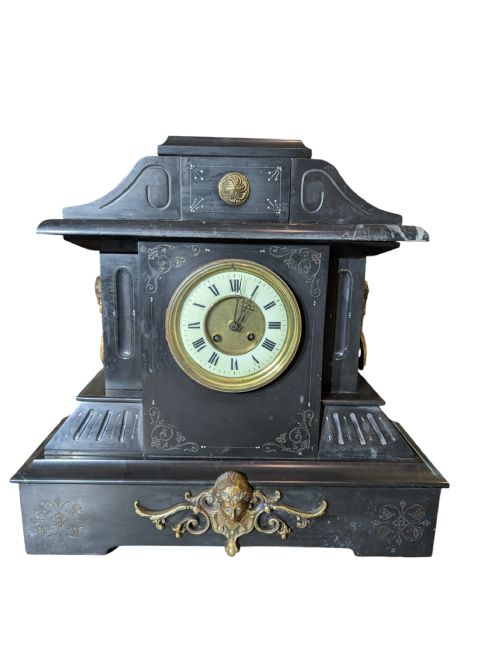
An architectural marble clock takes its design cues from classical buildings, featuring columns, pediments, and portico arrangements carved from solid stone. You will frequently encounter heavy black slate, rouge marble, and sienna varieties housing eight-day mechanical movements.
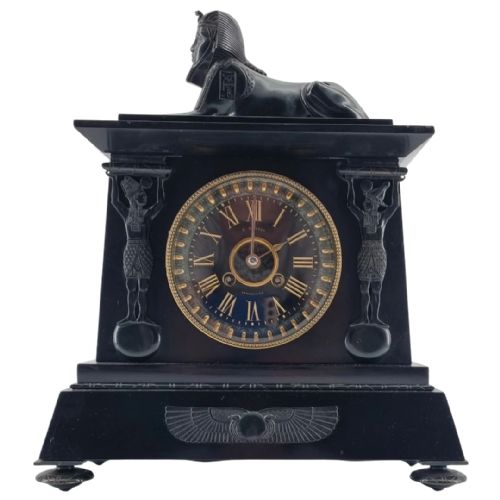
These pieces draw heavily upon Victorian classical revival, neoclassical, and Egyptian revival idioms, often standing substantial and weighty on a shelf. Makers built them to mimic miniature temples and public facades using dense mineral blocks.
Beyond standard single mantel pieces, the category includes elaborate clock sets accompanied by matching garnitures and specialised portico designs. The visual language borrows directly from masonry and ancient architecture translated to domestic scale.
Materials and construction
Masons shaped heavy blocks of black slate and natural marble into rigid structural housings, sometimes applying faux marble finishes or stone inlay work. Gilt brass, bronze mounts, and enamel dials provided contrasting metallic detail against the dark stone bodies.
Casting workshops produced decorative bronze figures and architectural ornaments to mount upon the stone chassis, while glass protected the delicate dial faces. Movements required skilled assembly to drive eight-day strikes reliably within the heavy mineral frames.
Assessing quality and finish
Quality rests in the crispness of the stone cutting, the weight and selection of the marble or slate, and the ambition of the architectural facade. Finer examples integrate precise gilt bronze mounts, stone inlay, and balanced proportions rather than relying on plain mass alone.
The sophistication of the internal movement and the integration of matching garnitures elevate certain pieces above standard domestic timepieces. Master workshops paid careful attention to surface polish and the harmony of the classical motifs applied to the stone.
Philippes Paris·Baby and Jannings·D. Munsey of Cambridge
The Architectural Marble Clock Glossary
- Slate
- A dense, fine-grained metamorphic rock commonly used as the heavy structural base for dark nineteenth-century timepiece cases. It took a high black polish and could imitate rarer marbles.
- Portico clock
- A distinct architectural clock style featuring a raised temple-like housing supported by columns. These designs often utilised alabaster or sienna marble.
- Garniture
- A set of matching ornamental objects, typically comprising a central clock flanked by matching vases or urns. They formed a symmetrical decorative grouping on a mantelpiece.
- Fusee movement
- A conical pulley mechanism designed to equalize the diminishing power of the mainspring as it unwinds. This ensured consistent timekeeping across the eight-day duration.
Architectural Marble Clock: Frequently Asked Questions
How do I wind an architectural marble clock?
Most pieces utilise an eight-day mechanical movement wound via key holes positioned on the enamel dial face.
Careful rotation engages the mainspring without over-tightening the mechanism, maintaining proper tension for the pendulum.
Where should I place a heavy marble clock?
These dense stone structures demand a deeply supportive surface such as a solid mantelpiece or heavy sideboard.
Level placement ensures the pendulum swings evenly and the striking train operates without binding.
What maintenance do these stone clocks require?
The dense marble and slate surfaces need only gentle dusting with a dry cloth to preserve their polished finish.
Mechanical movements benefit from professional servicing every few years to clean old oils and calibrate the escapement.
How do I identify the period of a clock?
Dating relies upon stylistic markers like Egyptian revival motifs, heavy Victorian classical proportions, and specific maker signatures.
Materials such as rouge marble, sienna stone, and gilt brass mountings also point toward mid to late nineteenth-century production.