
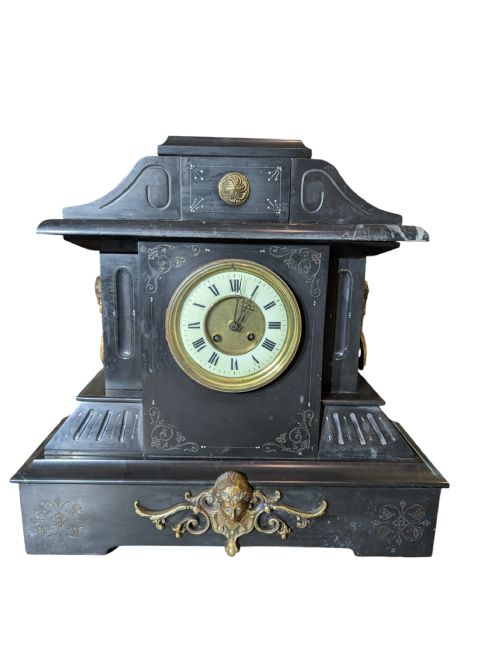


Brass Mounted Marble Clock
A brass mounted marble clock combines solid stone weight with bright metal detailing, making it a striking centrepiece for a mantelpiece.
Brass Mounted Marble Clock
A brass mounted marble clock is a heavy domestic timepiece housed in stone and finished with metal mounts. These objects served both to tell the time and to display status in nineteenth-century rooms.
The versions most commonly met on this page date from the Victorian era and the latter half of the nineteenth century. They appear primarily as mantel clocks or larger clock garnitures accompanied by matching candelabras.
Makers shaped the stone into architectural forms, sometimes incorporating figures or lyre shapes. The combination of cool marble and warm brass defines the visual character of the search phrase.
How they were made
Craftsmen shaped dense blocks of marble and black slate to form the heavy body of each timepiece. They then applied brass, ormolu, and gilt bronze mounts to the stone surfaces to create decorative contrast.
Dial faces utilised white enamel protected by glass covers, housing eight-day movements driven by mechanical gears. Figures cast in spelter or bronze were occasionally integrated into the stone architecture.
What varies in quality
The standard of carving and the selection of the stone determine the visual weight of the piece. Fine examples feature crisp cast brass mounts and carefully fitted marble panels rather than simpler mass-produced framing.
Movement sophistication also divides ordinary timepieces from superior specimens, particularly those incorporating specialised escapements or associated garniture sets. The presence of named makers adds another layer of distinction to the workmanship.
James Ritchie and Son·Auguste Moreau
The Brass Mounted Marble Clock Glossary
- Ormolu
- Gilded bronze applied as a decorative mount onto the marble body. This technique gives metallic highlights that contrast with the dark or white stone.
- Garniture
- A set consisting of a central clock flanked by matching ornamental pieces such as candelabras. These arrangements were designed to balance a mantelpiece display.
- Fusee
- A conical pulley used in clock movements to maintain even driving force as the mainspring unwinds. It represents a more complex mechanical standard.
- Spelter
- A zinc alloy frequently cast into sculptural figures mounted alongside the clock. It was often painted to simulate bronze.
- Enamel
- A glassy substance fused onto the metal dial face to provide a smooth, white surface for the numerals. It ensures clear legibility across the room.
Brass Mounted Marble Clock: Frequently Asked Questions
How do I wind a marble clock?
Most of these timepieces utilise an eight-day mechanical movement requiring a key to tension the springs.
Insert the key gently into the winding arbour and turn it slowly until you feel firm resistance, taking care not to overwind.
Where should I place a clock garniture?
A clock garniture is designed for a prominent position on a mantelpiece or a large sideboard.
Place the central clock in the middle with the matching candelabras positioned symmetrically on either side to maintain visual balance.
How do I identify nineteenth-century French pieces?
French pieces often feature distinct stylistic revivals such as Louis XVI or Second Empire designs.
Look for refined bronze mounts, sculptural figures after known artists, and French movement stamps on the interior mechanism.
What is the difference between slate and marble?
Black slate is a uniform, fine-grained stone that was frequently used for architectural mantel clock bodies.
Marble exhibits natural veining and colour variation, offering a softer and more decorative appearance than plain slate.