
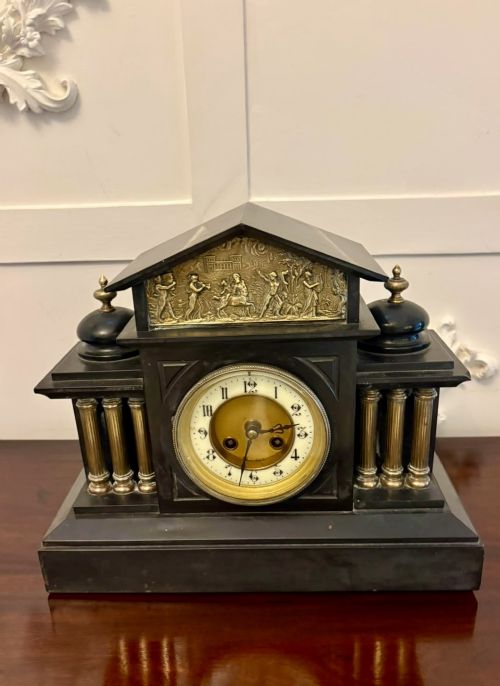
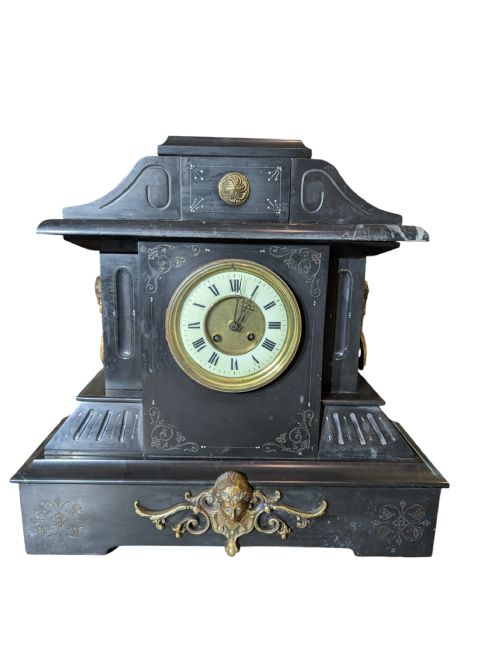


Black Slate Shelf Clock
A black slate shelf clock brings heavy architectural presence and precise nineteenth-century mechanics to a mantelpiece.
Black Slate Shelf Clock
When you search for a black slate shelf clock, you encounter solid nineteenth-century timepieces built during the Victorian period, frequently showing neoclassical, architectural, or Egyptian Revival influence. Most examples span the decades between 1860 and 1890, reflecting a time when dense stone cases dominated formal interiors.
The prevalent forms on this page include large mantel clocks and drumhead clocks, often housed in architectural facades that mimic temples or classical monuments. Alongside plain black slate, you will regularly find combinations involving marble inlays, gilt brass mounts, and bronze details.
Originating from British domestic markets and French workshops alike, these clocks utilise heavy stone chassis designed to sit securely on a shelf or mantel. The typical survival from this era relies on an eight-day movement to measure time reliably.
How they were made
Makers constructed the primary housing from solid black slate and black marble, shaping dense stone into robust architectural forms with polished surfaces. Stonemasons cut and squared heavy blocks to imitate classical buildings, sometimes incorporating contrasting marble inlays or incised decorative lines.
Metalworkers added brass, gilt brass, and bronze mounts to enrich the stone cases, fixing cast bezels and side ornaments directly to the slate chassis. Dials commonly employed white enamel with contrasting numerals, protected behind bevelled glass panes within hinged bezels.
Inside the stone housing, mechanical clockmakers fitted eight-day movements driven by metal gears and springs. These movements required careful calibration to operate steadily within heavy mineral frames.
Several clocks wear heavy stone pediments that could easily double as miniature fortifications for a very determined mouse.
What varies in quality
The distinction between standard examples and top-tier pieces rests on the ambition of the architectural design and the crispness of the stone cutting. Superior models incorporate elaborate applied bronze mounts, multi-coloured marble inlays, and sophisticated stylistic programmes such as Egyptian Revival motifs.
Signed works by established makers or retailers elevate a piece above ordinary production, demonstrating superior craftsmanship in both the stone case and the internal movement. The integration of complications, such as perpetual calendars or bronze sculptural figures, marks the upper tier of quality.
Philippes Paris·Baby and Jannings·D. Munsey of Cambridge·Achille Brocot
The Black Slate Shelf Clock Glossary
- Black slate
- A dense, fine-grained metamorphic stone that takes a high polish and serves as the primary structural material for heavy nineteenth-century mantel clocks.
- Egyptian Revival
- A nineteenth-century design style drawing on ancient pharaonic motifs, including sphinxes, hieroglyphs, and architectural pylons applied to clock cases.
- Drumhead clock
- A clock design featuring a circular dial housing mounted centrally upon a stepped or rectangular stone base, resembling the drum of an instrument.
- Eight-day movement
- A mechanical clock movement requiring manual winding approximately once a week to maintain continuous operation.
- Architectural mantel clock
- A clock case styled to resemble a miniature classical building, complete with pediments, columns, and heavy cornices.
Black Slate Shelf Clock: Frequently Asked Questions
How do I wind an eight-day movement?
Insert the winding key into the designated arbour on the enamel dial and turn it gently until you feel firm resistance. Avoid over-winding, as this can strain the internal spring mechanism.
Ensure you support the heavy slate case if your key requires significant torque. Most eight-day movements need attention once a week to maintain accurate timekeeping.
Why are these clocks so heavy?
Makers built these pieces using solid blocks of black slate and marble to create stable housings for mechanical gear trains. This dense mineral mass helped dampen vibrations and secure the heavy brass movements.
When placing your clock on a shelf, verify that the surface can support significant stone weight.
How do I clean a slate case?
Dust the polished stone surface regularly with a soft, dry cloth to prevent grime accumulation in the incised details. Avoid harsh chemical cleaners or excess water, which can damage exposed brass mounts and marble inlays.
A light application of neutral wax can help maintain the deep sheen on polished black slate.
How do I distinguish Victorian from Egyptian Revival styles?
Standard Victorian architectural models rely on classical European elements like pediments, columns, and restrained marble inlays. Egyptian Revival pieces incorporate distinct ancient motifs such as sphinxes, winged sun discs, and pyramid forms.
Both styles utilise the same heavy black slate substrate but express different nineteenth-century aesthetic interests.