

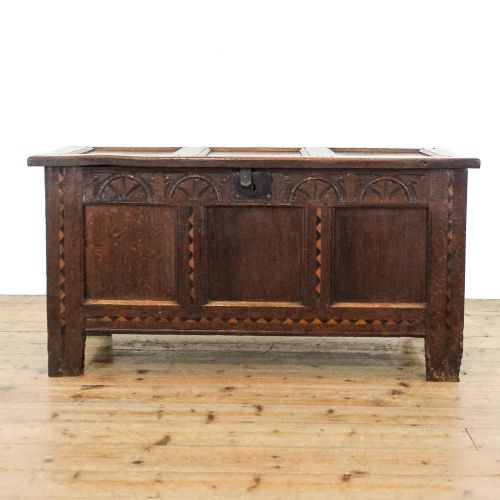
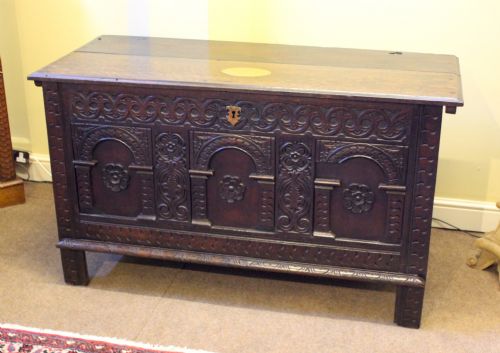


Arcaded Oak Chest
An arcaded oak chest brings solid seventeenth-century proportion and carved architectural rhythm straight into a modern hallway.
Arcaded Oak Chest
When you search for an arcaded oak chest, you are looking at substantial storage furniture built primarily in the seventeenth century, alongside later revivals from the nineteenth and twentieth centuries. These pieces function as coffers, trunks, and occasional side tables, serving as robust domestic storage since the Jacobean era. The seventeenth-century examples dominate the form, featuring distinct arched panel carvings across the front elevation.
You will encounter pieces spanning the seventeenth and eighteenth centuries, as well as revival pieces dated around nineteen hundred and nineteen twenty. The forms range from simple boarded trunks to large carved coffers and storage trunks that double as window seats. Oak remains the defining structural timber across these diverse periods and revival styles.
Construction and materials
These pieces are built from oak, often accented with fruitwood inlay, wood inlay, brass, and iron hardware. Master craftsmen utilised heavy timber frames joined by traditional methods to ensure durability across centuries of domestic use.
The decorative schemes rely on carved architectural motifs, specifically arcading, which mimics stone arches using timber gouges and chisels. Inlaid details in contrasting woods occasionally supplement the carved panels on both seventeenth-century originals and later revival pieces.
Some seventeenth-century ancestors probably sat on these very lids while pulling on muddy riding boots before breakfast.
Assessing quality and craftsmanship
Quality rests upon the crispness of the carved arcading and the integrity of the original oak construction rather than surface polish alone. Early seventeenth-century pieces demonstrate a depth of relief and proportion that distinguishes them from later revival iterations.
The integration of secondary timbers and the survival of original iron or brass fitments determine the architectural coherence of the piece. Superior examples maintain their primary structural oak without extensive timber replacement.
The Arcaded Oak Chest Glossary
- Arcading
- A row of arches supported by piers, carved directly into the wooden panels of the chest front. This architectural motif defines the primary visual characteristic of these pieces.
- Jacobean Revival
- A nineteenth or twentieth century architectural and furniture style that copies the heavy oak forms and carved details of the early seventeenth century. This movement produced many of the later pieces found in this category.
- Inlay
- A decorative technique where pieces of contrasting material, such as fruitwood, are fitted into depressions flush with the oak surface. It adds visual complexity to the front panels.
Arcaded Oak Chest: Frequently Asked Questions
What is an arcaded oak chest?
An arcaded oak chest is a sturdy storage trunk featuring carved arch motifs across the front panels. These pieces date primarily from the seventeenth century, with later revival examples appearing around nineteen hundred.
Originally designed for secure household storage, they provide deep interior space while serving as benches or side tables in contemporary interiors.
How do I date an oak coffer?
Dating relies on construction methods, joinery types, and decorative carving styles associated with specific historical periods. Seventeenth-century pieces display hand-tooled surfaces and period-specific architectural motifs like Jacobean arcading.
Revival pieces from nineteen twenty or nineteen hundred often utilise machinery alongside traditional hand tools, showing cleaner, more uniform cuts than their antique predecessors.
Where should I place a trunk in my home?
These chests suit entrance halls, living rooms, and bedrooms where their flat lids function practically as window seats or display surfaces. Their robust timber construction handles everyday domestic use with ease.
Keep them away from direct heat sources and dramatic humidity fluctuations to protect the ancient oak timbers and prevent wood movement.
What is the difference between a coffer and a chest?
The terms are often used interchangeably, though a coffer traditionally denotes a more heavily constructed, domed or flat-topped box meant for valuables. Both forms utilise heavy oak framing and robust iron or brass hardware.
In historical listings, these items appear under various descriptions including storage trunks, coffers, and window seats depending on their specific proportions.