


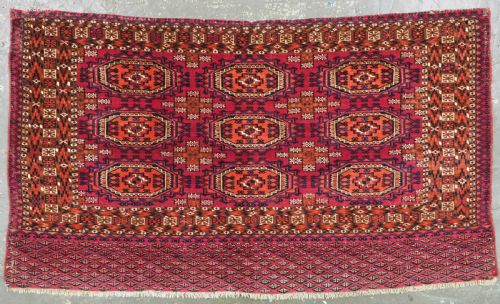


Antique Wool Camel Bag
An antique wool camel bag is a nomadic textile piece offering tribal history and rich texture for the home.
Antique Wool Camel Bag
When you search for an antique wool camel bag, you encounter tribal weavings created by nomadic groups across Central Asia and the Caucasus. These utilitarian items served practical storage functions during migrations and daily encampment life.
The pieces on this page are predominantly Turkmen torbas, chuvals, and saddle bags originating from groups such as the Tekke, Yomut, Ersari, Saryk, and Salor tribes. You also find Shahsevan examples from Azerbaijan, reflecting distinct regional weaving traditions.
Dating ranges widely from the middle of the eighteenth century through to the early decades of the twentieth century. Many survive as fragments or complete faces, while others retain their original plain weave backs and hanging loops.
Materials and construction
Weavers utilised hand-spun wool as the primary foundation and pile material, supplemented by cotton and silk highlights in specific decorative areas. Natural dyes provided the rich palette characteristic of these tribal textiles.
Construction techniques include intricate pile knotting alongside banded flatweave designs and embroidered faces. Leather and metal details occasionally appear alongside wool tassels and complete plain weave backs.
Nomadic weavers often attached tassels and loops so the bags could be secured directly to restless pack animals during long desert journeys.
Judging quality in tribal weavings
Quality rests upon the fineness of the weave, the clarity of the primary guls, and the depth of the natural colour palette. Examples with complete backs, original hanging loops, and intact tassels command greater interest among collectors.
The complexity of the design layout, such as the number and crispness of the guls or the inclusion of silk highlights, elevates certain pieces above standard utility grades. Condition also plays a role, though historic repairs and handling wear reflect the genuine nomadic usage of these textiles.
The Antique Wool Camel Bag Glossary
- Torba
- A small Turkmen storage bag, typically wider than it is tall, used inside a tent for household possessions.
- Chuval
- A large Turkmen tent storage bag traditionally used for bedding and clothing during migrations.
- Gul
- A medallion pattern or primary motif repeated across Turkmen and Central Asian carpets and bags.
- Mafrash
- A rectangular storage bag or travel pouch produced by nomadic tribes for carrying goods on animals.
- Flatweave
- A textile constructed without pile by interlacing warp and weft threads together, creating a smooth surface.
Antique Wool Camel Bag: Frequently Asked Questions
What is a camel bag?
A camel bag is a woven textile container produced by nomadic tribes for storage and transport during seasonal migrations.
These pieces were draped over pack animals or hung inside tents to hold household belongings and provisions.
Are these bags complete?
Survival state varies considerably across historical nomadic textiles from this region.
Many listings comprise only the decorative face of the bag, while others retain their original plain weave backs, hanging loops, and tassels.
How should I display a textile?
Tribal bags and torbas suit gentle wall hanging using appropriate conservation mounting methods.
Avoid placing antique wool textiles in direct sunlight to protect the natural dyes from fading over time.