
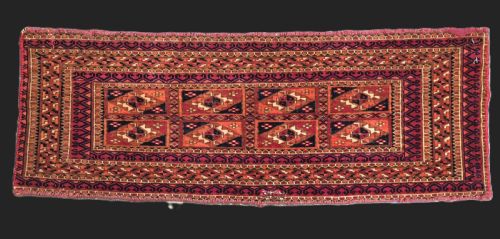


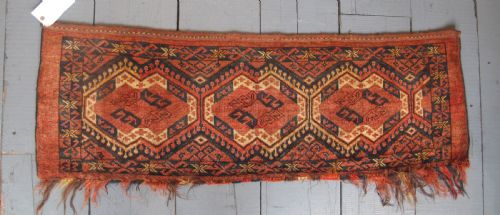
Antique Turkmen Torba Panel
These antique turkmen torba panel examples are tribal storage bag faces woven in Central Asia using wool and natural dyes.
Antique Turkmen Torba Panel
An antique turkmen torba panel represents a tribal storage bag face woven across Central Asian traditions during the nineteenth and early twentieth centuries. These pieces display distinct tribal motifs and medallion structures that served both practical storage functions and cultural identification within nomadic societies.
The most common examples encountered here are torba faces or combined mafrash formats originating from specific tribal groups such as the Tekke, Yomut, Ersari, Saryk, and Chodor. They frequently arrive as single panels or matched pairs showcasing traditional guls and banded flatweave designs.
Dated specimens span from the first half of the nineteenth century through to the 1920s, capturing a period of traditional tribal weaving before commercial dyes predominated. Collectors encounter these textiles primarily as wall-hung panels or small display rugs due to their format as bag faces.
What varies in quality
The visual strength of an antique turkmen torba panel depends heavily on the precision of the drawing and the saturation of the natural dyes. Crisp execution of guls and balanced proportions separate superior weaving from more standard examples.
Structural integrity and the retention of original borders or elem panels significantly influence the overall standard of a piece. Finer knot density and inventive tribal designs elevate individual bag faces above simpler utilitarian items.
Listings span from the early nineteenth century through to the 1920s, featuring wool construction and natural dyes.
The Antique Turkmen Torba Panel Glossary
- Gul
- A primary medallion or octagonal design motif used by Central Asian tribes to identify specific groups and lineages. Each major tribe utilised distinct variations of these primary guls.
- Torba
- A small horizontal storage bag traditionally used inside a nomadic tent for holding household goods. Surviving examples are often found as individual panel faces separated from their original backings.
- Mafrash
- A larger rectangular storage container or bag format used for bedding and household possessions. These pieces frequently share design vocabulary with torbas.
- Elem
- The decorative lower panel of a Turkmen bag face or rug, often featuring detailed tree or floral motifs below the main field of guls.
- Flatweave
- A textile structure created without pile by interweaving warp and weft threads, seen in banded storage bag designs.
Antique Turkmen Torba Panel: Frequently Asked Questions
What is a torba used for?
A torba served as a practical storage bag inside nomadic Central Asian tents for holding small possessions, clothing, or household items.
Over generations, many of these bag faces have been separated from their original rear panels to be displayed as decorative wall hangings or collector textiles.
How do I identify different tribal styles?
Tribal attribution relies on the specific primary medallion known as a gul, alongside the secondary motifs and overall colour palette. Tekke, Yomut, Ersari, Saryk, and Chodor weavers each employed distinct geometric arrangements.
Examining the border patterns and structural drawing helps distinguish between these regional Central Asian traditions.
What are natural dyes?
Natural dyes are colourants derived from plants, roots, and insects used by nomadic weavers before the introduction of synthetic dyes in the late nineteenth century.
These traditional dyes interact with wool fibres to create rich, varied tones that soften gracefully over time.
How should I display a bag face?
Bag faces are generally mounted on a fabric sleeve or conservation-grade Velcro system to distribute weight evenly across the wool textile.
Keeping them away from direct sunlight preserves the natural dyes and protects the wool fibres from fading over years of display.