
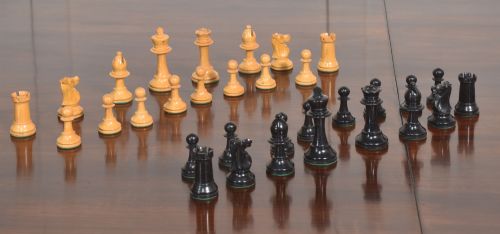


Antique Wooden Chess Set
An antique wooden chess set brings tactile history to the table, offering finely turned figures in boxwood and ebony that demand a game.
Antique Wooden Chess Set
When you search for an antique wooden chess set, you encounter complete groupings of pieces alongside travelling boards, folding boards and larger games compendiums that combine multiple pastimes. The examples appearing here span the nineteenth century, the Edwardian era and the Regency period, capturing decades of domestic leisure.
The Staunton pattern dominates the pieces available, joined by St George and Calvert patterns alongside regional English variants and Ottoman Revival expressions. Most pieces pair natural boxwood with ebonised wood or dark ebony, housed within fitted wooden boxes or folding rosewood and mahogany boards.
Beyond standalone sets, items include nested tables, tantalus compendiums and burr walnut boxes that incorporate chess alongside backgammon and draughts. These pieces reflect how Victorians and Edwardians structured their social evenings around tactile, material play.
What varies in quality
The crispness of the turning on the pawns and the depth of hand-carving on the knight's head separate ordinary sets from notable examples. Signed pieces bearing maker marks demonstrate superior workshop execution and material selection.
Condition of the original felt undersides, the presence of matching fitted wooden boxes and the preservation of the contrasting wood tones dictate the standing of a set. Uniformity in height and weight across every piece signals a higher standard of manufacture.
Listings feature boxwood, ebony, mahogany, rosewood and brass across nineteenth-century sets.
Jaques·Whitty·British Chess Company·F. H. Ayres·Gillows
The Antique Wooden Chess Set Glossary
- Staunton pattern
- The standard design for chess pieces introduced in the mid-nineteenth century, characterised by architectural rooks and distinctive knight carvings. This style remains the benchmark for tournament play.
- Boxwood
- A dense, pale wood traditionally utilised for the light side of a chess set. It takes fine detail from turning tools cleanly.
- Ebonised
- Wood treated to imitate ebony, creating a deep dark finish for the contrasting pieces. It offers a uniform appearance without the cost of solid tropical hardwood.
- Games compendium
- A multi-use box containing equipment for several pastimes such as chess, backgammon and cards. These sets demonstrate nineteenth-century woodworking and storage ingenuity.
- Calvert pattern
- A distinct nineteenth-century style of chess pieces associated with specific carving traditions. Collectors recognise them by their specific proportions and turned details.
Antique Wooden Chess Set: Frequently Asked Questions
How do I date an antique chess set?
Dating relies on the style of the pieces, the materials used, and any maker marks stamped on the wood or box. Staunton patterns typically point towards the mid-nineteenth century onwards.
Boxes, hinges and felt undersides provide additional clues. Comparing the turning style against documented maker output helps narrow down the decade of production.
What is a compendium of games?
A games compendium is a fitted wooden box housing equipment for multiple pastimes, including chess boards, backgammon pieces and draughts. They were popular during the Victorian and Edwardian eras for household entertainment.
These boxes often feature folding boards and internal compartments lined with baize. They range from modest travelling versions to large burr walnut cabinets.
Are wooden chess sets fragile?
Solid hardwoods like boxwood and ebony withstand normal handling, but delicate carved elements such as knight ears and rook battlement edges require care. Drops can crack aged wood or chip fine points.
Storing sets in dedicated wooden boxes protects them from impacts and direct sunlight. Keeping them away from extreme temperature swings prevents the wood from warping.
How do I clean an antique chess set?
Cleaning requires a dry or barely damp soft cloth to remove dust from the turned surfaces. Avoid harsh chemical cleaners and excessive water, which can damage aged wood and loosen glued bases.
Felt undersides should be brushed gently without soaking. Maintaining stable humidity levels in the room preserves the finish of the boxwood and ebony.