
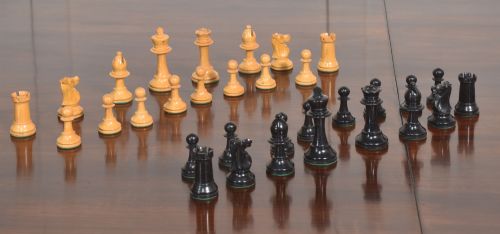


Antique Staunton Chessmen
These antique staunton chessmen are the defining playing pieces of the game, offering both tactile heft and historical table presence.
Antique Staunton Chessmen
When you search for antique staunton chessmen, you encounter complete sets dating from the Victorian and Edwardian periods, stretching from the late 19th century through to 1910. These sets serve as both functional equipment for play and notable decorative objects for the library or study.
You are most likely to meet sets housed in wooden boxes or accompanied by folding boards, reflecting their original domestic use. The pieces span straightforward club sets to weighted tournament examples designed for serious play.
The material combinations remain remarkably consistent, pairing pale boxwood with contrasting dark ebony or ebonised wood. Occasionally, rosewood or bone appears, alongside alternative forms such as the St George and Calvert patterns.
How they were made
Turned wood forms the foundation of nearly every set, shaped on a lathe to create the distinctive profiles of rooks, knights, and pawns. Artisans utilised boxwood for the natural white pieces, contrasting them with dark ebony or ebonised wood for the black side.
Lead weighting inside the base of each piece provides the stability necessary for tournament play, a standard innovation of the period. Bases are typically finished with felt to protect the playing surface of the board during use.
What varies in quality
Carving detail on the knight pieces distinguishes standard utility sets from the work of premier makers. The depth of the hand-carved eye, mane, and muzzle reveals the skill of the individual turner.
Consistency in the turning across the entire complement of pieces indicates a higher grade of workshop production. Weighting and the presence of makers' signatures or stamps elevate the standing of a set considerably.
Jaques·Whitty·British Chess Company·F. H. Ayres
The Antique Staunton Chessmen Glossary
- Staunton
- The standard design of chess pieces introduced in the mid-19th century, featuring architectural forms for major pieces and clear differentiation between ranks. It remains the universal standard for tournament play today.
- Boxwood
- A dense, pale hardwood traditionally chosen for the white pieces in a chess set. Its fine grain allows for crisp turning and detail work on the smaller pieces.
- Ebonised wood
- Fruitwood or another pale timber treated with a black stain to imitate true ebony. It offers a dark, uniform appearance for the opposing side of the board.
- Weighted
- A description for chess pieces containing lead inserts within their bases to improve balance and prevent tipping during play. This feature is particularly common in sets intended for club or tournament use.
Antique Staunton Chessmen: Frequently Asked Questions
What is a Staunton chess set?
A Staunton chess set is the traditional style of chess pieces featuring standardised, architecturally inspired designs that make every piece instantly recognizable.
Commissioned in the mid-19th century to resolve confusion over varying regional piece designs, it quickly became the mandatory standard for competitive play worldwide.
How do I date an old chess set?
Dating relies on examining the turned profiles, the materials used, and any accompanying box labels or stamps from known makers.
Victorian sets often display hand-carved knight details and lead weighting methods specific to late 19th-century workshops.
Why are some chess pieces heavier?
Heavier pieces contain internal lead weights added to their bases during manufacture to provide greater stability during movement.
This weighting was particularly important for tournament and club sets where rapid play demanded pieces that would not easily tip over.
What is the difference between ebony and ebonised wood?
True ebony is a naturally dense, dark black timber used directly for the contrasting pieces in higher-end antique sets.
Ebonised wood is typically boxwood or a similar pale timber treated with a dark stain to achieve the same visual contrast at a lower production cost.