
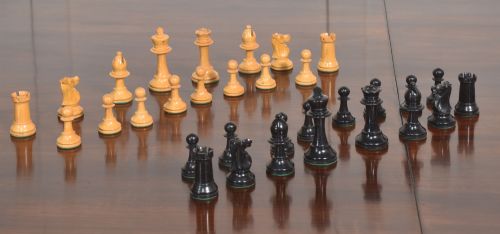


Antique Wooden Chessmen
These antique wooden chessmen bring tactile warmth and history to the board, offering collectors fine craftsmanship from the nineteenth and early twentieth centuries.

Antique Wooden Chessmen
When you search for antique wooden chessmen, you encounter sets designed for serious play and leisurely parlour games alike. The selection on this page centres primarily on nineteenth century and Edwardian examples, spanning robust club sizes down to delicate miniature sets.
The dominant form met here is the Staunton pattern, alongside alternative nineteenth century styles such as St George and Calvert pattern sets. These pieces usually arrive complete with their original boxwood and ebonised counterparts or dark ebony pairings.
Many of these sets originate from notable British makers and workshops of the period, complete with weighted bases for stability during play. Alongside complete sets, folding chess boards with integrated pieces occasionally appear to complete the offering.
How they were made
Turned boxwood provides the pale foundation for almost every set, paired with dark ebony or ebonised wood to create the contrasting sides. Artisans shaped each piece on a lathe before hand-carving intricate details, particularly on the knight heads and king crowns.
Many pieces incorporate lead weighting inside the turned base to improve balance and tactile feel during movement. Bases are frequently lined with green felt or baize to protect the board surface from friction.
Listings feature sets primarily from the Victorian and Edwardian eras, constructed in boxwood, ebony, rosewood, and ebonised wood.
What varies in quality
The grade and selection of the timber dictate the visual depth, with finer grain in the boxwood and rich, dense ebony lifting an ensemble above standard commercial output. Maker attribution and original weighted bases also elevate a set's standing.
Jaques·Whitty·British Chess Company·F. H. Ayres·Calvert
The Antique Wooden Chessmen Glossary
- Staunton pattern
- The standard design for chess pieces introduced in the mid-nineteenth century, characterised by realistic architectural forms and a cross surmounting the king. It remains the universal tournament standard today.
- Boxwood
- A dense, pale wood traditionally utilised for the white pieces in a chess set due to its fine grain and smooth finish.
- Ebonised wood
- Fruitwood or boxwood treated with a dark stain and polish to imitate the appearance of genuine ebony.
- St George pattern
- An earlier nineteenth century British chess design featuring simpler, more cylindrical king and queen pieces without finials.
- Calvert pattern
- A distinct nineteenth century regional style of chessmen known for characteristic king and rook designs.
Antique Wooden Chessmen: Frequently Asked Questions
What are antique wooden chessmen?
Antique wooden chessmen are hand-turned and carved playing pieces dating generally from the nineteenth and early twentieth centuries. They were produced for home and club play using traditional timbers like boxwood and ebony.
These pieces reflect the prevailing design standards of their era, most notably the widespread adoption of the Staunton pattern. They range from utilitarian club sets to finely weighted presentation pieces.
How do I identify a Staunton chess set?
A Staunton chess set is identified by its standardised, highly recognisable forms where the king wears a crown and cross, the queen wears a coronet, and the bishop wears a mitre. The pieces have stable, broad bases and clear silhouettes designed for rapid recognition during play.
This pattern displaced earlier regional designs in the mid-nineteenth century because its functional clarity suited competitive play. Most sets from this period follow these exact proportional rules.
Were these chess pieces weighted?
Many nineteenth and twentieth century sets incorporated lead weights inserted into the hollowed base of each piece. This added heft improved stability and tactile feedback during competitive play.
Weighted sets are frequently marked as such in period catalogues and listings, often featuring green felt undersides to conceal the weighting plug and protect the board.
How should I store an antique chess set?
Store antique chessmen in a dedicated wooden box or a velvet-lined games box away from direct sunlight and sudden humidity shifts. Stable environmental conditions prevent the boxwood and ebony from splitting or warping.
When packing pieces away, wrap individual delicate elements like knight ears or king finials if the storage box lacks fitted compartments to avoid chips.