


Victorian Chess Pieces
Victorian chess pieces are tactile pieces of history in boxwood, ebony, bone, and rosewood that bring period craftsmanship directly to the board.
Victorian Chess Pieces
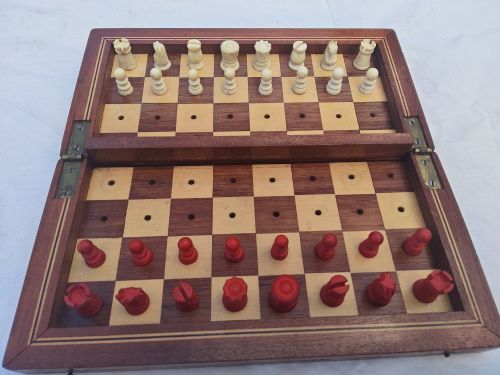
When searching for victorian chess pieces, buyers encounter complete sets and games compendiums originating from the nineteenth century and the Edwardian era. The pieces vary from standard sets to travelling formats housed in mahogany boxes.
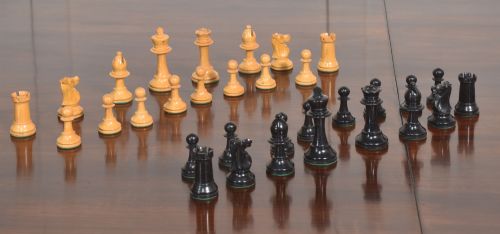
Most sets met on this page belong to the Staunton pattern, fashioned from boxwood and ebonised wood or ebony. Alongside these traditional club and tournament sets, older styles such as the Calvert pattern and Whittington pattern appear.
Makers and retailers like Jaques, F. H. Ayres, and the British Chess Company dominate the better recorded examples. Collectors also find bone sets and rosewood sets dating across the nineteenth century.
Materials and construction
Turned boxwood and ebony form the backbone of these sets, with ebonised wood serving as a common alternative for the darker pieces. Bone and rosewood also provide contrasting tones across different nineteenth century workshops.
Weighted pieces incorporate lead or metal weights beneath felt bases to improve stability during play. Finer sets feature intricate turning on the rooks, knights, and king's coronets.
Factors of quality
The precision of the turning on the knights and the uniformity of the carved crown details distinguish standard production from superior work. Maker attribution through signatures or stamps elevates certain sets significantly.
The preservation of the original finish, alongside intact weighted bases and matching felt underlays, marks the distinction between heavily worn sets and well-preserved survivals.
Jaques·F. H. Ayres·British Chess Company
The Victorian Chess Pieces Glossary
- Staunton pattern
- The standard design of chess pieces introduced in the mid-nineteenth century, characterised by realistic representations on architectural bases. It remains the standard for tournament play today.
- Whittington pattern
- An older nineteenth century design of chess pieces predating the universal dominance of the Staunton style. These pieces display distinct turning and proportions.
- Calvert pattern
- A nineteenth century style of turned chess pieces attributed to makers such as John Calvert. They often feature characteristic bulbous profiles.
- Games compendium
- A multi-game box containing chess pieces alongside draughts, backgammon, and other pastimes. These mahogany or rosewood boxes often feature folding boards.
- Ebonised wood
- Fruitwood or boxwood treated with a black stain to imitate true ebony. It was widely utilised in nineteenth century workshops to keep production costs practical.
Victorian Chess Pieces: Frequently Asked Questions
How do I spot a Jaques set?
Authentic nineteenth century Jaques sets often feature stamped king pieces or original mahogany box labels bearing the maker's details. The knights are typically carved with deep expression and distinct detailing.
Studying the proportion and the turning style of the rooks helps separate genuine workshop output from standard trade copies of the period.
What is a weighted chess set?
Weighted sets contain lead or metal inserts concealed beneath the felt bases during manufacture. This addition gives the pieces a heavier, balanced feel on the board.
Such improvements were particularly valued in competitive play during the late nineteenth century to prevent tipping.
How should I store these pieces?
Store antique sets in dry, temperature-controlled conditions away from direct sunlight to protect the boxwood and ebony finishes. Using a dedicated wooden box or compendium prevents surface abrasions.
Avoid extreme humidity fluctuations, which can cause bone components to split or wooden stems to warp over time.
Are bone sets fragile?
Nineteenth century bone chess sets are delicate and prone to drying out if exposed to harsh light or dry environments. Careful handling during games prevents chipping around the delicate stems and carved details.
Applying occasional specialist wax helps maintain the surface condition of bone pieces without causing staining.