
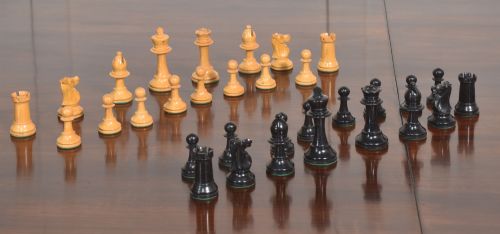


Carved Wooden Chessmen
These carved wooden chessmen are tactile, centuries-old tactical sets that bring weight, history, and craftsmanship to any table.
Carved Wooden Chessmen
When you search for carved wooden chessmen, you are looking at complete sets and boards originating primarily from the Victorian and Edwardian periods.
The versions you are most likely to meet on this page follow the standardised Staunton pattern, though alternative styles such as St George, Calvert Pattern, and miniature sets also appear.
These sets typically arrive complete with their original boxwood and ebonised wood or ebony pieces, housed in games boxes or folding boards.
How they were made
The makers turned and hand-carved these pieces predominantly from dense boxwood paired with contrasting ebony or ebonised wood, sometimes incorporating felt lining on the bases.
Many 19th-century examples utilised lead weighting inside the base to improve stability during play, a technique associated with leading makers of the era.
Carved Wooden Chessmen Retail Price Guide 2026
Typical asking prices for carved wooden chessmen among the pieces listed under this phrase on Sellingantiques today, from the lower quarter to the upper quarter. They describe what is for sale here now, not the wider market.
Every knight in a hand-carved set possesses a distinct facial expression, as carvers rarely made two identical horses.
What varies in quality
Quality in carved wooden chessmen rests in the precision of the turning, the depth of the hand-carved knight heads, and the crispness of the details.
Sets carrying maker attribution or original signature marks command greater interest, while the uniformity of the timber selection and surviving weighted bases elevate the standard of the set.
Jaques·Whitty·British Chess Company·F. H. Ayres·Calvert
The Carved Wooden Chessmen Glossary
- Staunton chess set
- The standard pattern of chess pieces introduced in the mid-19th century, featuring realistic architectural shapes and a crowned rook.
- Boxwood
- A pale, dense wood traditionally used for the white pieces in a chess set.
- Ebonised wood
- Timber treated or stained to imitate the dark appearance of ebony.
- St George
- An earlier English chess set style predating the widespread adoption of the Staunton pattern.
Carved Wooden Chessmen: Frequently Asked Questions
How do I identify a Staunton chess set?
A Staunton chess set is recognised by its standardised, architectural forms where the king wears a coronet and the knights feature carved horse heads. This style became the tournament standard.
Earlier patterns like St George or Calvert look distinctly different, with simpler crown designs and less uniform proportions.
Are these old chess sets weighted?
Many fine 19th-century sets include lead weighting inside the base to give each piece a heavier, more stable feel during play. This was often added by makers to improve the tactile experience.
Unweighted sets feel notably lighter when lifted from the board.
What woods were used for antique chessmen?
Boxwood served as the primary timber for the lighter pieces due to its pale colour and fine grain. Darker pieces were carved from ebony or utilised ebonised wood.
Other materials such as rosewood and bone occasionally appear in specific period sets.
How should I store a wooden chess set?
Keep the pieces in a dedicated games box or a lined folding board away from direct sunlight and dramatic temperature fluctuations. Proper storage prevents the wood from drying out or splitting over time.
Gentle handling preserves the delicate carved details on the knights and rooks.