
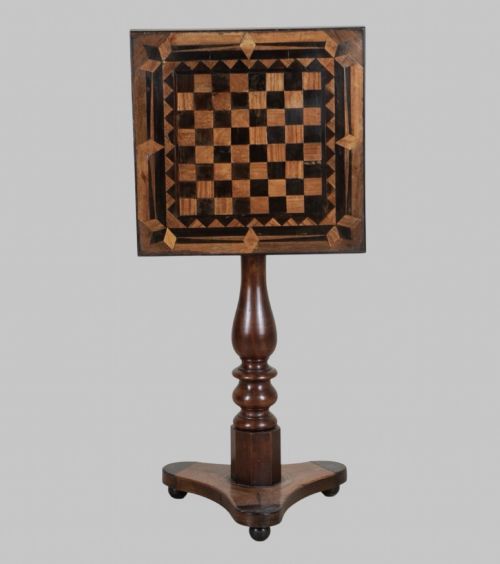
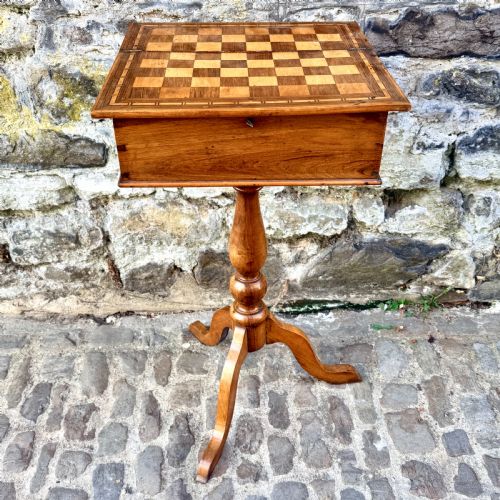


Marquetry Chess Board
These marquetry chess board pieces combine precise wood inlay with enduring tactical utility, offering both a surface for play and a striking decorative centrepiece.
Marquetry Chess Board
A marquetry chess board surface brings together contrasting timbers to form the familiar checkered playing field, often integrated into games tables or folding boards. These objects serve both decorative and functional purposes in historic interiors.
The pieces listed on this page span the Georgian and Victorian eras, alongside specific regional designs like Swedish Biedermeier and French Provincial pieces. Most examples take the form of games tables, occasional tables, or folding boards intended for travel.
Buyers will encounter various configurations, from walnut tripod tables featuring dedicated chess tops to travelling boards equipped with bone or mother-of-pearl accents. Each surviving example demonstrates the enduring popularity of domestic board games throughout the nineteenth century.
How they were made
Cabinet makers utilised a diverse palette of timbers to achieve the tonal contrast required for a marquetry chess board. Walnut, mahogany, boxwood, satinwood, rosewood, and birch provide the natural range of light and dark shades.
Inlayers applied thin veneers of contrasting woods onto a stable underlying structure to create geometric patterns and figurative details. Additional decorative elements occasionally incorporate bone and mother-of-pearl.
Folding portable boards relied on precise wooden hinges and textile or leather joins to withstand repeated opening and closing. Fixed tables integrated the inlaid top into tripod bases or pedestal structures.
What varies in quality
The visual success of a marquetry chess board relies on the precision of the wood selection and the tightness of the joints between contrasting squares. Subtle variations in grain direction and timber choice elevate the visual depth of the playing surface.
Construction methods distinguish standard production items from finer bespoke furniture pieces. The integration of the board into broader furniture forms, such as sewing boxes or tripod lamp tables, demonstrates the maker's structural ambition.
The Marquetry Chess Board Glossary
- Marquetry
- The art of applying pieces of veneer to a structure to form decorative patterns and pictures. Craftsmen select woods of various natural colours to build up the design.
- Parquetry
- Geometric mosaic woodwork using identically shaped tiles of timber. It frequently appears alongside marquetry on the borders of games boards.
- Veneer
- A thin slice of fine timber applied to a coarser underlying wood. This technique allows cabinet makers to display expensive grain patterns economically.
- Tripod Table
- A small occasional table supported by a central pillar and three legs. Many nineteenth-century games tables utilise this configuration for stability.
- Staunton Style
- The standard design of chess pieces introduced in the mid-nineteenth century. Its clear, functional forms became the tournament standard.
Marquetry Chess Board: Frequently Asked Questions
Are all these boards antique?
The selection includes items originating from the Georgian and Victorian periods, alongside nineteenth-century examples from various European regions.
Materials and construction techniques align with the manufacturing standards of those specific eras.
Can I use these for playing games?
Many examples are fully functional tables or folding boards suitable for regular use. Some pieces also include backgammon layouts or storage compartments for gaming sets.
Care should be taken with antique surfaces when playing with heavy or unpadded pieces.
How do I identify the wood types?
Makers relied on timbers such as walnut, mahogany, boxwood, and rosewood to create natural colour contrasts without artificial staining. Light squares often utilise boxwood or satinwood, while darker squares employ walnut or rosewood.
Close inspection of the grain reveals the natural characteristics of each species.
What is the difference between a table and a folding board?
Folding boards were designed for travel and domestic storage convenience, often closing to protect the pieces inside. Tables integrate the playing surface permanently into a piece of furniture intended for a specific room.
Both formats employ similar marquetry techniques for the playing grid.