
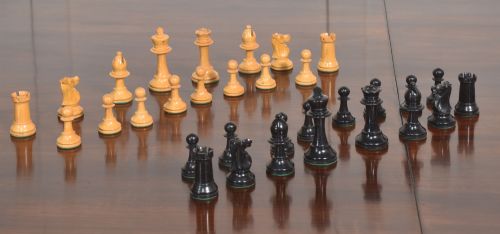


Staunton Chess Set
A staunton chess set brings together balanced form and precise craftsmanship, offering collectors a piece of game history built for actual play.
Staunton Chess Set
A staunton chess set is the definitive pattern for the game, characterised by recognisable, architectural pieces that replaced older styles during the Victorian era. When searching this phrase, buyers encounter complete groupings of sixteen pieces per side, scaled for regulation play and often housed in mahogany boxes or folding boards.
The versions most common on this page date from the late nineteenth century through to the Edwardian period. They span simple club sets to weighted tournament editions, reflecting the standardisation of chess design during that time.
How they were made
Makers shaped boxwood alongside contrasting ebony or ebonised wood on a lathe, turning each piece with sharp profiles and fine details. Many sets incorporate lead weights inserted into the bases to give a heavier, more stable feel during movement across the board.
Undersides frequently feature green or red felt linings to protect the playing surface. Alternative materials such as bone and rosewood appear in specific regional or export variations, adding distinct tactile qualities.
Some nineteenth-century sets still carry the faint scent of old mahogany storage boxes and decades of attic storage.
What varies in quality
The standard of carving in the knight pieces separates standard sets from the finest examples, as horses' heads demand hand-carved detail rather than simple machine turning. King height and precise proportions also define the tier of a set, alongside the presence of original weighted bases and matching wooden storage boxes.
Maker attribution elevates certain sets, particularly those bearing stamps or paper labels from prominent nineteenth-century makers. The consistency of the turning and the preservation of the original finish determine the overall integrity of the set.
Jaques·F H Ayres·British Chess Company·Whitty·Calvert
The Staunton Chess Set Glossary
- Staunton pattern
- The standard design of chess pieces introduced in the mid-nineteenth century, named after the player Howard Staunton. It remains the universal style for tournament play.
- Ebonised wood
- Boxwood that has been stained black to imitate ebony. This technique provided a cheaper alternative while maintaining a stark contrast against natural boxwood.
- Weighted
- Chess pieces fitted with lead weights inside their bases. This addition prevents the pieces from tipping easily during rapid play.
- Boxwood
- A dense, pale wood commonly used for the white pieces in a set. Its fine grain holds sharp carved details exceptionally well.
Staunton Chess Set: Frequently Asked Questions
What defines a genuine staunton chess set?
A genuine staunton chess set follows the standardised design template established in the mid-nineteenth century, where each piece uses architectural motifs like crowns and coronets to denote rank.
The king wears a cross pattée atop a closed royal crown, while pawns feature simple spherical finials atop tapered collars.
How do I know if a set is weighted?
Weighted sets feel noticeably heavy in the hand when picking up individual pieces, rather than feeling hollow or exceptionally light.
Looking beneath the felt base often reveals a lead plug or discernible weight distribution inside the turned wooden core.
Can I play chess with an antique set?
Playing with an antique set is common among enthusiasts, provided the board dimensions match the base width of the pieces.
Care should be taken with older boxwood and ebony pieces to avoid heavy impacts that might chip the fine turned edges or carved knight ears.
What is the difference between ebony and ebonised wood?
Ebony is a naturally dense, dark tropical hardwood used directly for the black pieces in premium sets.
Ebonised wood is pale boxwood treated with a black stain, a common nineteenth-century method that achieves a similar dark appearance at a lower production cost.