


Vintage Chess Pieces
These vintage chess pieces are tactile survivors of past parlours and libraries, offering traditional craftsmanship and enduring strategic play.
Vintage Chess Pieces
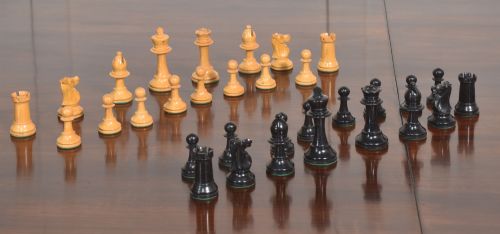
When you search for vintage chess pieces, you encounter sets spanning the Victorian, Edwardian, and George V eras, alongside related items like paperweights and games compendiums. The examples available on this page most commonly appear as traditional wooden sets configured in boxwood and ebony, or ebonised alternatives.
The materials range from bone and brass to mahogany and rosewood, reflecting the diverse manufacturing preferences of the nineteenth and early twentieth centuries. Specific regional patterns emerge across the listings, showing distinct carving traditions from makers like F. H. Ayres and the British Chess Company.
Many survivors are complete sets housed in original boxes or folding boards, while others appear as individual pieces or specialised travel sets. These objects represent a period when games boxes and compendiums were staple fixtures of British domestic life.
How they were made
The construction of these pieces relies heavily on turning dense timbers like boxwood and ebony on a lathe, followed by meticulous hand-carving for intricate details such as knight heads and rooks. Many sets incorporate lead weighting within the base to improve stability during play, a technique often associated with weighted Staunton designs.
Alternative materials such as bone and sterling silver are shaped through carving and casting, utilising natural grain and metal properties to define the form. Ebonised wood provides an accessible dark alternative to ebony, treated with surface finishes to mimic the appearance of heavier tropical hardwoods.
Listings feature wooden, bone, and silver materials across the Victorian, Edwardian, and George V periods.
What varies in quality
The distinction between standard and finer sets lies in the precision of the carving, particularly the execution of the knights and the uniformity of the turned bases. Maker attribution, such as pieces originating from F. H. Ayres or marked by the British Chess Company, tends to indicate higher manufacturing standards and careful material selection.
Completeness and originality also dictate the standing of a set, where matching bases, intact finials, and original weighted components preserve the integrity of the design. The condition of the applied felt undersides and the presence of contemporary storage boxes or compendiums further influence how well a set has endured.
F. H. Ayres·British Chess Company
The Vintage Chess Pieces Glossary
- Staunton pattern
- The standard design for chess pieces introduced in the mid-nineteenth century, characterised by heavily weighted, realistic forms topped with coronets and mitres.
- Ebonised wood
- Timber, typically boxwood, treated with a dark stain or finish to simulate the deep black appearance of genuine ebony.
- Whittington pattern
- A specific nineteenth-century regional style of chess pieces often associated with travelling sets and distinct turning characteristics.
- Calvert pattern
- An early nineteenth-century style of turned bone or wooden chess pieces named after the prominent London maker, featuring stacked ring turnings on the rooks and pawns.
- Games compendium
- A multi-game box containing a chess set alongside other traditional pastimes such as draughts, backgammon, and cribbage.
Vintage Chess Pieces: Frequently Asked Questions
How do I identify a Staunton set?
Staunton sets are recognised by their standardised, architecturally inspired shapes, featuring a cross on the king, a mitre on the bishop, and a carved horse head for the knight. This design became the tournament standard during the Victorian era and dominates surviving collections.
Earlier patterns often featured taller, thinner pieces without standardised crowns or bases, whereas the Staunton design prioritized stability and instant recognition during competitive play.
What is the difference between ebony and ebonised wood?
Genuine ebony is a naturally dense, dark tropical hardwood used for the dark side of finer chess sets. Ebonised wood is typically boxwood that has been stained or painted black to achieve a similar contrast.
Under close inspection, ebonised pieces may show lighter wood beneath minor chips or wear, while true ebony maintains its dark coloration throughout the material.
How were travelling chess sets used?
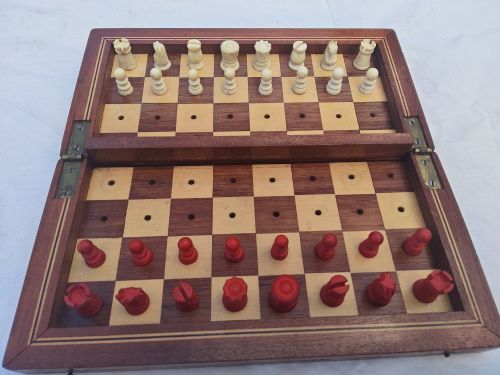
Travelling sets were designed for portability during railway journeys or sea voyages, often incorporating pegged pieces that fitted into drilled board holes or magnetic components to prevent sliding. These sets frequently utilised bone or boxwood housed within folding mahogany or rosewood cases.
Such configurations allowed players to pause a game mid-journey without losing the arrangement of the pieces.
Why are some vintage pieces weighted?
Weighting involves inserting lead or heavy metal slugs into the base of wooden chess pieces to lower their centre of gravity. This manufacturing technique prevents the pieces from tipping over easily during rapid or casual play.
Weighted sets from makers like the British Chess Company were particularly valued for club and tournament environments where stability mattered.
What is a games compendium?
A games compendium is a fitted wooden box containing the equipment for multiple pastimes, including chess, draughts, backgammon, and sometimes cards or dominoes. These multi-tier boxes were popular in Victorian and Edwardian households for evening entertainment.
They often feature folding boards that double as the outer lid of the box, housing all the necessary playing pieces internally.