
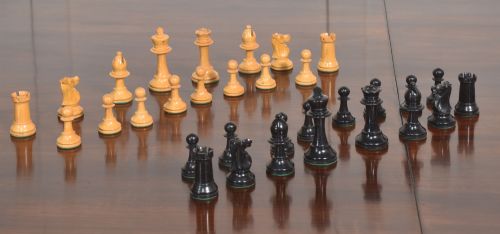


Boxwood Chess Pieces
Boxwood chess pieces offer a dense, pale turned medium that gives classic sets their crisp detail and enduring durability.
Boxwood Chess Pieces
When you search for boxwood chess pieces, you are looking at tactile implements shaped for play across the nineteenth and early twentieth centuries. The sets appearing on this page span the Victorian and Edwardian periods, stretching from the late nineteenth century to around nineteen ten. These include complete chess sets housed with boards or companion pieces in woods like rosewood and mahogany.
The prevailing format you will meet on this page is the Staunton pattern, which became the standard for competitive and library play after its introduction. Alongside these standard tournament forms, you encounter St George patterns and Calvert pattern sets. They range from utilitarian club pieces to weighted library sets designed for regular use.
How they were made
The primary material is boxwood, chosen for its fine grain and pale uniform tone, turned accurately on a lathe to form the distinct profiles of kings, queens, knights and pawns. To create the contrasting black side of the game, makers used natural ebony or applied an ebonised finish to secondary woods. Many pieces incorporate weighted bases containing lead or metal loads beneath baize, felt or green cloth pads for stability during play.
Carving and turning demand high precision, particularly for the intricate undercut knight heads and the delicate openwork finials on rooks and bishops. Makers utilised dense tropical hardwoods alongside native timbers, sometimes incorporating brass in associated boxes or folding boards. Each piece relies on hand-finishing to ensure the proportional balance required for proper handling.
Listings on this site feature nineteenth-century and early twentieth-century boxwood chess sets incorporating ebony, rosewood, and ebonised woods.
What varies in quality
The selection of materials and the presence of makers' signatures or stamps elevate a set. Sets bearing attribution to known makers like Jaques, F. H. Ayres, Whitty or the British Chess Company demonstrate superior execution in weight distribution, felt application and timber selection compared to anonymous workshop output.
Jaques·F. H. Ayres·Whitty·British Chess Company·Calvert
The Boxwood Chess Pieces Glossary
- Staunton pattern
- The standard design of chess pieces introduced in the mid-nineteenth century, featuring architectural forms and a distinctive horse head for the knight. It remains the universal standard for tournament play today.
- Ebonised wood
- Timber treated with a black stain or chemical process to imitate solid ebony. This technique allowed makers to produce contrasting dark chess pieces using more accessible domestic woods.
- St George pattern
- An earlier British chess piece design popular before the dominance of the Staunton pattern, characterised by shorter, sturdier pieces with simpler turrets on the rooks.
- Calvert pattern
- A distinct style of nineteenth-century chess pieces known for slender proportions, distinctive tiered bases and specific mitred slits on the bishops.
- Weighted pieces
- Chess pieces containing internal lead or metal weights in the base to improve stability during movement. This addition provides a satisfying heft during play.
Boxwood Chess Pieces: Frequently Asked Questions
What are boxwood chess pieces?
Boxwood chess pieces are turned wooden gaming pieces carved from dense, pale boxwood timber. They form the light side of traditional chess sets, often paired with dark ebony or ebonised pieces.
These pieces range from everyday club sets to finely carved library sets produced by notable nineteenth-century makers.
How do I identify Staunton chess pieces?
Staunton chess pieces are recognised by their standardised architectural design, where kings wear coronets, queens wear coronets with small balls, and knights feature carved horse heads. The pieces have wide, stable bases designed for practical play.
This pattern replaced earlier styles like the St George because its clear silhouettes reduced confusion on the board.
Why are some chess pieces weighted?
Weighted chess pieces contain lead or metal inserted into their bases to increase their overall heft and prevent them from tipping over easily. This addition gives the pieces a balanced, substantial feel during rapid movement across the board.
Most weighted sets feature green baize or felt on the underside to protect the playing surface.
How do I care for antique chess pieces?
Antique chess pieces should be kept away from direct sunlight and extreme humidity fluctuations to prevent the boxwood from splitting or warping. Gentle dusting with a dry, soft cloth is sufficient for routine maintenance.
Avoid using modern liquid polishes or harsh chemical cleaners, which can damage the original patina and degrade the felt bases.