
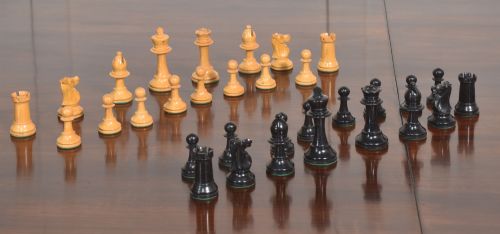


Wooden Chess Pieces
Wooden chess pieces bring tactile weight and history to the board, offering a traditional way to play through classic sets from the nineteenth and early twentieth centuries.
Wooden Chess Pieces
When you search for wooden chess pieces, you encounter complete sets dating from the nineteenth and early twentieth centuries, including Victorian and Edwardian examples. The most frequent finds on this page are Staunton pattern sets, alongside alternative styles such as St George and Calvert patterns.
These sets span full-sized library pieces and smaller travelling or miniature versions, occasionally accompanied by games compendiums or folding boards. They represent the practical and social history of board games from the 1900s, 1910s and preceding decades.
How they were made
Maker workshops turned these pieces predominantly from dense timbers like boxwood, contrasted with ebony or ebonised wood to distinguish the opposing sides. Rosewood and mahogany also appear in specific sets and associated games boxes.
Heavier tournament and library sets frequently incorporate weighting within the base to improve stability during play, complemented by felt undersides to protect the board. Fine detailing is achieved through precise lathe work and hand-carved elements, particularly on knights.
Listings feature nineteenth-century and Edwardian boxwood, ebony, mahogany and brass chess sets and compendiums.
What varies in quality
The degree of hand-carving detail on the knight pieces often separates standard sets from the finest examples, alongside the precision of the turning on rooks and pawns. Finer sets display crisp lines and uniform proportions across every piece on the board.
Maker attribution elevates a set significantly, particularly those bearing the stamps or labels of established nineteenth-century makers. The choice and preservation of contrasting woods, such as genuine ebony paired with rich boxwood rather than ebonised alternatives, also influence the standing of a set.
Jaques·Whitty·British Chess Company·F. H. Ayres·Calvert
The Wooden Chess Pieces Glossary
- Staunton pattern
- The standard design for chess pieces introduced in the mid-nineteenth century, characterised by realistic proportions and architectural king and queen tops. It remains the universal tournament standard today.
- Ebonised wood
- Fruitwood or boxwood treated with a dark stain to imitate ebony. This technique provided a cost-effective alternative for contrasting chess sets.
- Games compendium
- A fitted box containing multiple pastimes, frequently housing chess pieces alongside draughts, dominoes or playing cards. These multi-game sets were popular in Victorian and Edwardian households.
- St George pattern
- A nineteenth-century predecessor to the Staunton style featuring slightly more compact and simplified pieces. They saw widespread use before the Staunton design dominated play.
Wooden Chess Pieces: Frequently Asked Questions
What is a Staunton chess set?
A Staunton chess set is the standard design introduced in the mid-nineteenth century that established uniform shapes for all pieces. These designs prioritised rapid piece recognition during competitive play.
Most antique sets on this page follow this pattern, making them immediately familiar to modern players.
How do I date a wooden chess set?
Dating relies on stylistic shifts in the pieces, particularly the carving of the knight and the coronet of the queen. Packaging, box construction and maker marks also help narrow the decade of manufacture.
Nineteenth and early twentieth-century sets often display specific turning characteristics unique to their period of production.
What is an ebonised chess set?
An ebonised chess set uses a pale timber, such as boxwood, stained black to simulate the appearance of solid ebony. This provided players with a dark set without the expense of heavy tropical hardwood.
Many nineteenth-century sets combined natural boxwood with ebonised partner pieces.
Are antique chess pieces weighted?
Many library and club sets from the late nineteenth century onwards feature internal weighting in the base. This modification added stability during rapid or competitive matches.
Unweighted sets are more common in smaller travelling formats or earlier Victorian productions.