



Traditional Wooden Chessmen
Traditional wooden chessmen offer tactile engagement across the board, uniting period craftsmanship with strategic play.
Traditional Wooden Chessmen
Traditional wooden chessmen encompass sets created primarily during the Victorian and Edwardian eras, spanning the late nineteenth and early twentieth centuries. These objects reflect the golden age of chess design, when standardisation took root alongside traditional hand-turning and carving methods.
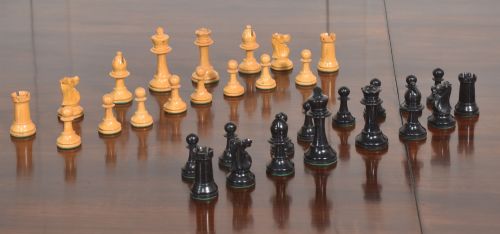
The Staunton pattern dominates these examples, establishing a universally recognised architecture for the pieces that persists today. Alongside these, alternative regional patterns such as the Calvert design appear, offering distinct carved interpretations of standard forms.
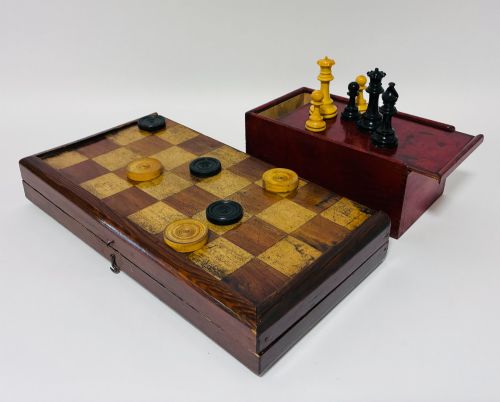
Complete sets frequently integrate folding boards or dedicated presentation cases, bringing together the pieces and their playing surface. Materials range from light boxwood paired with dark ebony to ebonised alternatives and rosewood.
How they were made
Turners shaped boxwood, ebony, and rosewood on lathes to create the characteristic stems and finials of each piece, applying detailed hand-carving to knights and rook turrets. Ebonised wood served as a practical alternative to solid ebony for darker pieces.
Base weighting involved inserting lead or metal loads into the undersides of pieces during manufacture to improve stability during play, often finished with green or red baize linings.
Traditional Wooden Chessmen Retail Price Guide 2026
Typical asking prices for traditional wooden chessmen among the pieces listed under this phrase on Sellingantiques today, from the lower quarter to the upper quarter. They describe what is for sale here now, not the wider market.
Many antique knights bear distinct hand-carved expressions, meaning no two horses share the exact same temperament.
What varies in quality
The selection and matching of dense hardwoods dictate the visual harmony of a set, where uniform grain and deep contrast between light and dark sides elevate the overall standard.
F. H. Ayres·British Chess Company
The Traditional Wooden Chessmen Glossary
- Staunton pattern
- The standard design for chess pieces introduced in the mid-nineteenth century, defined by architectural forms and a heavily detailed knight. This style remains the tournament standard.
- Ebonised wood
- Boxwood or another pale timber treated to imitate the deep black appearance of solid ebony. It provided an economical alternative for darker chess pieces.
- Baize
- A woven woollen fabric attached to the underside of chess pieces to protect the board surface. It reduces friction and sound during play.
- Weighted
- Pieces containing internal lead or metal weights in the base to provide balance and stability. This prevents tipping during rapid movement across the board.
Traditional Wooden Chessmen: Frequently Asked Questions
What defines a Staunton chess set?
The Staunton pattern relies on standardised, architectural forms designed for instant recognition during competitive play. Each piece reflects specific symbols of authority or military rank, topped by the iconic horse head knight.
Introduced in the Victorian period, this design quickly displaced eclectic regional patterns. Its balanced proportions remain the global standard for chess sets today.
Why are some pieces weighted?
Internal weights added stability during competitive matches, preventing pieces from tipping over when moved quickly across the board. Lead or metal inserts were sealed into the base beneath the baize lining.
Heavier pieces offer a more substantial tactile experience during play. This feature typically indicates higher quality production.
How do boxwood and ebony compare?
Boxwood provides the pale, creamy material used for the white pieces in traditional sets. Its fine grain accepts intricate turning without splitting.
Ebony offers a dense, dark contrasting wood for the black pieces. Alternatively, ebonised boxwood achieves a similar dark appearance at a lower cost.
How should I store these chessmen?
Keep wooden chess sets away from direct sunlight and fluctuating humidity to prevent timber from cracking or warping. Storing them in dedicated wooden boxes or folding boards lined with fabric protects the delicate carved details.
Regular handling actually helps maintain the patina of the wood through natural oils from the hands. Avoid harsh chemical polishes when cleaning.