

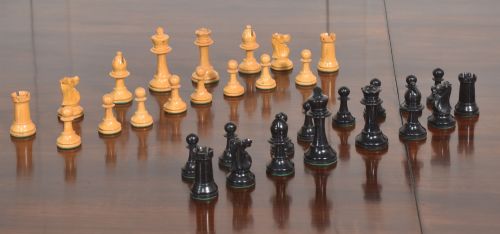


Vintage Staunton Chess Set
A vintage staunton chess set brings traditional English craftsmanship and functional history straight to the table.
Vintage Staunton Chess Set
A vintage staunton chess set represents the definitive standard for competitive and social play established during the Victorian era. These sets appear primarily in forms combining natural boxwood alongside ebonised wood or rich ebony, often housed with folding boards.
Most examples found here date from the late nineteenth century through to the Edwardian period. Buyers encounter both standard club sizes and substantial library editions, occasionally featuring weighted pieces for improved stability during play.
Maker-marked sets carry particular significance, alongside distinct regional variations such as Calvert pattern pieces. The standard design balances practical handling with formal architectural dignity across every rank.
How they were made
Turned boxwood provides the pale pieces, contrasted with dark counterparts carved from dense ebony or treated ebonised wood. Master turners shaped each knight by hand, giving every set its own individual character within the staunton design rules.
Heavier tournament sets incorporate internal lead weights beneath green felt bases to prevent tipping during rapid games. Craftspeople utilised durable rosewood and mahogany for companion folding boards and storage boxes.
Vintage Staunton Chess Set Retail Price Guide 2026
Typical asking prices for vintage staunton chess set among the pieces listed under this phrase on Sellingantiques today, from the lower quarter to the upper quarter. They describe what is for sale here now, not the wider market.
Listings feature traditional materials including boxwood, ebony, rosewood, and brass across the Victorian and Edwardian periods.
What varies in quality
Makers who stamped their boxes or weighted their pieces achieved a higher grade of manufacture intended for serious clubs and libraries. Material selection also defines value, distinguishing plain ebonised boxwood from dense natural ebony.
Whitty·British Chess Company·F. H. Ayres·Calvert
The Vintage Staunton Chess Set Glossary
- Staunton pattern
- The standard design of chess pieces created in the mid nineteenth century, characterised by architectural motifs and clear hierarchies. This style remains the universal template for tournament play today.
- Ebonised wood
- Fruitwood or boxwood treated with a dark stain to imitate genuine ebony. This technique offered an affordable alternative for nineteenth-century players.
- Calvert pattern
- A specific nineteenth-century style of chess pieces associated with a prominent London maker. These sets feature distinct crown details and robust proportions.
- Weighted set
- Chess pieces containing lead weights in their bases to improve stability during movement. This addition became essential for competitive club play.
Vintage Staunton Chess Set: Frequently Asked Questions
How do I date a staunton chess set?
Examine the turning style of the rooks, the height of the king, and the character of the carved knights. Subtle shifts in crown design and base proportions help narrow down the decade of production.
Material choices also offer clues, as certain woods and staining methods belong strictly to Victorian or Edwardian manufacturing traditions.
Why are some pieces heavier than others?
Many nineteenth-century sets were weighted with lead to improve balance and prevent the pieces from tipping during matches. This upgrade was standard for serious club and library sets.
Unweighted sets tend to be lighter and were often produced for travel or domestic social play.
What is a Calvert pattern set?
The Calvert pattern refers to a specific nineteenth-century design style produced by prominent makers. These pieces are celebrated by collectors for their unique craftsmanship and distinct proportions.
They represent a sought-after variation within standard antique chess collecting.
Can I play with an antique chess set?
These sets were built for practical use and handle regular games well provided they are treated with care. Many players enjoy experiencing the weight and tactile feel of nineteenth-century boxwood during matches.
Store the pieces securely in a lined box or folding board when not in use to protect the original finish.