
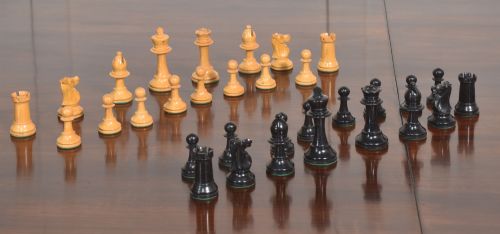


Boxwood Chess Set
A boxwood chess set brings tactile history to the table, offering finely turned pieces from the nineteenth and early twentieth centuries for daily play.
Boxwood Chess Set
A boxwood chess set most frequently appears in the familiar Staunton pattern, alongside alternative nineteenth-century styles such as St George, Calvert and Edinburgh Upright. These sets originate primarily from the Victorian and Edwardian eras, spanning the late nineteenth century into the early decades of the twentieth.
The pieces are found paired with ebony or ebonised wood for the dark side, housed in fitted mahogany or wooden storage boxes and occasionally accompanied by folding boards. The standard configurations range from modest library sets up to large four-inch weighted tournament examples.
Materials and turning
Makers turned pale boxwood on lathes to shape the dense, pale timber into knights, rooks and kings, often contrasting it against dark ebony or staining common wood to imitate it. Felt was frequently applied to the bases of the pieces to protect the board during movement.
Heavier tournament sets incorporated lead weights sealed into the bases during manufacture to improve stability during rapid play. Master makers carved intricate details by hand, particularly on the knight pieces, which serve as the primary indicator of workshop origin.
Some nineteenth-century knights carry such distinct facial expressions that players swear their horses have individual personalities.
Craftsmanship and distinction
Quality rests upon the precision of the turning and the depth of hand-carving on the knight heads, where master workshops achieved lively expressions and uniform proportions across the set. The presence of lead weighting and original storage boxes elevates the standing of a set.
Makers' stamps or signatures impressed into the top rook or box distinguish institutional workshop output from unmarked commercial production of the period.
Jaques·F. H. Ayres·Whitty·British Chess Company·Calvert
The Boxwood Chess Set Glossary
- Staunton pattern
- The standard design for chess pieces introduced in the mid-nineteenth century, characterised by architectural king and queen forms and horse-head knights. It remains the universal standard for tournament play today.
- Ebonised wood
- Ordinary timber, frequently fruitwood or boxwood, treated with a dark stain or polish to imitate ebony. This offered a cost-effective alternative for the dark pieces in a set.
- St George pattern
- A nineteenth-century predecessor to the Staunton design featuring shorter, simpler pieces without heavy bases. It was widely used in English clubs before the Staunton pattern took dominance.
- Calvert pattern
- A distinct nineteenth-century style of turned chess pieces associated with the London maker Calvert. The pieces feature characteristic stacked collar details and distinctive crown motifs.
Boxwood Chess Set: Frequently Asked Questions
How do I date a chess set?
Dating relies on the style of the pieces, turning characteristics, and any makers' marks stamped on the wood or boxes. The introduction of the Staunton pattern in the mid-nineteenth century provides a firm starting point for the majority of sets.
Secondary clues include the presence of original mahogany storage boxes, the type of green felt on the bases, and whether the set incorporates lead weights for stability.
Are these sets suitable for playing?
These sets were built for practical use and handle regular play remarkably well. Weighted pieces offer a particularly satisfying feel on the board during a match.
Care should be taken to store them in dry conditions within a lined box to protect the boxwood and ebony from humidity shifts.
What is the difference between ebony and ebonised pieces?
Ebony is a naturally dense, dark tropical hardwood used for the dark pieces in higher-end luxury sets. Ebonised wood is a lighter timber, typically boxwood, stained black to achieve the same visual contrast.
Close inspection of the grain and any minor wear points reveals whether the dark colour is natural timber or surface stain.
Why are some pieces weighted?
Weighting was introduced to prevent pieces from tipping over easily during vigorous club or tournament play. Lead pellets or inserts were sealed into the hollowed bases of the boxwood and ebony.
Weighted sets feel notably heavier in the hand and indicate a higher grade of manufacture intended for serious players.