

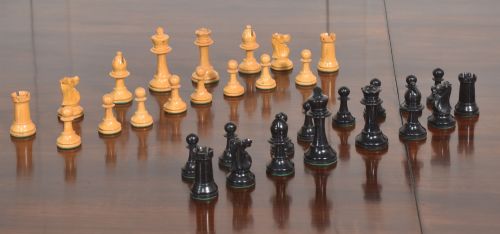


Traditional Wooden Chess Set
A traditional wooden chess set offers tactile weight and history, bringing craftsmanship to the table.
Traditional Wooden Chess Set
A traditional wooden chess set comprises carved playing pieces and folding or rigid boards originating primarily from the Victorian and Edwardian eras. These sets often follow the standard Staunton pattern or historical regional variations, designed for library or travel use.
Buyers will most frequently encounter nineteenth-century sets fashioned from boxwood and ebonised wood or ebony. Alongside complete chess sets, the selection includes games compendiums and folding travelling boards with integrated storage.
Originating from British workshops and makers active around eighteen ninety to nineteen ten, these sets combine utility with classic aesthetic proportions. They represent a functional tradition of parlour and library gaming.
How They Were Made
The pieces are turned on a lathe from dense hardwoods such as boxwood, paired with darker woods like ebony or ebonised wood for the contrasting side. Many sets incorporate lead weighting within the bases to improve stability during play.
Bases are typically lined with baize or felt to protect the board surface. Specialised patterns like the Calvert or Staunton designs require intricate hand-carving for details such as the knight's head and the finials of the crown.
Traditional Wooden Chess Set Retail Price Guide 2026
Typical asking prices for traditional wooden chess set among the pieces listed under this phrase on Sellingantiques today, from the lower quarter to the upper quarter. They describe what is for sale here now, not the wider market.
What Varies in Quality
Quality rests in the precision of the turning and the consistency of the hand-carved details across the entire army, particularly the knights. Finer sets display balanced proportions, crisp detailing in the coronets, and uniform wood grain.
The presence of maker attribution, such as works by F. H. Ayres or the British Chess Company, elevates the standing of a set. Materials also dictate grade, with genuine ebony and weighted bases commanding greater regard than unweighted ebonised alternatives.
F. H. Ayres·British Chess Company
The Traditional Wooden Chess Set Glossary
- Staunton pattern
- The standard design for chess pieces introduced in the mid nineteenth century, featuring realistic horse head knights and architectural pieces. This style remains the tournament standard today.
- Ebonised wood
- Fruitwood or boxwood treated with a dark stain to imitate genuine ebony. It provides a durable, uniform black surface for the darker pieces.
- Games compendium
- A fitted box containing equipment for multiple parlour games, such as chess, backgammon, and draughts. These multi-game sets were popular in Victorian and Edwardian households.
- Weighted
- Chess pieces fitted with lead weights inside the base to improve balance and tactile feel during movement. Weighting is a hallmark of better quality nineteenth-century sets.
- Calvert pattern
- An earlier nineteenth-century British chess set style characterised by distinctive turned forms and simplified, sturdy knights. Named after the prominent London maker.
Traditional Wooden Chess Set: Frequently Asked Questions
What is a Staunton chess set?
A Staunton chess set is the traditional design established in the Victorian era with standardised, easily recognisable pieces. The design ensures clear identification of each piece during play.
This pattern became the universal standard for competitive and casual play alike, replacing various regional English and European styles.
How do I identify the age of a set?
Age is determined by the turning style of the pieces, the type of wood used, and any maker marks on the box or board. Nineteenth-century sets often feature distinct crown details and patination on the boxwood.
Comparing the knight carvings and base weighting against documented period examples helps narrow down the decade of manufacture.
Were these sets used for travel?
Many nineteenth-century sets were specifically constructed as travelling chess boards with folding wooden cases. These compact boards often stored the pieces securely inside when folded.
Travelling sets usually featured smaller dimensions and sometimes peg-in pieces to prevent shifting during transit.
Are older wooden chess sets durable?
Hardwoods like boxwood and ebony are exceptionally resilient and withstand regular handling over generations. Proper care involves maintaining stable humidity to prevent wood movement.
Felt bases and original wooden storage boxes protect the pieces from unnecessary wear when not in active use.