
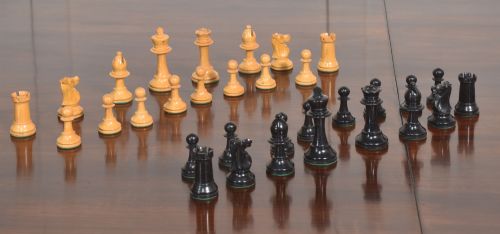


Carved Wooden Chess Pieces
These carved wooden chess pieces span the Victorian and Edwardian eras, offering tactile strategy and timeless design for any collector of games.
Carved Wooden Chess Pieces
When you search for carved wooden chess pieces, you encounter complete sets housed in games compendiums or accompanied by folding boards from the nineteenth and early twentieth centuries. These encompass functional sets designed for serious play as well as miniature variants suited for travel.
The dominant form on this page follows the standardised Staunton pattern, alongside alternative historical designs such as the St George and Calvert patterns. Sets frequently appear in matching boxwood and ebony, or boxwood and ebonised wood configurations, spanning periods from the Victorian era through the Edwardian period.
How they were made
Craftsmen utilised dense timbers such as boxwood, ebony, rosewood, and mahogany, turning and hand-carving individual pieces on a lathe before applying weighted bases for stability during play. Lighter pieces typically retain natural boxwood tones, while darker counterparts employ genuine ebony or utilise ebonised wood treatments.
Detailed carving defines the knights and ornate rook turrets, while green felt underlining frequently cushions the base of each piece. Maker attribution often appears through stamped signatures on specific pieces or incorporated labels within associated games boxes.
Miniature Edwardian chess sets packed tiny wooden armies into travel boxes for journeys by train.
What varies in quality
Quality rests in the precision of the turning and the depth of hand-carving, particularly visible in the individual expression and detail of the knight pieces. Finer sets display consistent proportions across all thirty-two pieces, sharp crown and mitre incisions, and well-balanced weighting.
The choice of contrasting woods elevates a set, with genuine ebony and fine boxwood sitting above ebonised alternatives. Associated storage quality also plays a role, with fitted mahogany games boxes or compendiums enhancing the overall standing of the set.
Jaques·Whitty·British Chess Company·F. H. Ayres·Calvert
The Carved Wooden Chess Pieces Glossary
- Staunton pattern
- The standard design for chess pieces introduced in the mid nineteenth century, featuring realistic architectural forms for major pieces. This style remains the tournament standard today.
- Boxwood
- A dense, pale wood commonly utilised for the light side in nineteenth century chess sets. It provides a smooth surface for intricate turning.
- Ebonised wood
- Timber treated to imitate the deep black appearance of genuine ebony. It offers a cost-effective alternative in many Victorian sets.
- Games compendium
- A fitted box containing multiple traditional parlour games alongside chess, often featuring folding boards and specialised compartments. These date extensively to the Victorian and Edwardian periods.
- Calvert pattern
- A distinct nineteenth century British style of chess piece featuring specific geometric cuts and characteristic finials. Sets in this pattern are collected for their regional design variation.
Carved Wooden Chess Pieces: Frequently Asked Questions
How do I date a chess set?
Dating relies on stylistic clues, proportions, and any associated maker marks stamped on the wood or containers. Victorian sets often display distinctive turning characteristics that separate them from Edwardian examples.
Material choices and the presence of weighted bases also help narrow the period of manufacture, moving from mid nineteenth century conventions toward 1900 standards.
Are these pieces suitable for regular play?
Many antique sets remain entirely functional for everyday matches, particularly weighted examples designed for stability. Care should be taken during handling to protect older finishes and delicate carved details like knight ears.
Storing pieces in appropriate folding boards or games boxes prevents unnecessary wear between matches.
Why do some pieces have felt underneath?
Green felt applied to the base of chess pieces protects both the timber of the pieces and the polished surface of the chess board during movement. This addition indicates a level of quality and thoughtful domestic use.
Original felt linings add authenticity to antique sets from the nineteenth and early twentieth centuries.