


Vintage Chess Compendium
A vintage chess compendium is a fitted box housing boards and pieces for multiple parlour pastimes, prized for combining social entertainment with fine cabinetmaking.
Vintage Chess Compendium
When you search for a vintage chess compendium, you are looking at multi-game boxes and travelling sets dating from the nineteenth and early twentieth centuries. These pieces encompass fitted games compendiums, travelling chess sets, and dedicated games boxes arranged for chess, backgammon, and other pursuits.
The versions you are most likely to meet on this page span the Victorian and Edwardian eras, alongside pieces from the nineteen-thirties. They range from large mahogany and burr walnut boxes equipped for multiple games down to miniature travelling chess sets housed in leather cases.
Many examples combine a chess set with backgammon interiors or boards made from materials such as mother-of-pearl and wood. Whether large stationary boxes or compact bone sets in Whittington patterns, each piece reflects the Victorian appetite for parlour amusements.
How they were made
Cabinetmakers constructed these boxes using timbers like mahogany, walnut, and oak, frequently employing burr walnut veneers to create rich figured surfaces. Brass mounts, hinges, and locks provided durable hardware for frequently opened compartments.
The chess pieces themselves were typically turned from boxwood and ebony, or carved from bone. Weighted Staunton sets demonstrate precise lathe work and lead ballasted bases designed for stable play during travel or at home.
What varies in quality
Quality rests upon the skill of the cabinetmaker and the material selection within the box. Superior examples feature well-figured burr walnut, flawless mahogany, and complex internal partitions that securely house every gaming component without rattles.
Turned and carved pieces show distinction in the crispness of their details, such as the distinct eyes of knights and the uniform height of pawns. Maker attribution, as seen in signed Staunton sets by established makers, elevates a compendium above standard workshop production.
F. H. Ayres
The Vintage Chess Compendium Glossary
- Staunton pattern
- A standardised style of chess piece introduced in the mid-nineteenth century featuring realistic head designs for pieces and a heavily weighted base. This design became the tournament standard worldwide.
- Compendium
- A single fitted box containing equipment for multiple games such as chess, checkers, and backgammon. These boxes often feature multiple lifting trays and folding boards.
- Whittington pattern
- A specific nineteenth-century design of carved bone chess pieces with distinctive proportions and turning styles. They are frequently found in mahogany travelling boxes.
- Burr walnut
- A veneer sliced from the grotesque growths on walnut trees, prized for its swirling grain patterns. It was widely used on high-grade Victorian games boxes.
- Travelling chess set
- A compact chess set designed for use on journeys, often featuring peg-in-hole boards or magnetic bases to keep pieces secure. They are typically housed in small wooden or leather cases.
Vintage Chess Compendium: Frequently Asked Questions
What games are in a compendium?
A typical compendium houses equipment for chess, backgammon, and draughts, often incorporating folding boards and miniature dice. Some larger boxes include cards, cribbage boards, and dominoes.
Interior trays lift out to reveal layered compartments designed to keep every accessory neatly organised and protected during storage.
How do I date a set?
Dating relies on timber choices, brass hardware styles, and the specific design of the chess pieces. Victorian boxes often display heavy brass locks and burr walnut veneers, while Edwardian pieces show lighter construction.
Makers' stamps or catalogue labels found inside the box lid also provide precise chronological markers for identification.
Were these used for travel?
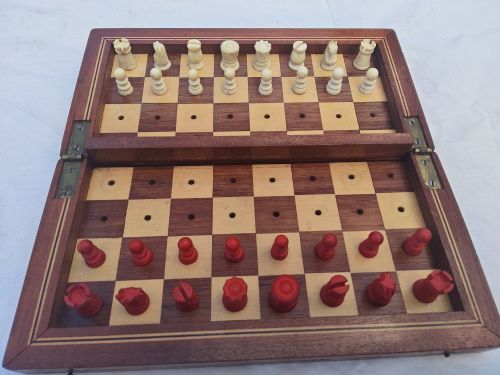
Many smaller sets were built specifically for journeys, featuring ingenious mechanisms to prevent pieces from shifting. Travelling chess sets often utilised peg-in-board designs where each piece has a pin fitting into a drilled square.
Leather cases and compact folding boxes allowed Victorian travellers to carry their games across trains and ocean liners.