
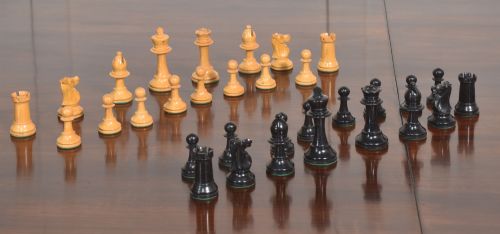


Victorian Wooden Chess Set
These Victorian wooden chess set pieces offer tactical history and tactile play, forged from dense boxwood, ebony, and rosewood for the serious collector.

Victorian Wooden Chess Set
A victorian wooden chess set comprises matching armies of hand-turned playing pieces, most frequently encountered in the iconic Staunton pattern alongside St George and Calvert variations. These sets date from the nineteenth century, including Victorian and Edwardian periods, and often form part of broader games compendiums or boxes.
The materials span boxwood and ebony, alongside ebonised wood, rosewood, and mahogany. Many sets include original felt bases or weight within the turned wooden bases to improve handling during play.
Comprising complete armies for two players, these sets occasionally appear alongside folding chess boards or games boxes featuring backgammon interiors. The forms range from standard club sizes to grand weighted tournament sets by known makers.
How they were made
Turners shaped boxwood against contrasting dark woods such as ebony and rosewood on a lathe, cutting intricate details into knights, rooks, and kings. Ebonised wood served as an accessible alternative to solid ebony for the darker pieces.
Makers added lead weights into the hollowed bases of pieces to improve stability during matches, securing them with green felt underneath. Skilled carvers also utilised mother of pearl for specialised boards and compendiums.
What varies in quality
The precision of the lathe work dictates the quality of a set, particularly in the carving of the knight heads and the symmetry of the rook turrets. Maker attribution also elevates a set, with pieces bearing stamps or signatures commanding stronger interest.
Subtle differences in wood selection and the retention of original weighted felt bases separate standard sets from superior tournament examples. The inclusion of fitted games boxes or compendiums adds further substance to the piece.
Jaques·Whitty·British Chess Company·F. H. Ayres·Calvert
The Victorian Wooden Chess Set Glossary
- Staunton pattern
- The standard design for chess pieces introduced in the nineteenth century, featuring realistic carved knights and clear hierarchical forms. This style became the official tournament standard worldwide.
- Boxwood
- A dense, pale wood utilised for the light side of chess sets due to its smooth grain and durability. It takes fine detail remarkably well on the lathe.
- Ebonised wood
- Timber treated to imitate solid ebony, providing a deep black finish for the dark pieces in a set. It offers a uniform appearance across all pieces.
- Games compendium
- A multi-game box housing chess, backgammon, and other pastimes within fitted wooden compartments. These boxes often feature burr walnut or rosewood construction.
Victorian Wooden Chess Set: Frequently Asked Questions
What woods were used for these sets?
Boxwood served as the primary material for the light pieces, paired with darker woods such as ebony, rosewood, or ebonised wood. Mahogany and burr walnut frequently appeared in the accompanying games boxes and boards.
The choice of timber directly affected the weight and contrast of the set during play, with dense tropical hardwoods prized for their durability.
Were these sets weighted for play?
Many nineteenth-century sets incorporated lead weights inside the turned wooden bases to improve balance and prevent tipping during fast matches. These weighted pieces usually retain their original felt pads underneath.
Lighter unweighted sets also exist from the period, typically intended for travel or casual home use rather than club play.
How should I store an antique chess set?
Keep wooden pieces away from direct sunlight and sudden humidity shifts to prevent the boxwood and ebony from splitting or warping. Storing them in a dedicated games box or lined compartment protects the delicate turns and carved knight ears.
Avoid plastic bags or sealed containers that trap moisture against the antique wood and original felt undersides.