
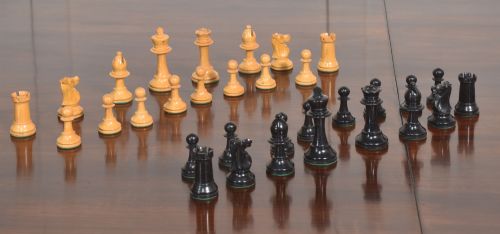


Carved Boxwood Chess Set
A carved boxwood chess set brings tactile heft and period character to the table, combining natural boxwood with contrasting dark timbers.

Carved Boxwood Chess Set
A carved boxwood chess set represents the pinnacle of board gaming history, featuring prominently in Victorian and Edwardian parlours. When searching for a carved boxwood chess set, collectors encounter complete sets designed for library or parlour use.
The pieces span the nineteenth century up to the Edwardian era, predominantly showcasing the influential Staunton pattern alongside St George and Calvert variations. These sets frequently pair pale boxwood with ebonised wood or deep ebony.
Completions often arrive housed in mahogany slide-top boxes or folding wooden boards equipped with internal storage. The surviving examples demonstrate the enduring popularity of British craftsmanship from these periods.
Evaluating craftsmanship and distinction
The finesse of the knight carvings separates standard sets from masterworks, as these pieces required hand-carving rather than lathe-turning alone. Uniformity in the turning of rooks, pawns and crown details indicates disciplined workshop production.
Maker attribution elevates a set significantly, particularly when bearing signatures or stamps from recognised nineteenth-century makers. The presence of original fitted boxes and balanced weighting further distinguishes superior examples.
Current listings feature boxwood combined with ebony, mahogany, and brass across nineteenth-century and Edwardian periods.
Jaques·Whitty·British Chess Company·F. H. Ayres·Calvert
The Carved Boxwood Chess Set Glossary
- Staunton pattern
- The standard design for chess pieces introduced in the mid-nineteenth century, characterised by architectural motifs for major pieces and heavily weighted bases. This pattern remains the tournament standard today.
- Boxwood
- A dense, pale yellow wood favoured by turners for intricate detail work and durability.
- Ebonised wood
- Timber treated with a dark stain or finish to imitate true ebony.
- Baize
- A woven woolen material used to line the underside of chess pieces.
- St George pattern
- An earlier British chess piece style preceding the universal adoption of the Staunton design.
Carved Boxwood Chess Set: Frequently Asked Questions
How do I date a chess set?
Dating relies on stylistic markers such as the transition from St George patterns to standardised Staunton designs during the Victorian era. Material choices, box construction, and maker stamps also provide reliable chronological evidence.
Comparing the turned details of rooks and the carving style of knight horse heads helps narrow the production window to specific decades.
What is a weighted chess set?
A weighted set contains lead or metal weights inserted into the base of each piece during manufacture. This addition lowers the centre of gravity, preventing the pieces from tipping easily during play.
Weighted pieces feel substantial in the hand and indicate a higher quality nineteenth-century production standard.
Are original boxes important?
Original mahogany slide-top boxes or hinged wooden cases significantly enhance the historical integrity of a set. They often bear maker labels or retailer stamps that confirm the origins of the pieces.
Finding a complete set housed in its period container is uncommon and preferred by serious collectors.
How should I store my chess set?
Store pieces in a dry environment away from direct sunlight to prevent the boxwood and ebony from splitting or fading. Keeping them in a lined wooden box or displayed on a dedicated board minimises handling wear.
Avoid extreme temperature fluctuations which can damage historical wood finishes and felt bases.