
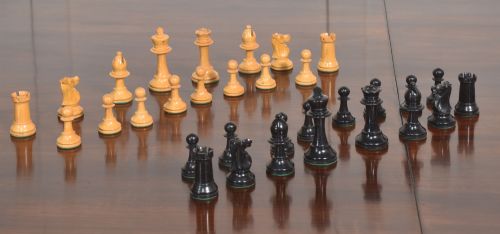


Boxwood Staunton Chess Pieces
These boxwood staunton chess pieces are classic nineteenth and early twentieth century sets offering traditional design and tactile timber play.
Boxwood Staunton Chess Pieces
When you search for boxwood staunton chess pieces, you encounter traditional sets dating from the nineteenth and early twentieth centuries, spanning the Victorian and Edwardian eras. These sets follow the standard staunton pattern designed for clear recognition during play, utilising distinctive architectural forms for each piece.
The most common examples on this page pair natural pale boxwood with contrasting dark ebony, ebonised wood or rosewood. You will find sets presented in fitted wooden boxes or accompanied by folding chess boards designed for convenient storage and play.
How they were made
The pieces are turned from dense hardwoods on a lathe, shaping the distinctive collars, stems and finials characteristic of the pattern. Lighter pieces utilise pale boxwood, whilst darker counterparts employ ebony, rosewood or ebonised wood to establish the essential two-tone contrast.
Some folding chess sets accommodate both chessmen and draft pieces within a single portable wooden case.
What varies in quality
Quality rests in the precision of the turning and the crispness of the carved details, particularly evident in the intricate mane and expression of the knight. Finer sets display balanced proportions and consistent heights across every rank, maintaining strict uniformity within each team.
The choice of materials and the presence of makers' signatures or weighted bases elevate a set above standard production. Maker attribution and original containment, such as designated wooden boxes, mark out superior examples from ordinary utilitarian sets.
Jaques·Whitty·British Chess Company·F. H. Ayres·Calvert
The Boxwood Staunton Chess Pieces Glossary
- Staunton
- The standard pattern of chess pieces introduced in the mid nineteenth century, featuring distinct, recognisable architectural forms for each rank. This design quickly became the universal standard for tournament and domestic play.
- Boxwood
- A dense, pale yellow hardwood traditionally used for the lighter pieces in a chess set due to its fine grain and smooth finish. It takes detailed lathe turning exceptionally well.
- Ebonised
- Common timber, such as fruitwood or boxwood, treated and stained to imitate the dark appearance of ebony. This technique provided a cost-effective alternative for the dark pieces.
- Baize
- A soft woollen fabric applied to the underside of chess piece bases to cushion movement. It prevents scratching on wooden boards.
- Weighted
- Pieces fitted with internal lead weights to increase stability during play. This addition gives each piece a substantial feel in the hand.
Boxwood Staunton Chess Pieces: Frequently Asked Questions
How do I identify a staunton chess set?
Staunton sets are identified by their standardised, highly recognisable forms, such as the royal coronet on the king and queen and the carved horse head for the knight. These designs were created to ensure players could easily distinguish each piece during a match.
Most sets following this standard also include weighted bases and distinct proportions that remain consistent across nineteenth and early twentieth century examples.
What woods are used for antique chess pieces?
Antique sets predominantly pair pale boxwood for the white pieces with dark ebony, rosewood, or ebonised wood for the black pieces. These dense timbers were chosen for their durability and smooth texture during frequent handling.
Alternative dark woods appear occasionally, reflecting the specific timber supplies available to nineteenth century makers and workshops.
Are older chess sets weighted?
Many better quality nineteenth century sets feature weighted bases, containing lead or heavy materials to improve stability on the board. This addition prevents the pieces from tipping easily during fast-paced play.
Unweighted sets also exist from the same periods, often representing more utilitarian or travel-sized editions.
How should I store antique chess pieces?
Store your pieces in a dry environment away from direct sunlight to prevent the timber from fading, warping, or cracking over time. Many sets survive alongside their original fitted wooden boxes designed specifically for this purpose.
Handling the pieces with clean hands preserves the natural patina of the boxwood and ebony surfaces.