
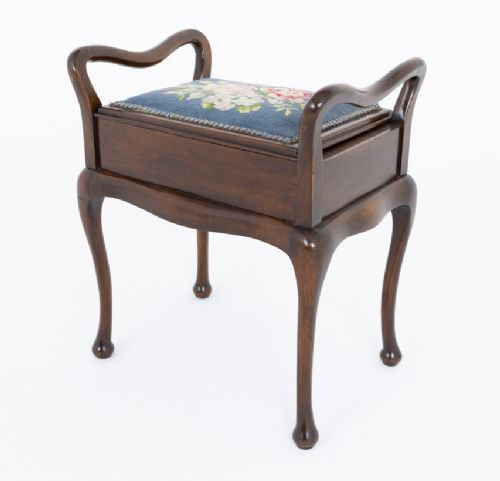


Antique Sheet Music Seat
An antique sheet music seat is a practical music room essential offering hidden storage or duet seating, prized for rich mahogany timbers and fine Edwardian craftsmanship.
Antique Sheet Music Seat
When you search for an antique sheet music seat, you are looking at specialised seating designed for musicians at the piano or duet bench. These pieces take the form of piano stools, duet stools, and music stools originating from the eighteenth century through to the nineteen twenties.
The version you are most likely to meet on this page is the Edwardian mahogany piano stool, often dated around nineteen hundred or nineteen ten. These examples frequently incorporate boxwood inlay or lift-up upholstered seats for holding scores.
Earlier pieces from the Victorian and Georgian eras also appear, including walnut upholstered fall front piano stools and oak items built in the Jacobean revival style. Alongside these, late Victorian duet stools and Georgian mahogany stools in the Chippendale manner represent the broader range of forms available.
How they were made
Makers constructed these music seats primarily using solid mahogany, walnut, and oak timbers. Workshops often enhanced the mahogany frames with delicate boxwood inlay, particularly on Edwardian pieces.
Upholstery played an essential role in the construction, utilising fabrics, velvet, and tapestry to create comfortable padded tops. Brass hardware appeared on hinges and fall-front mechanisms, allowing secure access to internal compartments for sheet music.
The secret compartments inside these seats have preserved forgotten nineteenth-century waltzes for decades.
What varies in quality
The refinement of the timber and the precision of the inlay set the finer examples apart from simpler utilitarian pieces. Crisp boxwood stringing and well-figured mahogany grain indicate higher workshop standards.
The sophistication of the mechanism also distinguishes the range, particularly the smooth operation of lift-up seats and fall-front compartments. Original upholstery materials and traditional joinery integrity contribute heavily to the overall character of the piece.
The Antique Sheet Music Seat Glossary
- Piano stool
- A compact seat designed specifically for keyboard players, often featuring internal storage for scores. These pieces date across multiple periods including the Victorian and Edwardian eras.
- Duet stool
- A wider seat intended to accommodate two players side by side at the piano. These forms appear in late Victorian iterations.
- Fall front
- A hinged front panel that drops forward to reveal interior shelving or storage space for music sheets. This mechanism is frequently found on walnut Victorian designs.
- Boxwood inlay
- Contrasting pale wood inserted into dark timber surfaces to create decorative borders and geometric motifs. This technique defines many Edwardian Sheraton Revival pieces.
- Chippendale manner
- A stylistic approach reflecting the mid-eighteenth-century design vocabulary popularized by Thomas Chippendale. Pieces in this manner exhibit classic proportions and carved details.
Antique Sheet Music Seat: Frequently Asked Questions
What is an antique sheet music seat used for?
These seats served primarily as dedicated seating for pianists, placing the player at the correct height while keeping musical scores organised close at hand. The internal compartments provided convenient storage to prevent sheet music from cluttering the room.
Today, they function just as effectively in a music room or living space, offering both comfortable seating and discreet storage for modern items.
How do I identify an Edwardian piano stool?
Edwardian examples typically feature light mahogany frames combined with decorative boxwood inlay work. They frequently include lift-up upholstered seats or compartment mechanisms dating around nineteen hundred.
By contrast, earlier Victorian pieces tend to use darker walnut timbers with fall-front storage designs rather than top-opening lids.
What is the difference between a piano stool and a duet stool?
A standard piano stool is built for a single musician, featuring a compact square or round top. A duet stool is significantly wider to accommodate two players performing together.
Both types maintain similar heights suited for keyboard instruments but vary strictly according to their seating capacity.
How should I care for antique wood and upholstery?
Protect the timber frames by avoiding direct sunlight and maintaining steady indoor humidity levels. Regular dusting with a soft, dry cloth preserves the polished mahogany and walnut surfaces.
Handle upholstered velvet and tapestry surfaces gently, using professional cleaning methods for any fabric maintenance to preserve the original textiles.