



Antique Record Storage Cabinet
An antique record storage cabinet keeps sheet music and recordings tidy in timber ranging from mahogany to oak.
Antique Record Storage Cabinet
An antique record storage cabinet is primarily designed for housing sheet music and early recordings, appearing across Victorian, Edwardian, and Art Deco periods. These pieces frequently manifest as music cabinets or specialised filing cupboards intended to keep paper and media organised.
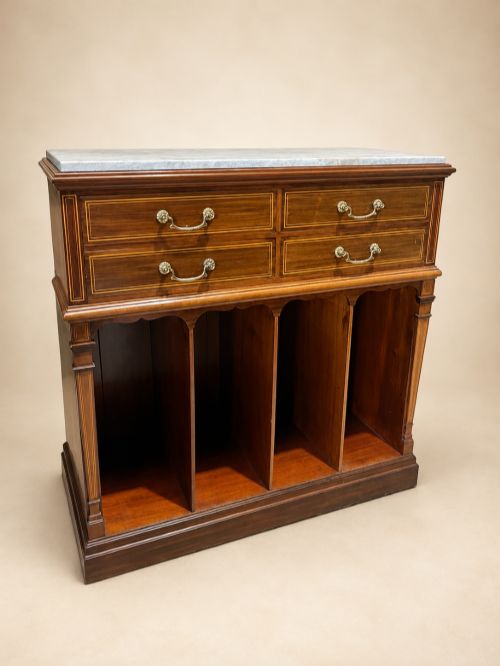
Buyers will most commonly meet Edwardian examples fashioned from mahogany or walnut, often featuring inlaid details typical of the Sheraton Revival style. French Art Nouveau pieces also appear, alongside robust oak storage units from the early twentieth century.
The form bridges domestic furniture and functional archive storage, reflecting the popularity of home piano playing and early recorded sound. Each iteration serves the practical demand of keeping paper scores and discs flat and accessible.
How they were made
Makers constructed these cabinets using dense timbers such as mahogany, walnut, and oak, frequently applying satinwood inlay or brass hardware for visual contrast. Glass doors occasionally feature on fronts, allowing visibility of the interior compartments.
Surface finishing relies on French polishing to bring out the natural grain of the wood, particularly on Edwardian and Victorian specimens. Internal organisation typically involves wooden shelving or dedicated filing dividers scaled precisely for paper sheets.
The listings span the Victorian, Edwardian, and Art Deco periods, utilising brass, glass, marble, and metals alongside mahogany, walnut, oak, and satinwood.
What varies in quality
The standard of timber selection and the precision of inlaid woodwork define the upper tier of these pieces. Fine grain figures in walnut and crisp satinwood banding elevate an example above plain utility furniture.
Cabinet construction integrity, from the jointing of the frame to the smooth operation of internal filing divisions, marks the distinction between standard production and superior workshop output.
The Antique Record Storage Cabinet Glossary
- Inlaid
- Ornamentation set flush into the surface of the wood, utilising contrasting timbers or lighter materials like satinwood. This technique creates geometric or floral patterns across door panels and tabletops.
- Sheraton Revival
- A late nineteenth and early twentieth century design style drawing on the neoclassical furniture of George Sheraton. It emphasises graceful proportions, lighter timbers, and delicate marquetry.
- French Art Nouveau
- A style emerging around the turn of the twentieth century characterised by organic, fluid lines and natural motifs. It appears on select music cabinets through curving mounts and distinctive decorative carvings.
- Burr Walnut
- Timber taken from the warted excrescence of a walnut tree, yielding a highly swirled and mottled grain pattern. It was selected for high-status cabinet doors and decorative surfaces.
- Music Cabinet
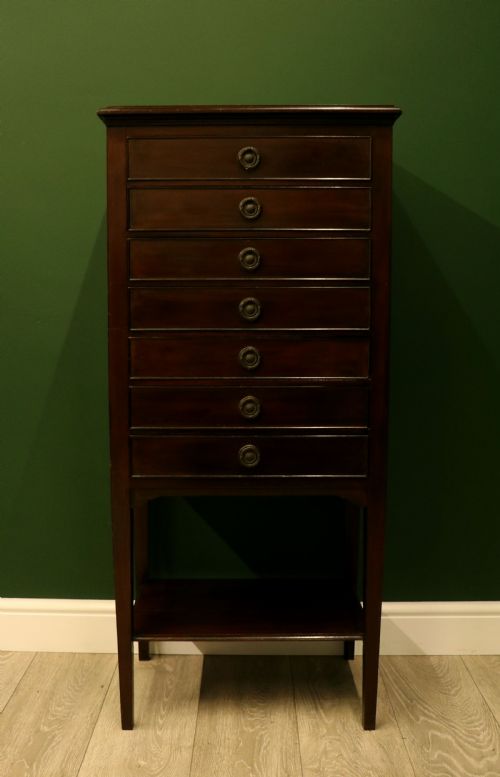
- A specialised piece of furniture designed with internal partitions or drop-down drawers for holding sheet music. These forms readily adapt to modern collection storage.
Antique Record Storage Cabinet: Frequently Asked Questions
What is an antique record storage cabinet?
An antique record storage cabinet is a specialised piece of furniture originally built to house sheet music, scores, and early audio recordings. They date predominantly from the Victorian, Edwardian, and Art Deco eras.
These pieces use timbers like mahogany, walnut, and oak, often featuring internal dividers or specialised filing drawers to keep paper and media flat.
How were music cabinets used originally?
Music cabinets were kept in drawing rooms and parlours to store the paper scores played on pianos and home instruments. The internal compartments kept sheets organised by composer or genre.
As recorded music developed, the interior layouts proved adaptable for storing early discs and subsequent formats without altering the exterior appearance.
How do I identify an Edwardian music cabinet?
Edwardian music cabinets typically feature light mahogany or walnut construction, often highlighted by Sheraton Revival satinwood inlay. They date from roughly 1901 to 1910 and display refined, upright proportions.
Many examples from this period include glass-fronted doors or drop-front drawers designed for quick access to paper sheets.
How do I live with an antique music cabinet?
These cabinets integrate easily into modern living spaces as side tables or dedicated media storage units. Their compact footprints suit smaller rooms while offering practical interior organisation.
Placement away from direct heat sources and strong sunlight protects the polished timber and delicate inlay work from drying out.
What is the difference between Victorian and Art Deco cabinets?
Victorian cabinets tend to use darker woods like black walnut and heavy mahogany, sometimes incorporating French Art Nouveau flourishes or rich carving. They reflect a more ornate aesthetic.
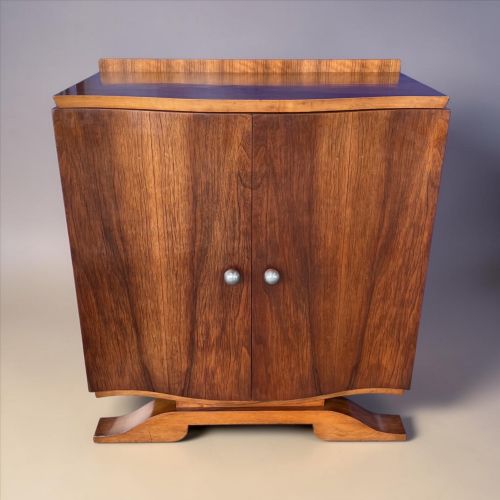
Art Deco cabinets from the 1930s favor clean geometric lines, streamlined veneers, and minimalist hardware, marking a shift toward modernist domestic design.