

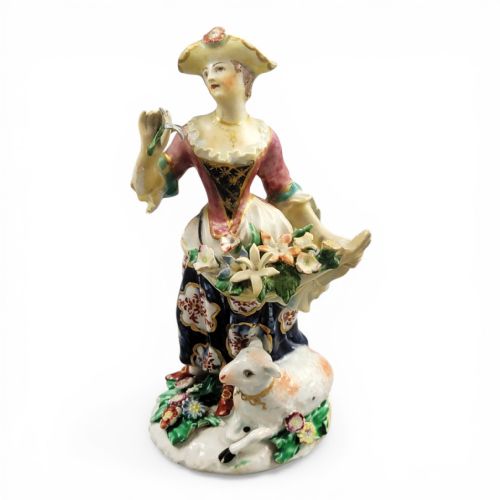


Antique Porcelain Shepherdess
An antique porcelain shepherdess brings pastoral charm to a room, captured in delicate figures from Georgian factories and later continental workshops.
Antique Porcelain Shepherdess
When you search for an antique porcelain shepherdess, you encounter glazed and bisque ceramic figures depicting pastoral women, often accompanied by sheep, lambs, or floral details. These pieces range from early English factory productions to later continental revivals.
The most frequent examples on this page hail from the nineteenth century, including German and French interpretations alongside eighteenth-century English works. Forms span individual statuettes, figural candlesticks, and paired groups.
Makers drew on Rococo and classical themes to create decorative sculptures for mantelpieces and display cabinets. Each piece reflects the aesthetic tastes of its period, from early Georgian realism to ornate Victorian styling.
Materials and manufacture
Potters utilised soft-paste and hard-paste porcelain, shaping the clay by hand or casting it in moulds before firing. Painters then applied enamel colours and gold leaf accents to the glazed surface.
Later nineteenth-century works often employed unglazed bisque porcelain, particularly French sculptures that emphasised matte textures over traditional bright enamels.
Sheep and lambs in these pastoral scenes often wear more attentive expressions than their human companions.
Variations in quality
Quality rests in the crispness of the moulding and the delicacy of the hand-painted details on the garments and flora. Finer figures retain subtle facial expressions and precise application of gilt and enamel.
Earlier eighteenth-century pieces demonstrate sharper definition in the porcelain paste, whereas later reproductions rely on heavier casting. The presence of modelled lambs and floral garlands adds complexity to the composition.
Derby Porcelain·Bow Porcelain·Samson Paris·Sitzendorf·Royal Dux·Vion and Baury
The Antique Porcelain Shepherdess Glossary
- Bisque porcelain
- Unglazed ceramic material fired once to produce a matte, white surface resembling marble. This finish became popular in nineteenth-century French sculptures.
- Soft-paste porcelain
- Early ceramic composition fired at lower temperatures, resulting in a slightly warmer tone and softer glaze. English factories utilised this material extensively during the eighteenth century.
- Hard-paste porcelain
- Dense ceramic mixture containing kaolin and petuntse, fired at high temperatures for a durable, vitreous body. Continental workshops favoured this formulation.
- Rococo revival
- Nineteenth-century design style emulating the asymmetrical curves and ornate flourishes of the mid-eighteenth century. Figures from this period often display elaborate scrolling bases.
- Enamel
- Vitreous coloured glass fused to the porcelain surface during a secondary firing. It provides the vibrant pigments found on garments and sheep.
Antique Porcelain Shepherdess: Frequently Asked Questions
How do I identify a genuine eighteenth-century piece?
Examine the porcelain body under magnification to check for the characteristics of soft-paste clay and early glaze pooling. Early figures often exhibit hand-modelled details that differ from later mass-produced moulds.
Compare the painting style and baseline markings to established reference examples from factories such as Derby or Bow. Weight and texture also offer clues to the period of manufacture.
What is the difference between English and continental figures?
English workshops in the eighteenth century primarily used soft-paste porcelain to create smaller, intimate shepherdess figures with floral embellishments. Continental factories, particularly in Germany and France, frequently employed hard-paste porcelain or bisque.
Continental pieces from the nineteenth century often lean towards larger, more theatrical pairings under the influence of Rococo revival styles. Marks on the base usually point to the country of origin.
Where should I display porcelain figures?
Place shepherdess figures inside a stable cabinet or on a mantelpiece away from direct sunlight and heavy foot traffic. Stable humidity and temperature protect the delicate enamel and gold leaf from degradation.
Ensure the shelf supports the weight, particularly for larger paired groups or figural candlesticks. Avoid placing them near heat sources that might stress the ceramic.