


Antique Physics Apparatus
Antique physics apparatus brings tactile scientific discovery into the room, offering brass, glass and mahogany instruments that once measured and demonstrated the laws of nature.
Antique Physics Apparatus
Antique physics apparatus encompasses instruments and demonstration models built to measure, test, and illustrate physical forces. When searching for antique physics apparatus, buyers encounter everything from early electrical generators to precision galvanometers.
The pieces on this page span the Regency period through to the mid twentieth century, covering Victorian scientific works and industrial apparatus. Forms range from large electrostatic machines and induction coils down to delicate boxwood thermoscopes.
Makers represented include prominent instrument makers and scientific firms from London, Paris, and Germany. These apparatuses served classrooms, laboratories, and lecture halls before finding a place in private collections.
What varies in quality
Quality in antique physics apparatus rests on the precision of the mechanical work and the reputation of the maker. Instruments signed by notable makers such as Watkins and Hill or Heinrich Daniel Ruhmkorff display superior graduation, finer materials, and more robust engineering.
The complexity of the apparatus and the survival of its original glass and brass components dictate the standing of a piece. Larger demonstration models built for projection or public lecture generally exhibit greater ambition in design than standard classroom instruments.
Listings feature scientific instruments spanning the Regency period through to the mid twentieth century, utilising brass, glass, mahogany, and iron.
G. Adam of Paris·Watkins & Hill·Max Kohl Germany·Heinrich Daniel Ruhmkorff·William Ladd London
The Antique Physics Apparatus Glossary
- Thermoscope
- An instrument that indicates changes in temperature without necessarily measuring them on a standardised numerical scale. Boxwood examples were frequently used in early lecture demonstrations.
- Galvanometer
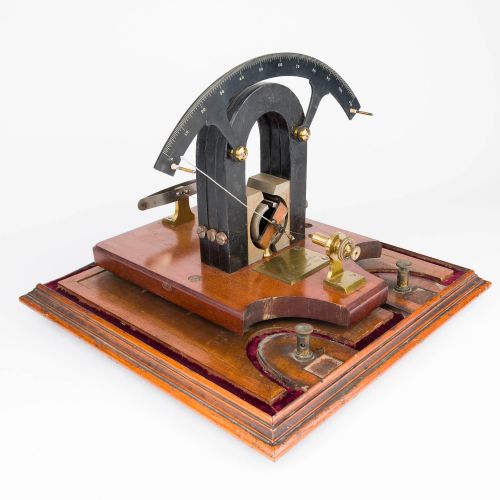
- An electromechanical instrument used for detecting and measuring small electric currents. D'Arsonval examples utilised a permanent magnet and a moving coil.
- Induction coil
- An electrical device that produces high-voltage alternating current from a low-voltage direct current source. Ruhmkorff versions are particularly well known among collectors.
- Electrostatic machine
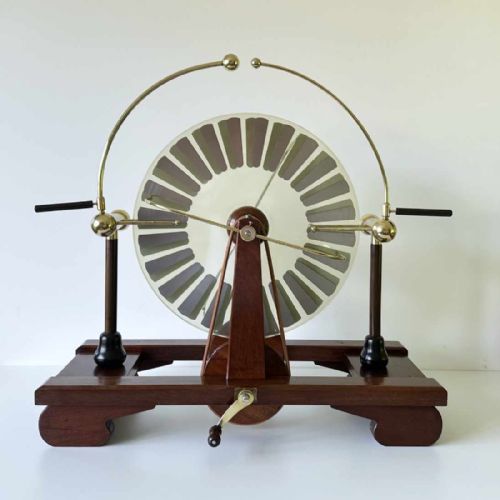
- A generator that produces static electricity at high voltages using friction or electrostatic induction. Winters pattern and Wimshurst designs are classic forms.
- Geissler tube
- A sealed glass tube used to demonstrate electrical discharge through rarefied gases. These tubes often incorporate vacuum scales for measurement.
Antique Physics Apparatus: Frequently Asked Questions
What is an antique physics apparatus?
Antique physics apparatus refers to historical instruments and demonstration models used to explore electricity, magnetism, thermodynamics, and mechanics. These pieces were built for research, university lectures, and school demonstrations.
They combine scientific utility with cabinet-maker craftsmanship, utilising brass, glass, mahogany, and boxwood. Today they are collected for their aesthetic appeal and historical role in scientific discovery.
How do I date an induction coil?
Dating an induction coil involves examining the maker's signature, the materials used in the base, and the style of the wiring and terminals. Pieces by makers such as Heinrich Daniel Ruhmkorff often date to the mid nineteenth century.
Later Victorian and Edwardian examples show shifts in insulation materials and manufacturing methods. Comparing the apparatus to documented catalogue designs helps narrow the period.
Were these pieces used in schools?
Many of these pieces were indeed built for educational use in schools, universities, and public lecture institutions. Makers produced robust demonstration models specifically designed for projection or classroom viewing.
Other items, such as sensitive galvanometers, originated in professional laboratories and research facilities. Their provenance often reflects the tier of institution they served.
How should I display a Wimshurst machine?
Displaying a Wimshurst machine requires a stable surface out of direct sunlight and away from high humidity to protect the glass plates and brass fittings. Because these are delicate scientific instruments, a secure shelf or cabinet is ideal.
Allowing sufficient space around the apparatus lets the intricate glass discs and neutralizing rods be viewed clearly. Avoid aggressive cleaning of the metal components to preserve their historic patination.