


Antique Scientific Display
These pieces of antique scientific display bring precision instruments and educational apparatus into domestic interiors, offering physical proof of historical discovery and industrial craftsmanship.
Antique Scientific Display
When you search for antique scientific display, you encounter a specialised gathering of brass instruments, mahogany cased barographs, and educational models designed originally for laboratories, consulting rooms, and shops. These items transition easily from utilitarian work to decorative placement, showing the mechanics of weather, measurement, and human anatomy.
The objects span from the Georgian period through Victorian workshops to Edwardian and mid century production, reflecting changing tastes in scientific utility and desk or wall presentation. Barometers and barographs housed in bevelled glass and oak or walnut dominate the selection, accompanied by telescopes, precision scales, and botanical or anatomical models.
Origins stretch across English workshops and continental makers such as French and German firms, bringing diverse regional styling to otherwise identical functional categories. Whether dealing with a shop display aneroid barometer or a classroom demonstration model, the appeal rests on visible mechanical complexity paired with substantial timber and metal cabinetry.
Materials and Construction
Makers utilised heavy timbers including mahogany, oak, walnut, and plain wood to house delicate mechanisms, often incorporating bevelled glass panels and chart drawers to protect recording surfaces. These timber enclosures frequently feature leather dressings on telescopes or paper scales within barometers.
Brass and iron provide the structural backbone for lenses, dials, balance beams, and gauge casings, polished or finished to withstand rigorous laboratory or field deployment. Precision engineering combines with cabinet making standards, visible in dovetailed boxes and neatly engraved dial faces.
Some nineteenth century weather instruments were large enough to advertise waterproof clothing directly to passing street traffic.
Assessing Quality
Quality rests upon the refinement of the mechanical components and the integrity of the housing cabinet. Superior examples feature signed movements from established makers, heavy cast brass elements, and unblemished timber cases with original glass and fittings.
Lesser or later items may show simpler joinery, replacement glass panels, or missing auxiliary components such as ink pens for barographs and lens caps for telescopes. The clarity of engraved lettering on dials and scales separates standard utility items from exhibition pieces intended for prominent display.
G. Adam of Paris·Cary London·De Grave, Short, & Co·Negretti & Zambra·Max Kohl Germany·Heinrich Daniel Ruhmkorff·Educational & Scientific Plastics Ltd·Jules Richard of Paris·John Gilbert
The Antique Scientific Display Glossary
- Barograph
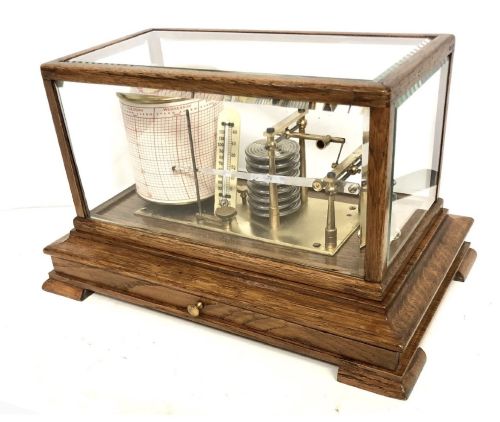
- A self-recording aneroid barometer that traces atmospheric pressure onto a rotating paper chart housed within a glazed wooden case. These instruments combine meteorological utility with handsome domestic cabinetry.
- Anatomical model
- A three dimensional teaching aid constructed from plaster, plastic, or papier-mache to demonstrate human or botanical structures. These educational pieces were widely used in classrooms and medical consulting rooms.
- Galvanometer
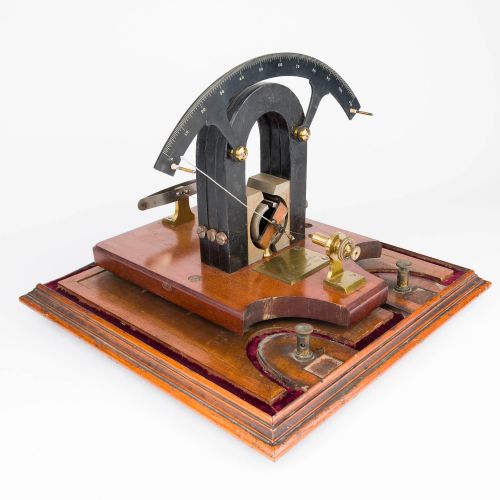
- An electromechanical instrument used for detecting and measuring small electric currents. They typically feature delicate needle indicators set behind glass faces within brass and timber housings.
- Hypsometer
- An apparatus used to determine atmospheric pressure by measuring the boiling point of water at varying altitudes. These complex field instruments pair thermometer tubes with boiling chambers.
- Spyglass
- A small portable handheld telescope consisting of multiple sliding brass draws often wrapped in leather. Edwardian and Georgian versions offer compact magnification for travellers and explorers.
Antique Scientific Display: Frequently Asked Questions
What is a barograph?
A barograph is a mechanical weather recording instrument that uses an aneroid stack to move an inked arm across a revolving drum holding a paper chart.
Enclosed in glass and mahogany or oak cases, they were designed to track barometric pressure trends continuously over the course of a week.
How do I maintain wood and brass?
Maintain timber cases with traditional wax polish applied sparingly, avoiding direct heat sources that can split mahogany or oak and crack antique varnish.
Keep brass components unlacquered where appropriate, dusting gently with a soft cloth to preserve the natural oxidation built up over decades.
Were these items used outdoors?
Most items on this page were built for indoor laboratory, office, shop, or classroom use, though field instruments like explorer telescopes saw outdoor travel.
Barographs and large shop display barometers relied on stable indoor environments to maintain accurate readings away from extreme weather.
How are periods dated?
Dating relies on maker signatures, material choices, typography on instrument scales, and the prevailing joinery styles of Georgian, Victorian, and Edwardian cabinet makers.
Comparative study of known workshop catalogues and patent dates helps narrow the production era of unmarked scientific apparatus.