


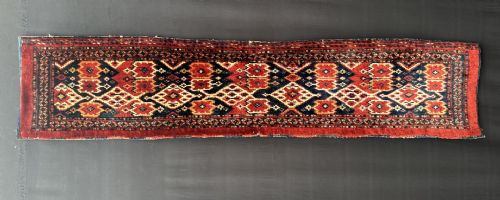
Antique Oriental Carpet Fragment
An antique oriental carpet fragment brings centuries of nomadic design and vegetable dyes into a modern room as a striking wall hanging.
Antique Oriental Carpet Fragment
An antique oriental carpet fragment is a surviving portion of a larger tribal or regional weaving, preserved for its colour, pattern, and historical significance. When you search for an antique oriental carpet fragment, you encounter pieces that have been cut or worn down from full rugs and carpets over generations.
The pieces listed here most frequently take the form of bag faces, torbas, and chuvals created by tribal groups such as the Turkmen, Tekke, Saryk, and Ersari. These remnants of Central Asian tribal, Caucasian, and Persian weaving offer access to ancient motifs that are rarely found intact in full room-size carpets.
Originating across regions from the Trans-Caspian steppes to East Turkestan and North India, these textiles range from early nineteenth-century Khotan fragments to late nineteenth-century Caucasian runners. Each surviving piece serves as a study in traditional tribal symbolism and structure.
Materials and construction methods
The weavers of these textiles relied primarily on hand-spun wool and cotton, occasionally incorporating silk for specific highlights. These natural fibres were knotted or flat-woven to create dense structures designed to endure the demands of nomadic life.
Colour was achieved through natural and vegetable dyes, producing rich tones of crimson, ivory, and deep madder red that deepen with age. The interaction of these organic dyes gives each remnant its characteristic surface variation and depth.
Current listings feature pieces spanning from the early nineteenth century to 1900, incorporating wool, cotton, and silk.
Assessing quality in textile remnants
Quality in a remnant rests upon the precision of the drawing and the saturation of the natural dyes. Superior pieces display crisp tribal guls and balanced compositions that retain their visual power despite the loss of the surrounding carpet.
The handle and suppleness of the wool, alongside the complexity of the secondary ornaments, separate standard utility pieces from exceptional tribal works. A finer knot density and thoughtful use of contrasting silks or whites elevate a fragment from a mere remnant to a textile of note.
The Antique Oriental Carpet Fragment Glossary
- Gul
- A primary medallion or octagonal motif repeated across Turkmen and other Central Asian carpets. These tribal emblems often identified the specific clan or sub-tribe of the weaver.
- Torba
- A small wall-hanging bag or storage sack used within a nomadic tent. They frequently feature finely detailed faces that survive as independent textiles.
- Chuval
- A large tent bag used for storing household goods during nomadic migrations. Their clipped faces are prized for their bold tribal layouts.
- Soumak
- A flat-weave technique utilising a wrapping stitch that creates a textured, durable surface without pile. Shahsavan weavers employed this method for intricate bag faces.
- Soumak
- A flat-weave technique utilising a wrapping stitch that creates a textured, durable surface without pile. Shahsavan weavers employed this method for intricate bag faces.
Antique Oriental Carpet Fragment: Frequently Asked Questions
How were these fragments originally used?
Many of these pieces began life as functional tent bags, storage sacks, or animal trappings used by nomadic tribes for daily domestic life. They served to organise belongings within a yurt or adorn camels during ceremonial migration.
Over time, wear or damage led to the division of larger carpets and bags, leaving behind the striking panels and faces that collectors preserve today.
How do I hang a textile fragment?
Mounting a fragment safely requires distributing the weight evenly across the upper edge without puncturing or straining the historical fibres. Methods often involve conservation-grade Velcro stitching or custom linen sleeves attached to a rigid backing board.
Keep mounted textiles away from direct sunlight to protect the natural vegetable dyes from fading over the years.
How can I tell tribal groups apart?
Distinguishing between groups relies on recognising characteristic motifs, such as the distinct gul patterns used by Tekke, Saryk, and Ersari weavers. Palette choices also offer clues, with specific regions favouring particular madder reds, ivories, and blues.
Structure and knotting style further separate Caucasian Shirvan and Kazak pieces from Central Asian tribal work.
What is a bag face?
A bag face is the decorative front panel of a utilitarian nomadic sack, separated from the plain back panel when the object wore out. Because families invested their finest weaving skill into these visible fronts, they survive as complete artistic statements.
These panels capture the signature design vocabulary of the weaver in a manageable format.