

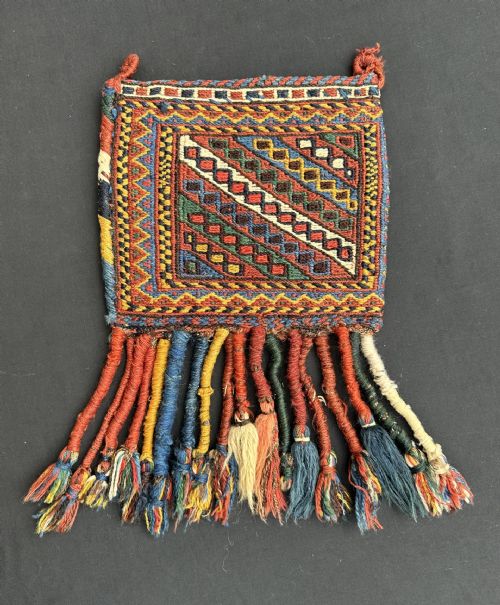


Nomadic Woven Saddlebag
When you handle a nomadic woven saddlebag, you touch the daily migration of pastoral peoples across Persia and the Caucasus.
Nomadic Woven Saddlebag
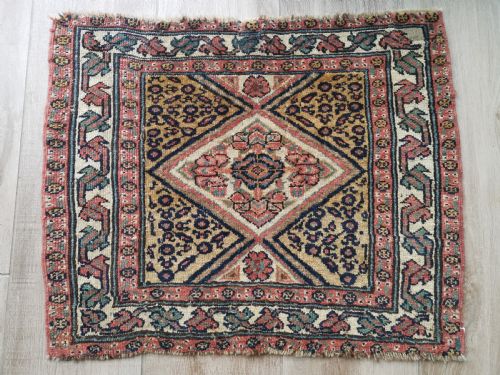
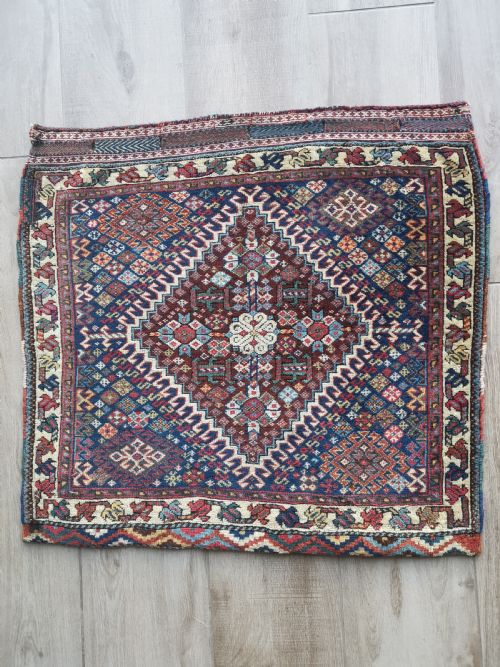
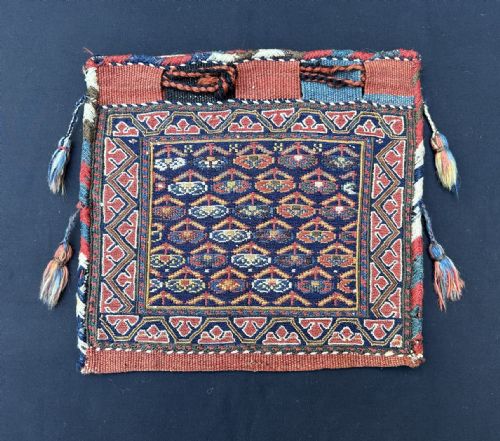
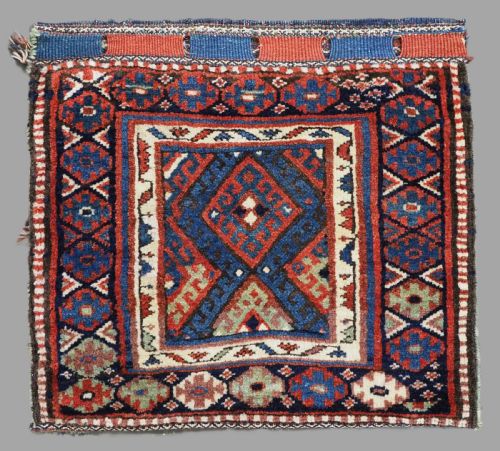
A nomadic woven saddlebag serves as a portable container used by tribal groups to transport personal belongings on pack animals during seasonal migrations. These pieces appear in forms ranging from complete double bags joined by a web to individual bag faces and surviving halves.
The selection here draws primarily from nineteenth and early twentieth century tribal weaving traditions originating across Persia, Anatolia, and Azerbaijan. Pieces are attributed to specific confederations such as the Qashqai, Shahsavan, Afshar, and Jaf Kurd.
Many examples survive as single bag faces because the plain weave backs, which endured heavier friction against pack animals, wore away over time. Complete sets with their original flatwoven backs and connecting webs remain considerably scarcer.
Materials and Methods
Weavers utilised hand-spun wool for the foundational warps, wefts, and pile, often selecting lustrous fleeces that absorbed natural dyes deeply. Cotton appears frequently in foundation structures of later pieces, while leather and metal occasionally reinforce closures or suspension points.
Construction techniques divide between pile knots and flatwoven structures such as soumak, where pattern wefts wrap around vertical warps to create a textured surface. The back panels typically employ sturdy plain weave structures designed to withstand the rigours of transit.
The inventory spans weaving traditions from eighteen-fifty through nineteen-ten, utilising wool, cotton, natural dyes, and leather.
Evaluating Quality
Quality rests upon the integrity of the natural dye palette, the clarity of tribal iconography, and the density of the weave. Tighter knotting or more precise soumak wrapping allows complex geometric medallions and boteh motifs to emerge with sharp definition.
Condition and completeness heavily influence worth, distinguishing heavily repaired fragments from intact bag faces or complete double saddlebags retaining their original plain weave backs. The handling of secondary borders and the quality of the wool fleece further separate standard utility pieces from exceptional tribal weaving.
The Nomadic Woven Saddlebag Glossary
- Khorjin
- The traditional Persian term for a double-sided saddlebag used by nomadic tribes for transport. These items were draped across horses, donkeys, or camels.
- Soumak
- A flatweave technique involving coloured weft threads wrapped over and under warp threads to produce a durable, patterned fabric without pile. This method creates a textured surface resembling embroidery.
- Bagface
- The decorative front panel of a storage bag that remained visible while packed on an animal. Many survive independently after the plain weave backs deteriorated.
- Boteh
- A traditional almond-shaped or paisley motif with a curved upper end, frequently rendered in tribal weavings. This ancient symbol represents fertility, cypress trees, or flames.
- Warp
- The vertical foundation threads stretched tightly on a loom before weaving begins. Weft threads are passed across and through these stationary parallel strands.
Nomadic Woven Saddlebag: Frequently Asked Questions
What did nomads store inside these bags?
Nomadic families utilised these heavy containers to hold personal belongings, clothing, salt, grains, and household utensils during seasonal migrations across harsh terrain.
Because belongings needed protection from weather and pack friction, the weaving had to be dense and robust.
Why do so many pieces survive as single faces?
The plain weave backs suffered constant friction against the flanks of pack animals and wore out long before the decorative pile fronts.
Collectors often framed or preserved the surviving face once the structural back had disintegrated beyond repair.
How do you identify which tribe made a bag?
Specific tribal groups utilised distinct colour palettes, structural wool qualities, and signature geometric or boteh motifs passed down through generations.
For example, Shahsavan pieces frequently display intricate soumak technique, whereas Afshar weavings often incorporate deep indigo grounds and stylized floral forms.
How can I display a saddlebag in my home?
Complete saddlebags and sturdy bag faces can be mounted on textile-safe walls using custom display sleeves or placed flat as small floor rugs in low-traffic areas.
Keeping them away from direct sunlight preserves the natural dyes derived from plants and minerals.