


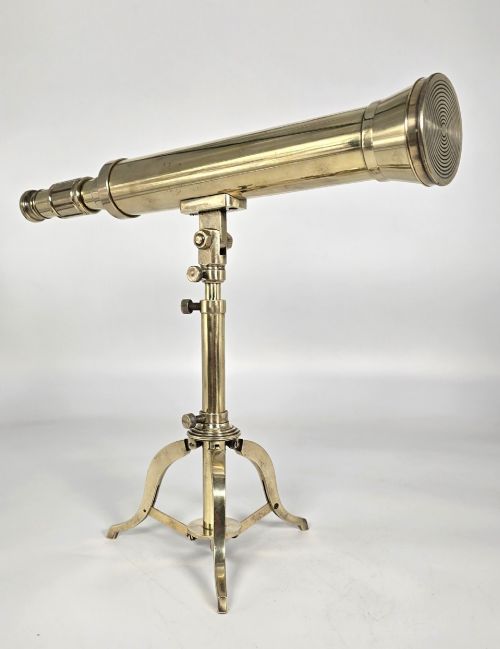


Antique Nautical Spyglass
These antique nautical spyglass options are brass and wood maritime instruments designed for navigation and terrestrial observation.
Antique Nautical Spyglass
When a buyer looks for an antique nautical spyglass, they encounter extendable optical tubes designed for marine navigation and land observation. These instruments range from small pocket versions to large library and table top models housed on folding stands.
The pieces on this page appear in single draw, two draw, three draw, four draw, and six draw configurations. They date across the Georgian, Regency, Victorian, and Edwardian periods.
Origins span English makers alongside German naval equipment from the early twentieth century. Most examples combine polished metal with wood or leather casings for grip and protection.
Materials and construction methods
Makers constructed these instruments using solid brass for the draw tubes and main barrels, pairing the metal with glass lenses. Many barrels feature tight wrappings of leather, mahogany, fruitwood, walnut, or oak to improve handling at sea.
Workshops turned wood on lathes and hammered sheet brass into precise tubular segments that slide smoothly within one another. Opticians ground glass lenses to focus light across terrestrial and astronomical distances.
Decagonal barrels kept eighteenth century spyglasses from rolling off rolling dining tables during heavy seas.
What determines quality
Quality depends on the precision of the optical glass and the tightness of the draw tubes when extended. Instruments by documented London opticians demonstrate superior lens clarity and mechanical engineering compared to unmarked work.
The presence of original protective leather coverings, fitted wooden cases, or dedicated brass tripod stands elevates an example. Heavy gauge brass and clean maker signatures stamped into the metal distinguish high grade pieces.
Nairne & Blunt of London·Ross of London·Voigtländer & Sohn AG·Clarkson London·Steward of London·Newton & Co·Broadhurst Clarkson & Co·Cary London·L. Casella London·Chadburn Brothers of Sheffield·John Gilbert
The Antique Nautical Spyglass Glossary
- Draw
- A sliding tubular section of a telescope barrel that extends to alter the focal length. Multi draw instruments collapse down for portable storage.
- Achromatic
- A lens design corrected to focus red and blue light on the same plane, reducing false colour fringes around images. Non achromatic lenses lack this specific optical correction.
- Terrestrial
- An optical setup configured to present an upright image for viewing land objects and shipping, unlike astronomical telescopes that invert views.
- Decagonal
- A geometric form featuring ten flat sides along the barrel exterior. This shape prevents the instrument from rolling off a sloping ship table.
Antique Nautical Spyglass: Frequently Asked Questions
How do I use an antique spyglass?
Extend all the brass draw sections fully until the internal lenses lock into alignment. Support the barrel with one hand while adjusting the eyepiece distance until distant objects appear sharp.
Keep glass lenses clean using a soft cloth and avoid forcing stuck metal draws if dust builds up inside the sleeves.
Can I see ships at sea with these?
These historical instruments function for terrestrial viewing and magnify distant horizons. Older optics have narrower fields of view and less light gathering power than modern binoculars.
Expect historic lenses to show minor dust particles internally due to their age and construction methods.
How do I date a brass telescope?
Examine the style of the maker signature and the number of draw tubes used in the construction. Georgian and Regency pieces often feature simpler inscriptions, while Victorian models frequently utilise multiple draw sections and leather grips.
Material choices like mahogany or gilt brass provide further clues to the manufacturing decade.
Why are some spyglass barrels wrapped in leather?
Leather wrapping protects the brass body from salt spray and harsh marine environments aboard ships. It also provides a secure non slip grip for wet hands during navigation.
Wood veneers like mahogany or walnut served a similar purpose while adding decorative warmth to library instruments.