


Antique Lighthouse Painting
An antique lighthouse painting captures the lonely sentinel of the coast, bringing the drama of maritime navigation into a room.
Antique Lighthouse Painting
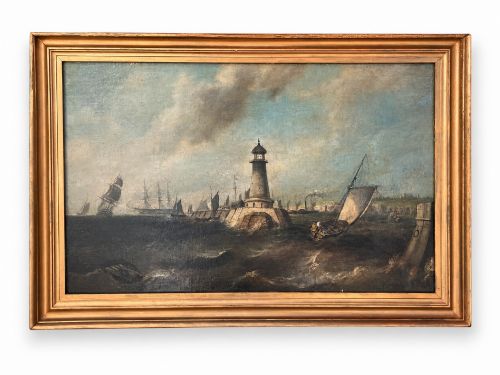
When you search for an antique lighthouse painting, you encounter coastal scenes from the nineteenth and early twentieth centuries that place navigational beacons at the heart of marine activity. These works record specific stretches of coastline, from British headlands to French shores and Portuguese cliffs, often framing towers against stormy seas or calm evening waters.
The pieces on this page span the Victorian and Edwardian eras, reaching into the nineteen-twenties and thirties through oils on canvas and delicate watercolours on paper. You will find grand oils depicting vessels passing structures like the Eddystone Lighthouse alongside modest folk art depictions and atmospheric watercolours of local piers.
Maritime realism and Victorian marine art dominate the formal works, while primitive and folk art pieces offer a simpler, more direct interpretation of coastal life. Whether capturing a moonlit harbour or a dramatic rescue near a rocky outcrop, these paintings serve as historical records of maritime engineering and coastal trade.
Materials and methods of the coast
Painters of these coastal scenes relied primarily on oil on canvas or board for large, durable works intended to capture the heavy atmosphere of the sea. Watercolour pigment on paper served for lighter, immediate views of harbours and headlands, often framed under glass to protect the delicate washes.
Supports ranged from traditional stretched canvas to wooden panels and heavy paper sheets, matched to the scale and ambition of the composition. Pigments were applied with brushes or palette knives to build up the heavy seas, grey skies, and white masonry of the lighthouse towers.
Listings feature works executed in oil on canvas, watercolour on paper, and mixed media across the Victorian and Edwardian eras.
Distinctions across the range
The standard of execution in marine art rests on the artist's command of light, atmosphere, and maritime anatomy. Finer works demonstrate a secure understanding of coastal topography, shipping rigging, and the way light strikes the stone or brick of a lighthouse tower against changing weather.
Compositional balance separates ambitious maritime oils from simpler decorative watercolours or naive folk art pieces. A work by a recognised marine specialist carries greater narrative weight and technical precision than a generic coastal view produced by an unrecorded hand.
Nicholas Condy·George F Pennington·Ernest F Hill·Arthur Wilde Parsons·Joseph Heard·Tommaso De Simone·Vilhelm Arnesen·Thomas Sidney·William Daniel Penny
The Antique Lighthouse Painting Glossary
- Marine art
- Artwork that depicts ships, sea views, harbours, and coastal architecture such as lighthouses. It forms a distinct genre within nineteenth and twentieth-century painting.
- Watercolour
- A paint medium where coloured pigments are suspended in a water-soluble vehicle, typically applied to paper. It allows for translucent washes that suit atmospheric coastal skies.
- Oil on canvas
- A painting technique utilising pigments bound with a drying oil, applied to a stretched cloth surface. This method provided the durability required for large nineteenth-century marine scenes.
- Folk art
- Artistic work created by untrained or self-taught makers, often using traditional methods and materials. These pieces prioritize direct narrative over academic perspective.
- Seascape
- A painting or photograph that depicts the sea, distinct from a landscape which focuses primarily on land. Lighthouse scenes are a natural subset of this genre.
Antique Lighthouse Painting: Frequently Asked Questions
What periods do these paintings cover?
The available works span the nineteenth century through the nineteen-thirties, encompassing Victorian, Edwardian, and later modernist interpretations of the coast.
Most examples date from the mid-nineteenth century to the interwar period, reflecting the height of traditional maritime painting and coastal recording.
How were these coastal scenes used?
These paintings were created for domestic display in homes, offices, and maritime institutions, celebrating national naval power, local trade, or coastal scenery.
They served as both decorative furnishings and personal mementos of specific coastal towns, shipping routes, or dramatic maritime events.
How do I live with a maritime watercolour?
Watercolours on paper require careful placement away from direct sunlight to prevent the fading of delicate pigments over time.
Keeping them behind protective glass in stable indoor humidity ensures the paper support and watercolour washes remain secure for years to come.
How do I tell an oil painting from a watercolour?
Oil paintings feature a textured surface built up with thick pigments on canvas or wood, often exhibiting visible brushstrokes and a glossy or satin finish.
Watercolours present a flat, matte appearance on paper where the grain of the sheet shows through translucent layers of pigment.