



Sailing Ship Watercolour Painting
A sailing ship watercolour painting brings the movement of coastal tides and tall-masted vessels directly onto paper through fluid washes of pigment.
Sailing Ship Watercolour Painting
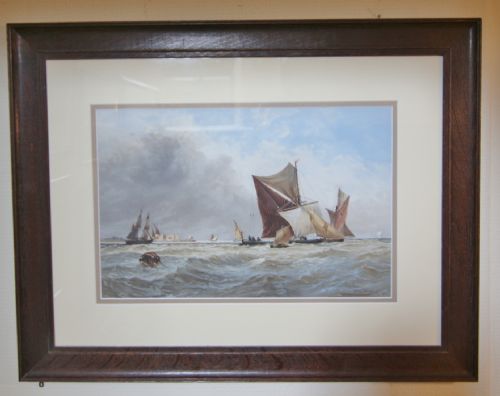
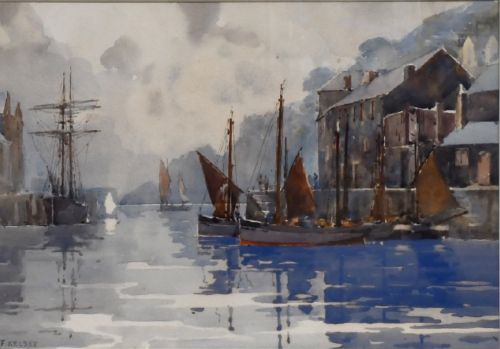
A sailing ship watercolour painting captures maritime scenes, coastal harbours, and deep-sea vessels from the nineteenth and early twentieth centuries. These works range from tightly detailed depictions of commercial clippers to atmospheric, rapidly executed sketches of working boats in choppy waters.
The versions most commonly met on this page date from the Victorian and Edwardian eras, executed by British artists recording the domestic and international shipping trade. They appear framed behind glass, often set within traditional wood or gilt frames that complement the tonal palette of the paper beneath.
Materials and technique
Artists applied watercolour pigment and ink onto heavy paper sheets, often utilising the natural white of the paper to render the glare of open water or billowing canvas sails. Washes were layered to build depth in the sea and sky, whilst finer pen work defined rigging and hull structures.
Framing typically involved glass protection set into wood, gilt wood, or hand-enamelled polychrome frames. These housings served to shield the delicate water-soluble pigments from atmospheric moisture and dust.
Listings feature works spanning the nineteenth century, the Edwardian era, and the 1920s to 1930s.
Understanding quality
Quality rests upon the artist's command of water and pigment to convey the weight of a vessel and the motion of the sea without overworking the paper. Stronger examples display confident brushwork in the rigging and water, whereas lesser pieces rely on rigid, mechanical line drawing with flat washes.
The handling of light and atmospheric perspective also distinguishes the work. Superior paintings capture the specific weight of coastal weather and maritime atmosphere, while standard decorative works present a more formulaic arrangement of ships and waves.
Charles Edward Dixon·Thomas Bush Hardy·William Frederick Settle·George Stanfield Walters·Henry Scott Tuke
The Sailing Ship Watercolour Painting Glossary
- Barque
- A sailing vessel with three or more masts, having the fore and mainmasts square-rigged and the mizzenmast fore-and-aft rigged. This rig was common for medium-sized cargo ships during the nineteenth century.
- Seascape
- A painting depicting the sea, coastal views, or ships operating upon open water. These works form the primary category for maritime watercolours.
- Wash
- A thin, fluid layer of diluted watercolour pigment spread across paper to create smooth areas of tone or colour. It forms the basis of sky and water effects in maritime art.
- Gilt wood
- Wood coated with a thin layer of gold leaf or metallic paint. Such frames were frequently used to house nineteenth-century watercolours.
- Man-of-war
- A powerful armed warship belonging to a royal navy during the age of sail. These large vessels appear in specialist maritime paintings.
Sailing Ship Watercolour Painting: Frequently Asked Questions
How should I hang a vintage watercolour?
Watercolours are sensitive to bright light and damp conditions, meaning they should be positioned away from direct sunlight and exterior walls. Using conservation glass and proper backing helps protect the paper from environmental degradation over time.
Ensuring stable room temperatures prevents the wooden frames from warping and keeps the paper free from foxing spots caused by trapped moisture.
What subjects appear in these paintings?
The compositions record commercial shipping, coastal ports, royal navy vessels, and fishing boats navigating British and international waters. Artists frequently documented specific estuaries, barques at anchor, and lighthouses.
Many works capture the daily labour of maritime trade, showing steam and sail vessels operating together in busy harbours.
How do I date an antique marine watercolour?
Dating relies upon artist signatures, period framing styles, and the specific rigging of the vessels depicted in the scene. Costume details of figures on the shore or deck also provide clear chronological markers for Victorian and Edwardian works.
Inscriptions on the reverse of the paper or on the frame mount often record the specific location and year the painting was executed.
Are these works original paintings?
The listings consist of original hand-painted watercolours created directly by artists rather than modern mass-produced prints. Each piece displays unique brushwork, pigment variation, and individual handling of ink and paper.
Close inspection under magnification reveals the delicate layering of water-soluble pigments and the texture of the original paper surface.