
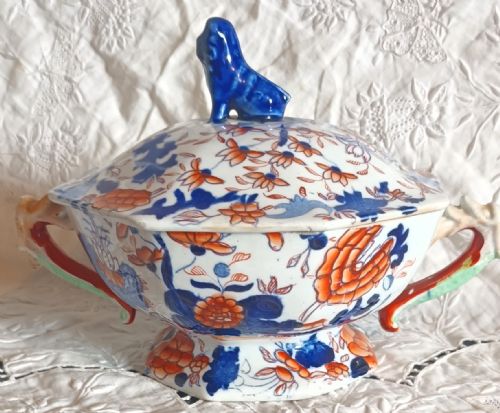


Antique Ironstone Tureen
These robust antique ironstone tureen vessels bring substance and bold nineteenth-century pattern to the table.
Antique Ironstone Tureen
An antique ironstone tureen is a heavy ceramic serving vessel designed for soup, sauce, or vegetables, built to withstand daily dining while making a decorative statement. These pieces emerge primarily from the nineteenth century, spanning Georgian, Regency, and Victorian periods.
The most common forms on this page are large soup tureens with covers and smaller pairs of sauce tureens, often accompanied by ladles or serving dishes. Makers produced these utilitarian display items in distinct styles like English Chinoiserie and Victorian Imari.
Buyers encounter forms ranging from vegetable tureens to massive dinner service centerpieces. The predominant material is ironstone ceramic, frequently decorated with transfer prints and hand-applied colours.
How they were made
Potters shaped these dense ironstone and earthenware bodies to resist chipping, applying a durable glaze over the ceramic base. This tough composition allowed for heavy kitchen and dining use while maintaining a smooth surface.
Decoration relied heavily on blue and white transfer printing, supplemented by enamel colours and occasional touches of gold leaf or gilt. Specific patterns like Chinoiserie Mandarin, Bamboo, and Japan Basket required precise hand-painting over printed outlines.
Listings feature nineteenth-century ironstone ceramics spanning Georgian, Regency, and Victorian periods, utilising glaze, enamel, and gold leaf.
What varies in quality
Quality rests in the crispness of the transfer print and the precision of the hand-applied enamel colours. Stronger pieces display vibrant green, blue, and gilt details that sit firmly beneath or upon a clean glaze.
The complexity of the form and pattern dictates distinction, with elaborate shapes like the Bamboo or Mandarin patterns showing greater artistic ambition than plain utilitarian vessels. Complete sets with matching covers and ladles stand apart from single surviving bowls.
Mason's·Coalbrookdale
The Antique Ironstone Tureen Glossary
- Ironstone
- A heavy, durable type of earthenware patented in the nineteenth century to rival Chinese porcelain. It provides a sturdy body for large serving vessels.
- Transfer print
- A decorative technique where an engraved copper plate transfers a design onto paper and then onto the ceramic body before glazing. This method allowed for repeatable, intricate patterns.
- Chinoiserie
- A European artistic style reflecting Chinese motifs and landscapes. It appears frequently on nineteenth-century pottery in patterns such as Mandarin and Grasshopper.
- Gilt
- A thin layer of gold applied to the ceramic surface for ornamentation. It highlights handles, rims, and specific pattern details.
- Tureen
- A deep covered bowl used for serving soup, sauce, or vegetables at the dining table. They range from small sauce boats to large soup vessels.
Antique Ironstone Tureen: Frequently Asked Questions
How do I use an antique tureen?
These vessels work well for serving soups, stews, and vegetables at the dining table, functioning exactly as they did in the nineteenth century.
Many collectors also place them on sideboards or open shelving as decorative display pieces when not in active use.
Are these tureens dishwasher safe?
Modern dishwashers and harsh detergents will damage the historic glaze, enamel colours, and delicate gold leaf decorations over time.
Hand washing in warm water with mild soap preserves the ceramic body and the integrity of the transfer-printed patterns.
How do I date an ironstone tureen?
Dating relies on maker marks stamped into the ceramic base, stylistic clues such as Regency or Victorian motifs, and the specific application of transfer printing and hand-colouring.
Georgian and Regency pieces often feature specific Chinoiserie transfer patterns, while later Victorian items show broader stylistic influences.
What is the difference between a soup and sauce tureen?
Soup tureens are large, deep vessels designed to hold substantial volumes of liquid for a whole table, often accompanied by a ladle.
Sauce tureens are much smaller companion pieces meant for gravies and sauces, usually set upon their own attached or separate ceramic bases.