
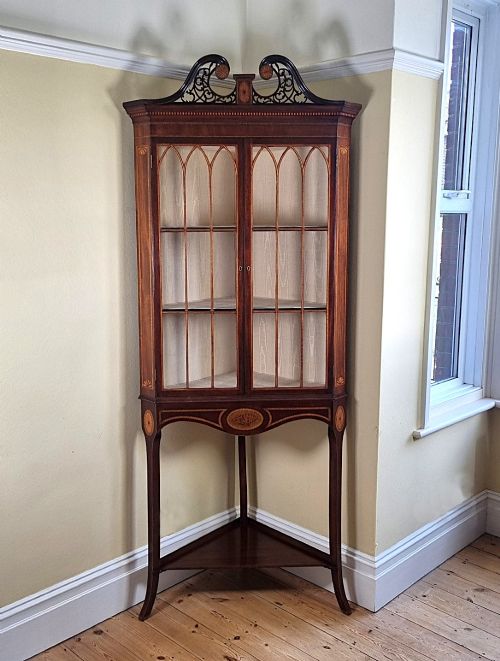
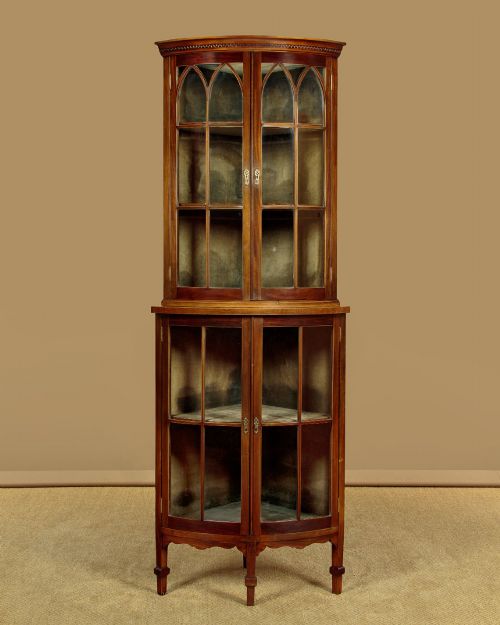


Antique Gothic Corner Cabinet
An antique gothic corner cabinet brings architectural presence to unused room junctions through pointed arches, tracery and rich timber.
Antique Gothic Corner Cabinet
An antique gothic corner cabinet is a fitted or freestanding storage piece designed to occupy the meeting point of two walls, drawing inspiration from medieval ecclesiastical architecture. These items take several forms across this selection, ranging from hanging wall cupboards and bow front display units to grander cabinets mounted upon stands.
The periods represented here stretch from the Georgian era through the Victorian and Edwardian epochs into the early twentieth century. Buyers will frequently encounter dark carved oak or rich mahogany constructions, alongside occasional Edwardian marquetry and painted faux tortoiseshell finishes.
Makers adapted the vertical emphasis of the gothic style for domestic interiors, producing both tall hall cupboards and compact corner display cabinets. Surviving hardware, including brass hinges, demonstrates how structural fittings reinforced the medieval aesthetic.
How they were made
Cabinetmakers utilised solid timbers such as oak, walnut and mahogany to construct these sturdy corner units, often enhancing the surfaces with satinwood inlay or intricate carving. Timber selection dictated whether the piece adopted a dark, brooding gothic revival character or a lighter Georgian refinement.
Glazing bars divided glass panels into pointed arch configurations or lancet shapes to mimic ecclesiastical windows. Heavy brass ironmongery and specialised cabinet hardware provided both structural integrity and decorative contrast against the dark wood.
The listings on this site span multiple eras, featuring Georgian mahogany alongside heavy Victorian carved oak and Edwardian marquetry.
What varies in quality
Quality rests upon the depth and precision of the timber carving, where crisp tracery and well-defined mouldings separate superior workshops from routine production. The integration of contrasting details, such as satinwood inlay or specially cast brass hinges, elevates the refinement of the piece.
Proportion and timber selection dictate overall merit, with well-figured mahogany or richly patinated oak displaying superior visual balance. Cabinets retaining their original stands or integrated glazing bars demonstrate greater architectural integrity than altered examples.
The Antique Gothic Corner Cabinet Glossary
- Gothic Revival
- An architectural and decorative style popular during the nineteenth century that revived medieval forms such as pointed arches, quatrefoils and heavy timber panelling. This movement heavily influenced the design of Victorian ecclesiastical and domestic furniture.
- Marquetry
- The art of applying decorative veneer pieces to a structure to form intricate patterns or pictures. Craftsmen utilised various coloured woods to create pictorial scenes on cabinet doors.
- Bow Front
- A convex curved cabinet front that projects outward in a smooth arc. This shape softened the sharp angles typically associated with corner furniture.
- Tracery
- Architectural stonework ornamentation supporting glass in a window, translated by cabinetmakers into delicate woodwork patterns on cabinet doors. It defines the characteristic look of gothic glazing bars.
- Corner Cupboard
- A storage unit specifically built with a triangular cross-section to fit neatly into the ninety-degree junction of a room. These pieces maximised domestic space in older properties.
Antique Gothic Corner Cabinet: Frequently Asked Questions
Where should I place a corner cabinet?
These cabinets fit precisely into the junction of two walls, transforming neglected angles into focal points. They work particularly well in dining rooms or hallways where floor space is at a premium.
Taller pieces on stands require sufficient vertical clearance, while hanging wall versions suit lower rooms or spaces above existing furniture.
How do I date a gothic cabinet?
Dating relies upon timber choice, construction methods and stylistic revival periods. Georgian and early nineteenth-century examples often feature clean mahogany surfaces, whereas Victorian pieces frequently display heavy carved oak and pronounced gothic motifs.
Later Edwardian iterations introduce lighter marquetry work while retaining structural corner formats.
Can these cabinets hold heavy items?
Solid timber construction in oak and mahogany provides sturdy internal shelving suitable for books, ceramics or glassware. Glazed display versions safely exhibit collections behind glass panels.
Wall-mounted units depend heavily on secure fixings into wall studs to support the weight of the timber and its contents.
What is the difference between a cupboard and a cabinet?
Cupboards generally enclose storage space behind solid wooden doors, designed for utilitarian concealment. Cabinets often incorporate glass panels in the doors or upper sections for display purposes.
In corner furniture terminology, both terms describe triangular units built to utilise room angles.